
The Freemasons
From stonemasons’ lodges to the Grand Lodge of 1717.
What is the documented history of the Freemasons?
The orders and mystery schools, told three ways and kept apart: the documented history, the order’s own legend, and the conspiracy theory. The house claims no order’s secrets.
History, legend, and which is which
Ask the OracleWhat is truly known of the Freemasons, the Rosicrucians and the mystery schools?
An order, in this sense, is a society a person joins by a ceremony and belongs to by keeping its rules: a mystery cult of the ancient world, a brotherhood of fighting monks, a lodge of Freemasons, a Victorian magical society. They have little else in common. What draws people to the subject is secrecy, and secrecy is what makes it hard to study, because a closed door invites both an order's flattering account of itself and its enemies' worst guesses.
The house tells each order three ways and keeps the three apart. The first is the documented history: charters, minutes, trial records, excavated temples and dated books. The second is the order's own legend, the ancient origin it claims for itself. The third is conspiracy theory, what others say it secretly does. Most of what is commonly repeated belongs to the second or the third. The house claims no order's secrets and describes no private ceremony.
As each order and mystery in the words it left of itself teaches it.
An order is a body of people that a person enters by a rite and belongs to by keeping a rule. No one is born into it. The candidate asks of their own free will, is examined, makes a promise and is received, often with a new name or a new rank; from then on the member keeps what the order asks, its duties, its silence and its way of life, and may climb through its grades. The pattern holds from the mysteries of Demeter to the lodges of London, and each order on these pages fills it in its own way.
Two old words carry the idea. To initiate is to make a beginning, from the Latin initium: the rite is the start of a new life, not the end of a search. A mystery, from a Greek verb meaning to close, is a rite about which its initiates close their lips: what is undergone is kept.
Many of the orders teach their first lesson in one figure: the candidate comes in darkness and is brought to light. At Eleusis the initiates reached the sanctuary by torchlight and kept a night rite in a great hall, and those who wrote of it speak of a crowd falling silent as the holy things were shown in a great light. Lucius, in the rites of Isis, says that at midnight he saw the sun shining brightly. The Freemason comes as one in darkness seeking light, which is the craft's word for instruction, and the Golden Dawn calls its candidate a child of earth.
With the light goes a death and a new birth. Lucius says he came to the boundary of death and trod the threshold of Proserpina before he returned. The Master Mason is taught by the legend of Hiram, killed for keeping his trust and raised from the grave. The adept of the Golden Dawn sees the tomb of the Rosicrucian founder opened and its occupant rise. The Gnostic books call their hearers to rise from a heavy sleep. An old saying of the Greeks likens dying to being initiated, and these rites keep its sense: the initiate passes through an ending in order to begin.
Before the threshold comes preparation. The candidates at Eleusis bathed in the sea and fasted before they drank the barley drink; Lucius waited for the goddess's call, was bathed and sprinkled, and kept ten days without meat or wine. The orders also test the one who asks. The Templar candidate was asked before the brothers whether he had a wife, debts or a hidden sickness, and heard the hard sayings of the life before he chose it. The test belongs to the teaching: the door is narrow so that whoever passes it means to. These steps are told as the orders kept them, not as practices to copy.
Then comes the promise. The member swears to keep the order's silence, its rule and its trust, and the hymn of Eleusis gives the reason in its own way: awe of the gods checks the voice. What is kept is the rite itself, the things done, said and shown, with the signs by which members know one another. Much else the orders printed or let be known, their lectures, rules and legends, and that public part is all these pages teach.
Once received, the member climbs, and the steps are the order's map of the way. Eleusis had two: the initiate of the first year, the mystes, could return as an epoptes, one who has seen. Mithras had seven, from the Raven to the Father, each set under a planet. The Freemason passes three degrees, Entered Apprentice, Fellow Craft and Master Mason, in a lodge whose covering is the starry sky, reached by the ladder Jacob saw. The Golden Dawn set its grades on the Tree of Life, climbed from the Kingdom at the foot toward the Crown, and the Illuminati moved their members through a nursery, a Masonic class and the Mysteries.
In the orders that wrote their grades down, each grade has its own lesson and its own emblems, and the member passes them in order, since each rests on the one below. The grades of each order are taught on its own page.
Most of these orders keep a story at their heart, of their own beginning or of the beginning of things, and the story is their teaching in a form that can be lived through. Eleusis tells of Demeter searching with torches for her daughter, carried off to the land of the dead and given back for part of every year. The temples of Mithras show the god slaying the bull, from whose body ears of wheat spring. The Freemasons tell of Hiram Abiff at the building of Solomon's Temple; the Rosicrucians of Brother C. R., his journey east, his hidden brotherhood and his vault opened after a hundred and twenty years; and the Gnostic books of Wisdom's fault, the ignorant craftsman and the spark of light that must find its way home.
Such a story is learned as a story, and in several orders the members act it out. It is the order's own legend, and it is taught here as the legend it is; what the record shows of the order's real beginnings is learned beside it and kept apart from it.
In several orders the place of meeting is built as a picture of the world, so that a passage across the room is a passage through creation and through oneself. Porphyry says the first cave of Mithras was an image of the cosmos the god had made, and the mithraeum kept the shape of a cave. The Masonic lodge reaches, in its lecture, from east to west and from the earth to the heavens. The vault of Christian Rosenkreutz has seven sides and a sun of its own in the ceiling, and holds a compendium of the universe. The hall of the Golden Dawn sets its officers at the quarters, with the one who shows the mysteries on the throne of the east.
In the lodge and the hall the east matters most, because the light rises there: the Master of a lodge sits in the east, and the candidate comes in from the west, the side of the setting sun, and is led toward it.
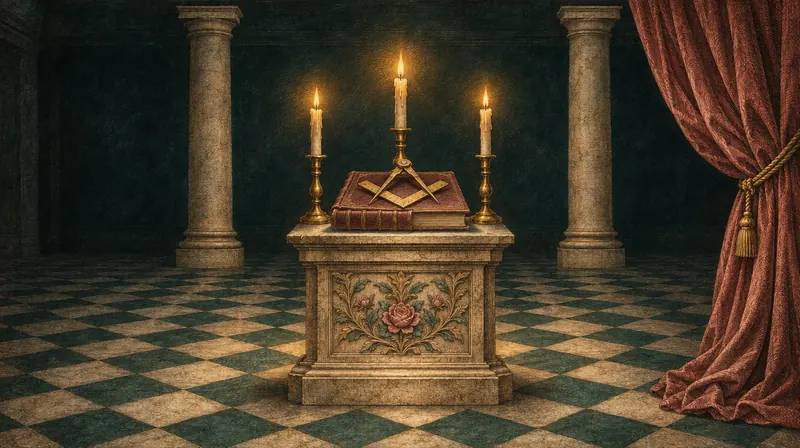
The lodges and the mysteries teach by allegory, setting a thing before the eye and drawing a lesson out of it. The Freemason's working tools become virtues: the square for morality, the level for equality, the plumb for uprightness, and the rough stone and the squared stone for a person before and after the work. The two pillars of Solomon's porch stand for strength and establishment, and in the Golden Dawn for the two sides of the Tree, with the way running between them. The Rosicrucian rose blooms on its cross, and the Mithraic grades bear the emblems of their planets. A symbol is read on more than one level and kept in mind until it is lived.
An order is a way of living as much as a rite. The Rule of the Temple ordered its brothers' prayer, table, dress and obedience hour by hour. The charges of the Freemasons bind a member to duties toward God, neighbour and self, and to brotherly love, relief and truth. The first article of the Rosicrucian brothers was to heal the sick, and that without payment, and the Golden Dawn put study before practice, a table of symbols learned by heart before any ceremony was taught. The ancient mysteries, by contrast, asked no creed and forbade no other worship: their rule was the rite and its silence.
Every order is told three ways, and the first lesson of this art is to keep them apart. There is the record: charters, rules, minutes, trial papers, excavated temples and dated books. There is the order's own legend, the ancient origin and the hidden masters it claims for itself. And there is what its enemies say it secretly does. Each is studied for what it is, and a claim belongs in one column or another, never in two at once.
The third telling is taught as the claim it is, with the facts that answer it. The best known tale of lodges worshipping the devil was invented by a hoaxer, Léo Taxil, who said so himself before a public meeting. The claim that a hidden order rules the nations has no record behind it, and the forms of it that blame the Jews rest on a forgery, the Protocols of the Elders of Zion, which was shown to be copied in large part from an older French satire aimed at the emperor Napoleon III that had nothing to do with Jews.
A student begins with what an order said of itself in public. Read one founding text whole: the Hymn to Demeter, the Fama of the Rosicrucians, the printed lecture of a Masonic degree, the Rule of the Temple or a book of the Gnostics. Then learn one ladder of grades in order, with what each step is said to teach. Then rule a page in three columns, record, legend and accusation, and set each claim met in its own column; a claim about an order after its end needs a document from that time. Nothing on these pages is a way into any order, and no order's secrets are claimed.
The branches follow the pattern through time. The ancient mysteries show it in its oldest public form, and the Gnostics show schools of saving knowledge that were churches and circles of study, not lodges. The Templars and the Illuminati are two real orders with legends piled high on them; the Freemasons give the lodge and its three degrees; the Rosicrucians a brotherhood announced in books; and the Golden Dawn gathers much of this, a Masonic shape, a Rosicrucian legend, the Tree of the Qabalah and the gods of Egypt, into one graded course.
The Oracle keeps documented history apart from an order’s own legend, and both apart from conspiracy theory. It claims no order’s secrets.
Each one is a question you can ask.
From stonemasons’ lodges to the Grand Lodge of 1717.
What is the documented history of the Freemasons?
Three pamphlets of 1614 to 1616, and a brotherhood nobody found.
Who were the Rosicrucians, and did the brotherhood exist?
Eleusis, Isis, Mithras: what is known of the rites.
What is known of the ancient mystery schools like Eleusis and Mithras?
The London order of 1888 that shaped modern occultism.
What was the Golden Dawn, the London order of 1888?
Two real orders, and the legends piled on them.
What is truly known of the Knights Templar and the Bavarian Illuminati?
The early schools of hidden knowledge, and the books found at Nag Hammadi.
Who were the Gnostics, and what was found at Nag Hammadi?
Each opens its page in the dictionary.
American lawyer, writer and Confederate brigadier general. From 1859 until his death he led the Scottish Rite of Freemasonry’s Southern Jurisdiction, whose degrees he rewrote. His Morals and Dogma (1871) is a long commentary on those degrees, much of it taken from the French occultist Éliphas Lévi.
Adventurer and healer generally identified as Giuseppe Balsamo of Palermo. He founded an “Egyptian Rite” of Freemasonry, was tried and acquitted in the Affair of the Diamond Necklace in Paris (1786), was condemned by the Roman Inquisition, and died a prisoner in the fortress of San Leo.
A courtier, musician and chemist of unknown birth who moved through the courts of Europe in the middle of the eighteenth century and let it be believed that he was far older than he looked. He died in 1784 at Eckernförde, under the protection of Prince Charles of Hesse-Kassel.
English occultist, poet and mountaineer. He wrote The Book of the Law in Cairo in 1904 and founded on it the religion of Thelema, whose law is “Do what thou wilt”. He ran the Abbey of Thelema in Sicily from 1920 until Italy expelled him in 1923. He struggled with heroin for much of his later life and died in Hastings.
General, First Consul and Emperor of the French. His expedition to Egypt in 1798 took scholars with it, and their Description de l’Égypte began Europe’s fascination with Egypt, which fed the esoteric revival of the next century. He spoke often of his “star”, as a figure of speech for his fortune.
Simon MagusValentinusApuleiusManiJacques de MolayFrancis BaconJohann Valentin AndreaeElias AshmoleBenjamin FranklinMartinez de PasquallyGiacomo CasanovaGeorge WashingtonAdam WeishauptEdward Bulwer-LyttonGiuseppe MazziniPaschal Beverly RandolphHenry Steel OlcottAnnie BesantWilliam Wynn WestcottJoséphin PéladanStanislas de GuaitaPapusFlorence FarrW. B. YeatsMax HeindelH. Spencer LewisJack ParsonsDionysusMithrasChristian RosenkreuzHiram AbiffAugustin BarruelLouis-Claude de Saint-MartinWolfgang Amadeus MozartLéo TaxilArthur Edward WaiteMargaret MurrayGerald GardnerIsrael RegardiePierre PlantardDoreen ValienteNorman Vincent PealeIsis and OsirisPersephoneThe Holy GrailIgnatius of LoyolaMichael MaierRobert BoyleCourt de GébelinJohann Wolfgang von GoetheAnna KingsfordMacGregor MathersPamela Colman SmithRené GuénonDion FortuneCharles HaanelRobert FluddCharles Leadbeater
Magic and protectionPower and influenceConspiracies, examinedSymbols
The Gnostic GospelsDictionary: FreemasonrySearch the treeThe whole tree
Make today specific
The same sky reaches everyone differently. Your birth details turn a general forecast into one theme, and one thing worth doing about it.
One instrument, one answer. Explore the preview; membership opens every tool.
Read more

