
Ignatius of Loyola
1491 to 1556
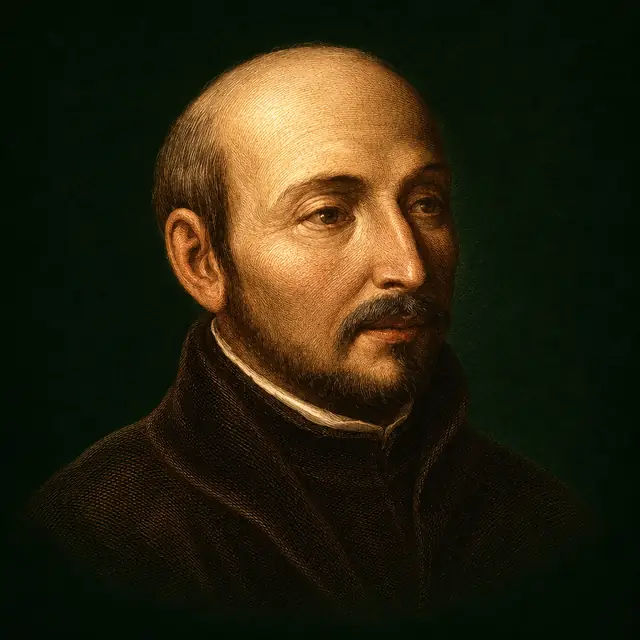
Who was Ignatius of Loyola, and what is truly known of them?
What is known
Basque nobleman and soldier, wounded by a cannon shot at Pamplona in 1521. Reading lives of the saints while he mended, he gave up his career, hung his sword before the Virgin at Montserrat and spent most of a year in prayer at Manresa, where he began the Spiritual Exercises, a month of ordered meditation under a guide. He went as a pilgrim to Jerusalem, then studied for eleven years, ending at Paris; in Spain the Inquisition jailed and questioned him at Alcalá and at Salamanca and found no error. In 1534 he and six companions took vows at Montmartre. Pope Paul III approved their Society of Jesus in 1540, and Ignatius led it from Rome until his death. He was declared a saint in 1622.
The teaching
Taught from The Spiritual Exercises, in his own order of weeks, notes and rules.
What an exercise is
As walking, travelling and running are exercises of the body, Ignatius writes, so every way of preparing and disposing the soul to rid itself of all disordered attachments, and then to seek and find the will of God in the ordering of one's life, is a spiritual exercise. The book is not for reading straight through. It is a handbook for one who guides another through about a month of prayer. The guide gives the matter of each prayer briefly and lets the one praying find its fruit, for it is not knowing much that fills and satisfies the soul, but feeling and tasting things inwardly.
The guide adapts everything to the person, to their age, learning and strength, and those busy in the world can make the Exercises over many months, an hour or so a day. Above all the guide does not push the one praying toward any choice, but stands like a balance at rest, and lets the Creator deal with the creature directly.
The Principle and Foundation
The Exercises rest on one page. “Man is created to praise, reverence, and serve God our Lord, and by this means to save his soul.” The other things on the face of the earth are created for him, to help him toward that end. So he is to use them as far as they help him toward it and to leave them as far as they hinder him, and for this he must make himself indifferent to all created things, as far as his free choice allows: not wanting health rather than sickness, riches rather than poverty, honour rather than dishonour, a long life rather than a short one, but desiring and choosing only what leads more to the end for which he is made.
Four weeks
The month falls into four weeks, which are stages rather than seven days each. The first is on sin and mercy; the second on the life of Christ, from his birth to his entry into Jerusalem; the third on his passion; the fourth on his rising and his appearances. The first week ends at the foot of the cross, where the one praying speaks to Christ as to a friend and asks three questions: what have I done for Christ, what am I doing for Christ, and what ought I to do for Christ?
How an hour of prayer is made
Each hour has its order. A short prayer first offers everything in it to God. Then the place is composed: the one praying sees in imagination the place of the scene, the road from Nazareth to Bethlehem, how long and broad it is, whether level or through valleys and over hills, or the cave where the child is born. Then he asks for what he wants, which changes with the weeks: shame and sorrow for sin in the first; an inward knowledge of Christ, so as to love and follow him more closely, in the second; sorrow with Christ in his sorrow in the third; and joy with him in his joy in the fourth. Then come the points, worked through with memory, understanding and will, and at the end a colloquy, spoken as one friend speaks to another.
In the application of the senses the scene is lived through each sense in turn: seeing the persons, hearing what they say, smelling and tasting the sweetness of the divine, touching and embracing the places where they walk. The posture is whatever helps, kneeling, lying, sitting or standing, and where the one praying finds what he seeks, there he stays without hurrying on until he is satisfied. After the hour he looks back over how it went.
The Two Standards
In the second week two meditations sharpen the choice. In the Kingdom, the call of a good earthly king who asks his people to share his hardships and his victory is set beside the call of Christ. In the Two Standards the one praying pictures two camps. Lucifer sits on a throne of fire and smoke in the great plain of Babylon and sends his demons out to tempt with riches first, then with the empty honour of the world, then with pride, and from these three steps he leads to every vice. Christ stands in a lowly place near Jerusalem and sends his friends out to draw people to poverty, then to the desire for reproach and contempt, and so to humility, and from these three steps to every virtue.
Three kinds of people
Then three kinds of people are set before the mind, each of whom has gained a large sum, not purely for the love of God, and wants to be at peace. The first wants to be free of the attachment but takes no means until the hour of death. The second wants to be free of the attachment but keep the money, so that God must come round to what he wants. The third wants to be free of it so fully that he is ready to keep the money or give it up, whichever God moves him to. Where the heart pulls against one choice, Ignatius counsels asking in prayer for that very thing, so that the attachment loses its hold.
He adds three degrees of humility: to refuse, for anything in the world, to break a law of God that binds gravely; to be indifferent, so as not to commit even a small sin for any gain; and, most perfect, to choose poverty with Christ poor and contempt with Christ despised, out of love and to be more like him.
Making a choice
The Exercises are made for a choice, an election, of a state of life or of a course within it, and only between things that are good or at least lawful. There are three times for choosing well. In the first, God so moves the will that the soul follows without doubting, as Paul and Matthew followed Christ. In the second, enough light comes from the experience of consolation and desolation and the discernment of spirits. In the third, a quiet time, the soul uses its natural powers freely.
For that third time he gives two ways. In one, the one choosing sets the end before him, asks God's help, and writes down the advantages and disadvantages of each side, then sees which way reason leans. In the other, he imagines a stranger whose good he wishes in every way and asks what he would counsel him; or he pictures himself at the hour of death, or before his judge, and asks what he would then wish to have chosen. The choice made, he offers it to God and asks that it be confirmed.
Love shows itself in deeds
The last contemplation is for gaining love. Two notes begin it: love ought to show itself in deeds more than in words, and love consists in sharing, the lover giving to the beloved and the beloved to the lover what each has. Then the one praying recalls the gifts received; sees how God dwells in creatures, giving the elements being, the plants life, the animals feeling and people understanding; sees how he labours in all things for us; and sees how every good comes down from above, as rays from the sun and waters from a spring.
The answer is an offering. He gives back to God his liberty, his memory, his understanding and his whole will, everything he has and holds, asking only for God's love and grace, which is enough.
Praying by the breath
Among his ways of praying the gentlest goes by rhythm: with each breath, one word of a prayer such as the Our Father, dwelling on that word, or on the one addressed, or on one's own smallness, for the space between one breath and the next. The breath is never held or forced; it only sets the pace.
His rules for looking back over the day, the general and the particular examen, are taught on The evening review, and his rules for telling consolation from desolation and the good spirit from the angel of light on Testing the spirits.
Orders and memberships
Founder and first Superior General of the Society of Jesus, the Jesuits, a religious order of the Catholic Church with a papal charter and printed constitutions. It is not a secret society: its grades and its rules are public.
The legend
That the Jesuits are a secret power behind thrones, with a “black pope” at their head: a tale told by the order’s enemies since the sixteenth century. That he belonged to the Alumbrados, the “enlightened” of Spain: he was questioned on it and cleared.
What was forged, or is false
The Monita Secreta, or “Secret Instructions of the Jesuits”, printed at Kraków in 1614 as the order’s hidden rules for gaining wealth and power. It was written by Hieronim Zahorowski, who had been dismissed from the Society.
Their works
- The Spiritual ExercisesBook, begun 1522, printed 1548
A handbook for a guide leading another through about a month of ordered prayer: meditations on sin, on the life of Christ, his death and his rising, with rules for telling the movements of the heart one from another. Begun at Manresa and approved by Pope Paul III in 1548, it remains the centre of Jesuit life and of the retreats held in its name.
Ask the Oracle about it - Constitutions of the Society of JesusBook, written from 1541, approved 1558
The rule of the Jesuits, which he drafted and revised in Rome for the rest of his life, setting out how members are received, trained, sent on mission and governed. It is a printed and public rule, which is why the Society’s grades were never hidden.
Ask the Oracle about it - ReminiscencesAccount, dictated 1553 to 1555
His own story from his wounding at Pamplona to the first years in Rome, told late in life to the Portuguese Jesuit Luís Gonçalves da Câmara, who wrote it down. In it he calls himself the pilgrim and speaks frankly of his vanity, his scruples and his visions at Manresa.
Ask the Oracle about it - Spiritual DiaryDiary, 1544 and 1545
A surviving part of the private notebook he kept while deciding a point of poverty in the Constitutions, with brief notes of each day’s Mass, his tears and the consolations he felt. It is the closest view of his own prayer.
Ask the Oracle about it - LettersLetters, 1524 to 1556
Some seven thousand letters and instructions survive, sent from Rome to Jesuits, princes, benefactors and penitents across Europe, India and Brazil. They show the founder as an administrator and counsellor as much as a mystic.
Ask the Oracle about it
How the house tells a life
This life is told from the record, with what is documented, what is legend and what was forged kept apart. A membership in an order is stated only where documents show it. A person’s chart explains none of their deeds.
The arts it feeds
Lives near it in time
Thinkers and teachers
Ramon LlullMeister EckhartMarsilio FicinoJohannes ReuchlinPico della MirandolaNiccolò MachiavelliTeresa of ÁvilaJohn of the CrossTycho BraheGiordano BrunoFrancis BaconTommaso CampanellaThe whole tree

