
Christianity and Syncretism
Religious syncretism is the blending of elements from different traditions into a new or altered religious form. Christians disagree about where legitimate cultural translation ends and doctrinal compromise begins, so the label requires a specific practice, historical setting, and theological standard.
$0 today, then $12/month after 7 days. Cancel anytime.
Direct answer
Short version
Do not call every cultural adaptation syncretism. Ask what is being borrowed, what meaning it carries in its original setting, how Christian teaching changes or retains that meaning, whether worship or allegiance is involved, who has power in the exchange, and what the resulting practice teaches people to trust.

What does your own chart say about you?
Choose love, work or purpose. Your reading is written from your chart. Your reading uses your own birth details.
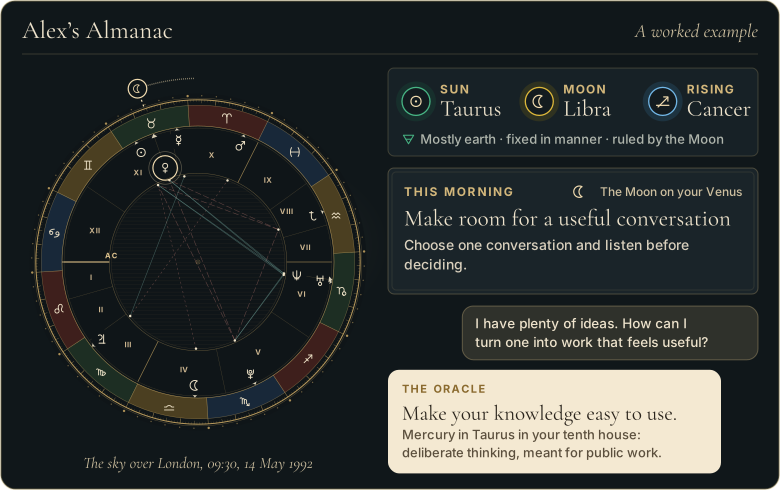
Walk through Alex’s whole example first
 The Road of AgesSee the turning points of your whole life, from your birth date
See your road's shape
The Road of AgesSee the turning points of your whole life, from your birth date
See your road's shape
Prefer to explore first?
 The Road of AgesThe turning points of your whole life, from your own chart
Walk my road
The Road of AgesThe turning points of your whole life, from your own chart
Walk my road
Free, by email
Your daily Almanac letter
One short letter at 7 each morning: the day’s theme read for your own chart, and one thing to do with it.
Quick facts
| Term | Working distinction |
|---|---|
| Syncretism | Blending religious elements so that beliefs, worship, or authorities are combined or transformed |
| Contextualization | Communicating and living a faith within a culture while seeking fidelity to its core claims |
| Inculturation | A sustained process through which Christian life takes culturally rooted expression |
| Translation | Rendering words and concepts into another language; never perfectly neutral, but not automatically religious mixture |
| Interfaith learning | Studying or cooperating with another community without necessarily merging worship or doctrine |
| Appropriation | Taking a community’s sacred form without adequate permission, context, reciprocity, or respect |
Why the word syncretism needs precision
In religious studies, syncretism can be a descriptive term for historical mixture. In church debate, it is often an accusation meaning unfaithful compromise. Those uses should not be confused. A historian may describe blended ritual forms without deciding whether they are theologically legitimate, while a pastor may evaluate a practice according to Scripture and doctrine.
The label can also hide power. Missionaries have sometimes condemned local music, clothing, language, or family customs as pagan while treating their own culture as neutral Christianity. Conversely, calling every mixture harmless can ignore coercive ritual, incompatible worship, or commercial borrowing from marginalized communities. Precision begins with the actual object: a song, prayer, divination method, calendar custom, philosophical term, healing practice, image, or claim about God.
Canonical patterns: fidelity, translation, and contested practice
The Hebrew Bible repeatedly opposes worship that combines devotion to Israel’s God with other deities, especially where covenant loyalty and injustice are at stake. The prophetic concern is not foreign vocabulary by itself; it is divided worship, distorted trust, and conduct that contradicts the covenant.
The New Testament shows both firm boundaries and cultural translation. In Acts 17, Paul engages Athenian poetry and an altar inscription while redirecting the argument toward the Creator and resurrection. In 1 Corinthians 8-10, food associated with idols is evaluated through knowledge, conscience, community harm, participation, and loyalty. The answer is not a slogan that every material object is contaminated or that intention makes every participation safe.
Acts 15 provides another model: a diverse community debates which inherited requirements apply to Gentile believers. Discernment happens through testimony, Scripture, communal authority, and concern for fellowship. These passages do not yield an automatic checklist, but they prevent two extremes: fear of every cultural form and indifference to what practices actually confess.
A six-question discernment matrix
| Question | What to investigate |
|---|---|
| Meaning | What does the practice signify to its source community and to present participants? |
| Allegiance | Does it involve worship, invocation, vows, divination, or authority that conflicts with Christian confession? |
| Transformation | Has the form received a genuinely different meaning, or is incompatible meaning merely being ignored? |
| Fruit | Does it produce truth, love, justice, humility, freedom, and responsibility, or fear, control, exploitation, and dependency? |
| Community | How do mature members, affected cultures, and accountable leaders evaluate it? |
| Power | Was the element shared, imposed, commercialized, or taken from a restricted tradition? |
Christian history is full of cultural translation
Christianity moved through Jewish, Greek, Roman, Syriac, Coptic, Armenian, Ethiopian, Persian, Indian, Slavic, African, Asian, European, and American settings. Translation required choices about divine names, philosophical vocabulary, artistic forms, music, architecture, kinship, law, and festivals. Communities did not all make the same choices.
Similarity does not prove simple borrowing. Two traditions can use water, light, meals, fasting, sacred time, or processions because these are widespread human forms. Historical claims require dates, transmission routes, texts, and evidence of changed meaning. Viral assertions that a Christian belief was “copied” from an older religion often rely on superficial parallels; defensive claims that Christianity developed in cultural isolation are equally weak.
A mature account can acknowledge mixture, resistance, adaptation, and conflict without reducing the faith to either pure timeless form or arbitrary collage. It also recognizes that winners often controlled the archives, so local voices and material evidence matter.
Astrology, numerology, and mixed spiritual practice
Christians approach astrology and numerology differently. Some reject them as divination; some distinguish observational calendars from predictive practice; some use symbolic language for reflection under explicit limits. The key question is not whether a practice has an attractive Christian vocabulary but what authority it is given.
A birth chart or number becomes theologically controlling when it is treated as revelation, commands action, assigns moral rank, overrides consent, or claims certainty about God’s will. Adding a Bible verse does not resolve that problem. Conversely, studying the history of astrology, observing the sky, or analyzing number symbolism is not identical to worshiping celestial bodies.
Anyone combining traditions should state the method plainly. Hidden blending prevents informed consent and makes critique difficult. A reader deserves to know whether a statement comes from canonical Scripture, church tradition, modern astrology, psychology, personal intuition, or another religion.
How a community can discern without panic
- Describe the practice accurately before naming it dangerous or harmless.
- Read primary sources in context and consult people who understand both traditions involved.
- Separate cultural discomfort from a genuine conflict of worship, doctrine, ethics, or authority.
- Include people whose culture is being borrowed, especially when sacred or restricted material is involved.
- Examine money, status, coercion, sexual boundaries, and claims of secret expertise.
- Permit uncertainty and proportionate responses; not every question requires denunciation or adoption.
- Revisit the decision when consequences, scholarship, or community understanding change.
Two errors to avoid
Purity rhetoric can become a weapon against minority cultures, converts, women, or unfamiliar forms while leaving the dominant culture unexamined. Syncretism accusations need evidence and consistent standards. A guitar, drum, icon, calendar date, philosophical word, or local garment is not compromised merely because another religion also used something similar.
Uncritical blending creates a different harm. It can flatten profound differences, market sacred practices, and promise benefits without accepting the obligations that give them meaning. Christian discernment should be neither cultural fear nor spiritual consumerism. It should be patient enough to understand, honest enough to name conflict, and humble enough to receive correction.
Sources and editorial method
Research and editorial references used for this page include:
- Encyclopaedia Britannica: Religious Syncretism - Historical and comparative definition of religious blending.
- Bible Gateway: Acts 17:16-34 - Canonical example of engagement with local religion and poetry alongside theological redirection.
- Bible Gateway: 1 Corinthians 8-10 - Canonical treatment of idols, conscience, participation, freedom, and community responsibility.
- Vatican II: Ad Gentes - Influential Catholic primary text on mission, culture, adaptation, and discernment.
These references support the factual, historical, textual, or interpretive claims on this page. Interpretive traditions are identified as such, and factual claims are kept separate from symbolic claims.
Related reading
From the reference page to your own chart
Every word here
is in your own chart.
- A personal reading about love, work or purpose, written from your chart
- A practical next step to consider
- It opens with 7 days free, with the AI Oracle and daily guidance
$0 today, then $12/month after 7 days. Cancel anytime.
Common questions
Is every Christian holiday syncretic?
No single answer fits every feast or local custom. Historical development must be studied case by case through dates, sources, transmission, theology, and actual practice rather than resemblance alone.
Is using non-Christian philosophy automatically syncretism?
Not necessarily. Christian thinkers have used and criticized philosophical concepts for centuries. The question is how the concept is transformed and whether it alters central confession or practice.
Can Christians learn from another religion?
Learning, dialogue, and cooperation are not identical to merging worship. Respectful engagement should preserve honesty about differences and avoid taking restricted practices without consent.
How can I tell contextualization from compromise?
Examine meaning, allegiance, transformation, fruit, community accountability, and power. The same outward form can carry different meanings, so neither appearance nor intention alone settles the question.
Free, by email
The Almanac, in your inbox at 7
One short letter at 7 each morning: the day’s theme read for your own chart, and one thing to do with it.
