
Syncretism vs DiscernmentHow Christians Test Practices
Discernment is not panic and it is not permission for everything. It is careful testing by authority, fruit, freedom, and love.
$0 today, then $12/month after 7 days. Cancel anytime.
The authority test
Ask what has final say. If a sign, number, chart, dream, or intuition outranks God, Scripture, conscience, wise counsel, or lived obedience, it has moved beyond a helpful prompt and into spiritual disorder.
What does your own chart say about you?
Choose love, work or purpose. Your reading is written from your chart. Your reading uses your own birth details.
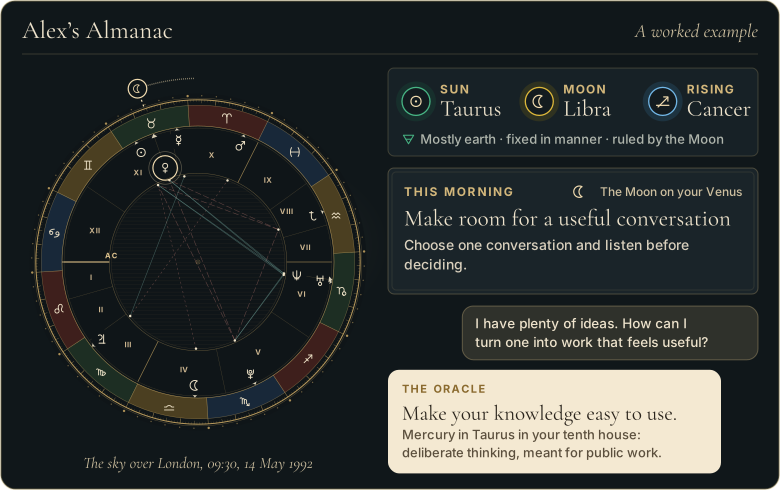
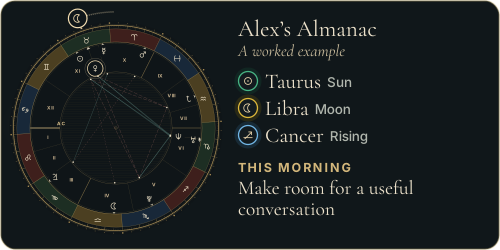
Walk through Alex’s whole example first
 The Road of AgesSee the turning points of your whole life, from your birth date
See your road's shape
The Road of AgesSee the turning points of your whole life, from your birth date
See your road's shape
Prefer to explore first?
 The Road of AgesThe turning points of your whole life, from your own chart
Walk my road
The Road of AgesThe turning points of your whole life, from your own chart
Walk my road
Free, by email
Your daily Almanac letter
One short letter at 7 each morning: the day’s theme read for your own chart, and one thing to do with it.
The fruit test
A practice should form humility, clarity, patience, repentance, courage, peace, and love. If it forms panic, superiority, secrecy, obsession, or passivity, step back and test it again.
The freedom test
Good counsel makes a person more responsible and less captive. If a practice creates constant checking, fear of missing signs, or dependence on confirmation, it is no longer serving wisdom.
How The Almanac applies this
The Great Almanac uses astrology and numerology as limited interpretive languages. The app should clarify seasons and next steps, not replace God, remove agency, or build identity around hidden knowledge.
What this question protects
Behind Syncretism vs Discernment: How Christians Test Practices stands the order of discernment: God first, created signs second, human responsibility always present. The question is not whether a symbol feels powerful, but whether it trains worship, humility, truth, love and freedom.
When Christians approach astrology, numbers, angels, dreams, Enochic material or the unseen world, the danger is rarely curiosity itself. It is misplaced trust: using a created thing for control, identity, secrecy or fear.
Reading it with discernment
The test offered here is the fruit: whether a question about the heavens or the unseen leads toward humility, prayer and love of neighbor, or toward fear, secrecy and control. God first, and every created sign after him.
Practical boundaries
Authority
God, Scripture, conscience, wise counsel, and love of neighbor stand above every reading.
Fruit
A practice should be judged by what it forms: humility or pride, peace or fear, responsibility or avoidance.
Limits
The hidden world is not a playground for control. Curiosity stays accountable and prayerful.
Discernment checklist
- Does this interpretation increase humility instead of pride or fear?
- Does it preserve responsibility instead of blaming the sky?
- Does it lead toward prayer, repair, patience, courage, and love of neighbor?
- Would a wise friend recognize the fruit as good?
Make it personal
Open a faith-aware personal reflection: reflective guidance drawn from your own chart, with no claim to predict what only God knows.
Open a faith-aware personal reflectionAnd for the year entire: the Cosmic Codex offers a reflective map of a year from your chart, never a prediction, one edition bought once. Open the Cosmic Codex
From the reference page to your own chart
Every word here
is in your own chart.
- A personal reading about love, work or purpose, written from your chart
- A practical next step to consider
- It opens with 7 days free, with the AI Oracle and daily guidance
$0 today, then $12/month after 7 days. Cancel anytime.
Common questions
Is it idolatry to study the stars?
Not when the heavens are read as created lights for "signs, and for seasons" (Genesis 1:14) rather than as rulers. Scripture forbids worshipping the sun, moon and stars (Deuteronomy 4:19), not observing them.
Can a Christian read a birth chart?
Christians disagree. Many reject astrology as divination; others read a chart only as symbolic language for reflection, never as fate or a rival authority. The test offered here is the fruit: prayer, honesty and love, or fear and control.
What should a Christian reject in this area?
Any reading that weakens conscience, prayer, responsibility, Scripture, or the love of God and neighbor, and any practice that seeks to control people or outcomes.
Continue in Syncretism & Spiritual Testing
Stay within this topic cluster for the closest related guides, or move through one of the neighboring faith and discernment hubs.
Free, by email
The Almanac, in your inbox at 7
One short letter at 7 each morning: the day’s theme read for your own chart, and one thing to do with it.


