Daily AlmanacReading the Calendar, Moon, and Sky
A daily almanac gathers date-based reference information into one practical view. Depending on its scope, it may include weekday and season, sunrise and sunset, twilight, Moon phase, rise and set times, planetary positions, observability, holidays, or traditional symbolic correspondences.
Direct answer
Short version
Read every item according to its data type. A Moon phase is an astronomical Sun–Earth–Moon relationship; moonrise is a local horizon event; a planetary longitude is a calculated coordinate; and a symbolic “theme of the day” is an interpretation. They can appear together without carrying the same evidentiary status.
The Instruments
Ten readings, worked out from your own birth chart
An instrument is a reading this house works out for you. Give your birth date, time and place once, and each one reads today’s real sky against the chart you were born under. Eight are personal; two are calendars anyone can open. A free account opens one instrument a day. The plans open every instrument, every day.
- Natal Chart Every planet, house and aspect in your chart
- Active Transits Where the planets are now, read against your chart
- Daily Counsel What to pursue today, and what to leave alone
- Personal Timing Your best days to decide, weeks ahead
- Fellowship Your chart and another, read side by side
- Theme of the Day The one thing today is asking of you
- Sacred Numbers Your life path, your cycles, your name in numbers
- Aeolian Harmonics Classical music chosen to match your chart
- Mercury Retrograde Every Mercury retrograde this year, with its dates Open to all
- Void-of-Course Moon When the Moon is between signs, hour by hour Open to all


Quick facts
| Daily item | What it describes | Location-sensitive? |
|---|---|---|
| Civil date and weekday | A calendar label under a time zone and calendar system | Yes, near the International Date Line and midnight boundaries |
| Sunrise, sunset, and twilight | The Sun crossing defined altitude thresholds at a local horizon | Strongly; latitude, longitude, date, elevation, and atmosphere matter |
| Moon phase | The changing Sun–Earth–Moon illumination geometry | The phase moment is global, while clock date and appearance depend on place and time zone |
| Moonrise and moonset | The Moon crossing a local horizon | Strongly; neighboring dates can differ and an event may be absent on one civil day |
| Planetary longitude | A body’s position in a declared astronomical or zodiac reference frame | Usually geocentric for astrology; topocentric positions vary by observer |
| Natal transit | A current position compared with one person’s birth chart | Personalized; accurate birth data and declared conventions are required |
What a daily almanac is
An almanac is a calendar-centered reference work that organizes recurring information for a stated period. Historical almanacs commonly combined civil dates, feast days, astronomical calculations, tide tables, weather lore, agricultural notes, public information, and short reading matter. Specialized nautical and air almanacs provide precise celestial positions for navigation. A daily almanac brings the relevant portion of that tradition into a single date.
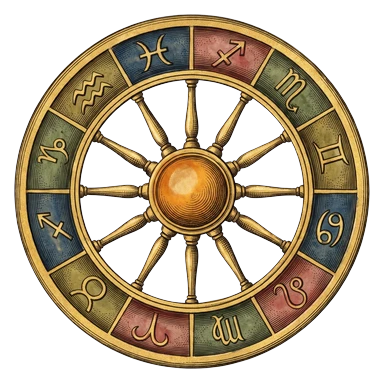
The word does not guarantee one fixed contents list. An astronomical daily entry may focus on sunrise, twilight, Moon phase, conjunctions, and visibility. A cultural entry may add observances and anniversaries. A traditional astrological entry may add zodiac positions, aspects, planetary hours, or symbolic counsel. The heading and source notes should make clear which layer each statement belongs to.
Its practical strength is compression: many time-sensitive facts can be checked together. Its weakness is also compression: unlike kinds of information can look equally certain when placed in matching boxes. A careful reader distinguishes measured or computed data, calendar convention, historical tradition, forecast, and personal interpretation before acting on any item.
Set the date, time zone, and location first
“Today” is not a universal instant. At the same moment, observers in different time zones may have different civil dates. Daylight-saving rules can change local clock labels, and historical rules are not always the same as current ones. For any timed event, record the location, time-zone abbreviation or UTC offset, and whether the time is local or Universal Time.
Sunrise and sunset are local events. They vary with latitude, longitude, season, elevation, horizon obstruction, and atmospheric refraction. Twilight also has defined stages: civil, nautical, and astronomical twilight correspond to different solar depression angles. A single global sunrise time is therefore meaningless without a place.
Polar regions require extra care. On some dates the Sun does not rise or set, and the Moon may likewise remain above or below the horizon throughout a civil day. A blank rise time can mean “no event occurred during this local date,” not missing data. Nearby cities can also differ by several minutes, so an almanac should never be treated as a substitute for safety-grade navigation or legal timing evidence unless its stated precision and authority fit that use.
Read Moon phase, illumination, and rise time as separate facts
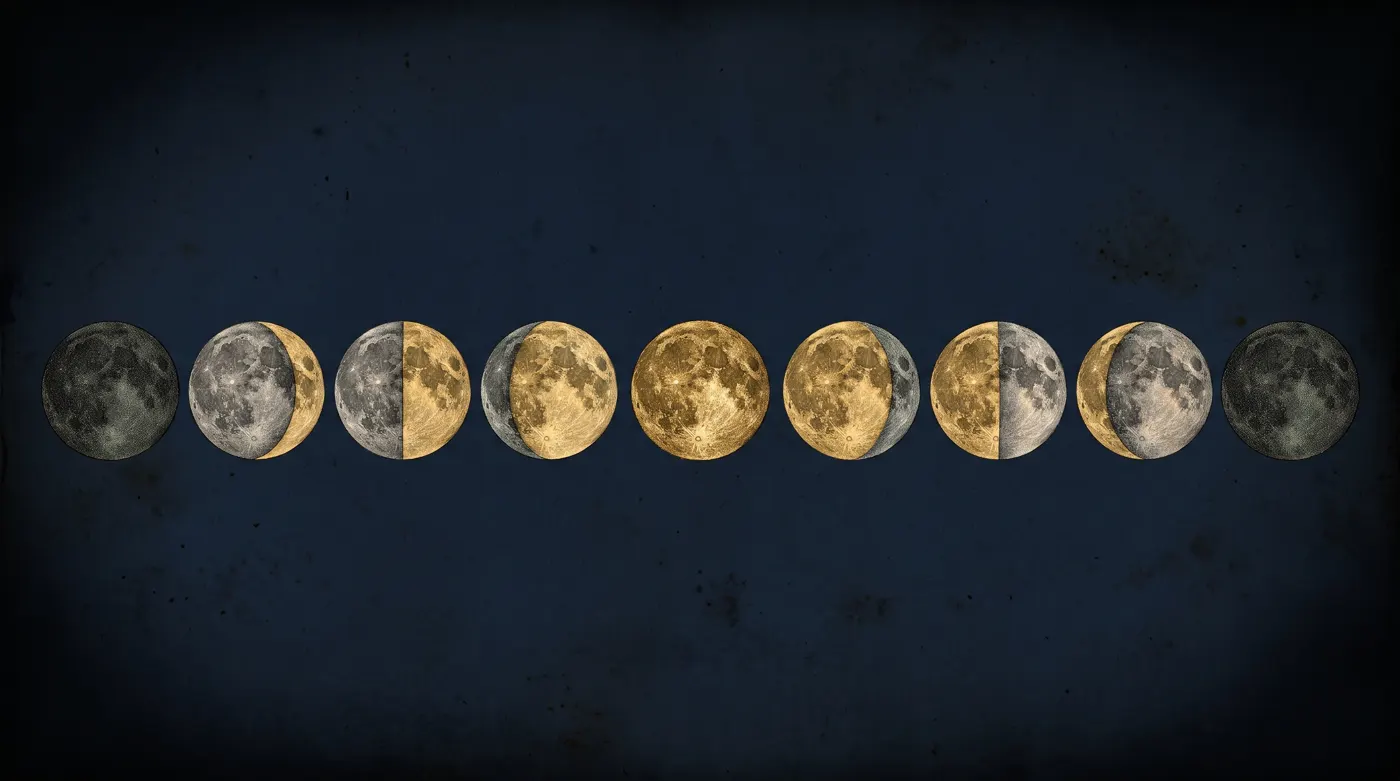
The Moon is always half illuminated by the Sun, except during an eclipse; its phase describes how much of that illuminated half is visible from Earth. The familiar sequence is new Moon, waxing crescent, first quarter, waxing gibbous, full Moon, waning gibbous, last or third quarter, and waning crescent. NASA gives the cycle as about 29.5 days.
Phase is not the same as percent illumination. Two dates can have a similar illuminated fraction while belonging to opposite halves of the cycle, waxing before full Moon and waning after it. Nor does phase give an exact local rise time. A full Moon generally rises near sunset, a first-quarter Moon near midday, and a last-quarter Moon near midnight, but local geometry shifts the actual times.
A phase such as “full Moon at 18:12 UTC” names an instant of geometric exactness. Local calendars may show that instant on different dates after time-zone conversion. The Moon may look full for more than one night because the change around exact opposition is gradual. For observation, check local moonrise, cloud cover, horizon, and illumination rather than relying on the phase label alone.
| Phase | Approximate relation to the Sun | Typical visibility pattern |
|---|---|---|
| New Moon | Near the Sun in the sky | Usually lost in solar glare; rises and sets roughly with the Sun |
| First quarter | About 90° east of the Sun | High in the evening; rises roughly near noon |
| Full Moon | Opposite the Sun | Visible through much of the night; rises roughly near sunset |
| Last quarter | About 90° west of the Sun | Prominent before dawn; rises roughly near midnight |
Planetary positions do not automatically describe visibility
An ephemeris can give a planet’s longitude, latitude, right ascension, declination, distance, or apparent magnitude. These coordinates answer different questions. Astrological longitude places a body along the ecliptic; altitude and azimuth describe where a local observer should look. A planet can occupy a notable zodiac degree yet be invisible because it is below the horizon, too close to the Sun, too faint, or obscured by weather.
Mercury and Venus remain relatively close to the Sun from Earth’s viewpoint, so elongation helps determine whether they appear in morning or evening twilight. Mars, Jupiter, and Saturn can be prominent at opposition, while Uranus generally requires favorable dark-sky conditions and optical aid and Neptune requires a telescope. A conjunction on a chart means bodies appear near one another in a coordinate sense; it does not ensure both can be seen with unaided eyes.
Geocentric data describe positions from Earth’s center and are widely used for planetary tables and astrology. Topocentric data adjust for a specific observer and matter especially for the Moon, near-horizon events, occultations, eclipses, and precise pointing. Before planning an observation, use local altitude, azimuth, rise and set times, visibility guidance, and weather. Never look directly at the Sun through binoculars or a telescope without certified solar equipment and trained procedure.
A five-minute method for using daily sky and calendar data
- Confirm the civil date, locality, time zone, and UTC offset. Around midnight or while traveling, note whether an event belongs to the previous or next local date.
- Check sunrise, sunset, and the relevant twilight stage. Use these to plan daylight, darkness, photography, prayer times, commuting, or observation, not a generic global time.
- Read the Moon in three parts: exact phase or age, illuminated fraction, and local rise/set window. Add weather and horizon conditions before making an observation plan.
- For planets, separate zodiac longitude from actual visibility. Check elongation, altitude, magnitude, local rise/set times, and whether optical aid is needed.
- Mark genuine calendar anchors such as solstices, equinoxes, eclipses, holidays, or anniversaries, then verify specialized claims with the responsible authority.
- If using symbolic correspondences, choose one modest reflection question and keep it separate from the factual data. Review the day afterward rather than forcing events to match the theme.
Public sky conditions versus birth-chart personalization
A Moon phase, equinox, or geocentric planetary configuration is public sky information: it describes a shared astronomical condition at a moment. Local circumstances (whether the Moon has risen, how high a planet appears, or when twilight ends) require an observer’s location. Neither kind requires a date of birth.
A natal transit is different. It compares a current position with the planetary positions and angles calculated for a particular birth. Planet-to-planet comparison needs at least a dependable birth date and correct time conversion; the Moon may require a birth time for precision. Ascendant, Midheaven, and houses require an accurate birth time and birthplace. Without those inputs, a personalized claim should not be presented as exact.
Even with complete birth data, personalization remains astrological interpretation rather than a demonstrated causal forecast. Public astronomical facts do not become evidence for personal predictions merely because they are accurate. A useful boundary is simple: the ephemeris can establish position; the interpretive tradition proposes meaning; the reader tests relevance against lived reality.
How to handle lore, correspondences, and weather claims
Traditional almanacs preserve agricultural sayings, saints’ days, lucky or unlucky dates, planetary rulers, seasonal customs, and weather lore. These records can be valuable cultural history. They should be labeled by region and source because a proverb developed for one climate or community may not transfer to another. “Traditional” identifies reception; it does not certify predictive accuracy.
Long-range weather cannot be inferred reliably from a Moon phase, zodiac sign, animal behavior anecdote, or one remembered season. For travel, farming, fire, flood, heat, or storm decisions, use current observations and the official meteorological authority for the relevant region. Tides likewise require local harmonic predictions; the Moon’s phase alone is not a local tide table.
Symbolic daily themes work best as invitations rather than commands. “Review commitments” can prompt a useful check of a schedule; “do not sign anything today” turns symbolism into an unverified prohibition. Keep agency, consent, practical evidence, and domain expertise at the center of consequential choices.
A reliability checklist for any daily entry
Accuracy is not one all-or-nothing property. A date can be correct while its time zone is wrong; a planet’s longitude can be precise while a visibility caption is misleading; a historical custom can be well documented while its promised effect remains unsupported. Verify the exact claim you intend to use.
For casual reflection, modest uncertainty is manageable. For eclipse viewing, navigation, litigation, aviation, religious observance, or hazardous weather, consult the specialized authority and its current notices. A daily reference is a starting map, not universal permission to ignore local conditions.
| Check | Reliable practice | Warning sign |
|---|---|---|
| Time | Shows local zone or UTC and converts exact events correctly | Lists a bare clock time for everyone |
| Location | Uses coordinates for rise, set, twilight, and visibility | Calls a horizon event globally identical |
| Definition | Distinguishes phase, illumination, position, aspect, and visibility | Treats those terms as synonyms |
| Source | Names an ephemeris, observatory, calendar authority, or historical text | Offers precise claims without provenance |
| Interpretation | Labels symbolic or traditional meaning and allows uncertainty | Presents metaphor as physical fact or guaranteed outcome |
| Decision boundary | Directs safety-critical questions to current qualified sources | Uses sky symbolism in place of medical, legal, weather, or navigation guidance |
Sources and editorial method
Research and editorial references used for this page include:
- U.S. Naval Observatory: Astronomical Data Services - Authoritative rise, set, twilight, Moon-phase, eclipse, position, calendar, and celestial-navigation data categories.
- U.S. Naval Observatory: The Air Almanac - Official example of an almanac supplying timed celestial positions, rise and set information, twilight tables, and sky diagrams.
- NASA Science: Moon Phases - Astronomical explanation of lunar illumination, the eight phases, their sequence, and typical rise-time relationships.
- Library of Congress: French-American Almanacs - Historical collection context for calendar, astronomical, meteorological, agricultural, and cultural information in almanacs.
These references support the factual, historical, textual, or interpretive claims on this page. Interpretive traditions are identified as such, and factual claims are kept separate from symbolic claims.
Related reading
Common questions
Is a daily almanac the same as a horoscope?
No. An almanac organizes date-based reference information. It may include astrology, but sunrise, Moon phase, observances, and planetary positions can be presented without a personal horoscope.
Why does the Moon phase date differ between sources?
An exact phase occurs at one instant, often listed in UTC. Converting that instant into local civil time can place it on different dates, and some summaries label the nearest evening rather than the exact moment.
Do sunrise and moonrise happen at the same time everywhere?
No. Rise and set are local horizon events determined by date and location, with additional effects from elevation, horizon shape, refraction, and the object’s motion.
Can current planetary positions give a personal reading without birth data?
They can describe shared current geometry, but an exact natal comparison requires birth information. Angles and houses especially depend on a reliable birth time and birthplace.
Can Moon phases predict weather, markets, or medical outcomes?
A phase is real astronomical geometry, but that fact does not validate unrelated predictions. Use official forecasts, clinical evidence, and financial analysis for those decisions.
Daily guides for all twelve zodiac signs
Choose a Sun-sign page for a broad daily reference. A sign page cannot substitute for the houses, angles, and exact contacts in a timed natal chart.