Current feed
Shows where tracked bodies are now and the closest pair in ecliptic longitude.
Learn the major kinds of celestial events, how to verify an observing opportunity, and what a current longitude feed can and cannot establish.
$0 today, then $12/month after 7 days. Cancel anytime.
A celestial event is a time-specific sky configuration such as a conjunction, opposition, occultation, eclipse, elongation, or meteor-shower peak. The live feed can show current longitudes; a future event calendar and local horizon calculation are still required before you plan an observation.
Shows where tracked bodies are now and the closest pair in ecliptic longitude.
Needed for exact future dates, station times, eclipses, occultations, and shower peaks.
Location, darkness, altitude, weather, brightness, and equipment determine what can actually be seen.
Verified current positions · refreshes hourly
Current geocentric longitudes. No local rise, set, altitude, direction, weather, or future visibility is inferred.
Angular comparisons use ecliptic longitude. They do not establish apparent separation, altitude, brightness, darkness, or local visibility.
Opening the Active Transits sky map…
A conjunction means two objects share or nearly share a coordinate such as ecliptic longitude; opposition places an outer object roughly opposite the Sun in the sky; greatest elongation is especially useful for Mercury and Venus; an occultation occurs when one body passes in front of another from the observer’s line of sight. Eclipses are special shadow events, while meteor showers are atmospheric streaks from debris streams.
The live card reports longitudinal separation, which is useful for orientation but not a complete apparent separation on the sky. Celestial latitude, distance, declination, and the observer’s position can change the view. Two bodies close in longitude can still differ in latitude, and a close pairing can occur in daylight or below a local horizon. Treat the card as a current coordinate clue, not a visibility claim.
Start with an authoritative event table and note the event time in UTC. Convert it carefully to your local time zone, including any daylight-saving rule. Then calculate altitude, azimuth, rise/set, and twilight for your coordinates. Finally check brightness, angular separation, lunar glare, cloud, smoke, and horizon obstructions. For solar events, use the required certified eye protection.
Wide conjunctions and bright planets may need only a phone or camera on a stable support; lunar detail benefits from a telephoto lens or telescope; faint deep-sky targets need darker skies and longer exposures. Field of view matters more than magnification when framing a pair. Never point unfiltered optical equipment at the Sun, even when a screen or camera is involved.
Astrological calendars often use the same event names but assign symbolic meanings to them. The event time and coordinates can be checked astronomically; the interpretation is a separate tradition. A careful almanac does not turn a conjunction into a guaranteed personal outcome and does not present a current snapshot as a forecast for a city.

Choose love, work or purpose. Your reading is written from your chart. Your reading uses your own birth details.
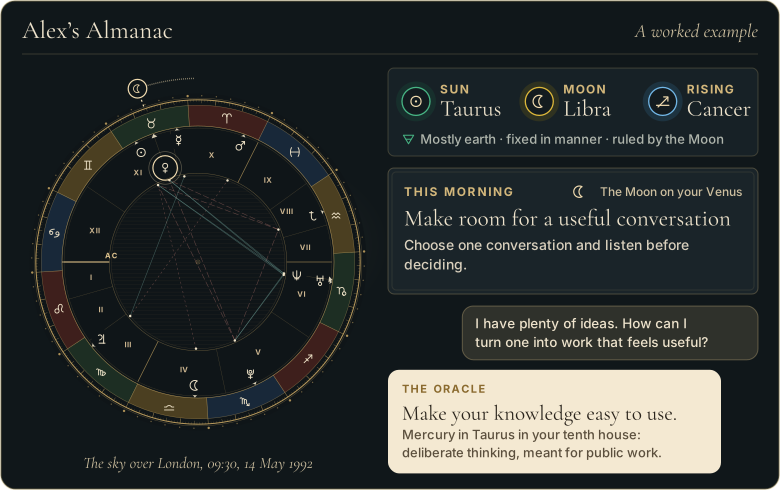
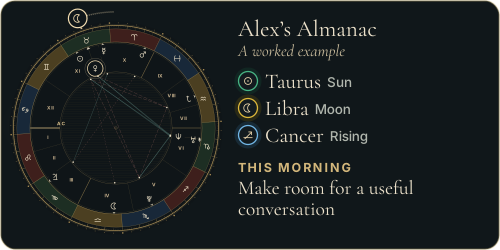
Walk through Alex’s whole example first
 The Road of AgesSee the turning points of your whole life, from your birth date
See your road's shape
The Road of AgesSee the turning points of your whole life, from your birth date
See your road's shape
 The Road of AgesThe turning points of your whole life, from your own chart
Walk my road
The Road of AgesThe turning points of your whole life, from your own chart
Walk my road
Free, by email
One short letter at 7 each morning: the day’s theme read for your own chart, and one thing to do with it.
From the reference page to your own chart
$0 today, then $12/month after 7 days. Cancel anytime.
Not necessarily. The live card compares ecliptic longitude only. Apparent separation, daylight, altitude, and your horizon still have to be checked.
This first cluster points readers to authoritative event services rather than extrapolating future events from a current snapshot.
No. A conjunction is coordinate alignment or close angular approach; an occultation requires one object to pass in front of another along a particular line of sight.
Free, by email
One short letter at 7 each morning: the day’s theme read for your own chart, and one thing to do with it.

Read more
Keep moving through the archive: signs, compatibility, chart timing, faith-aware discernment, and practical daily guidance.