Planets and points
Moon
Direct answer
Moon: The Moon in astrology is the luminary of emotion, body rhythm, memory, instinct, safety, attachment, habit, and daily change.
The Moon represents emotion, instinct, memory, and bodily rhythm.
$0 today, then $12/month after 7 days. Cancel anytime.
At a glance
- In astrology
- The Moon rules Cancer, is exalted in Taurus, falls in Scorpio, and is in detriment in Capricorn.
- Found in
- Planets & Celestial Bodies
- Related
- Planetary Placement, Planetary Position, Birth Chart, Transit
Deeper Almanac guide: Moon placement guides. This dictionary entry is a concise definition page; the linked guide remains the long-form topic page.
The Moon represents emotion, instinct, memory, and bodily rhythm.
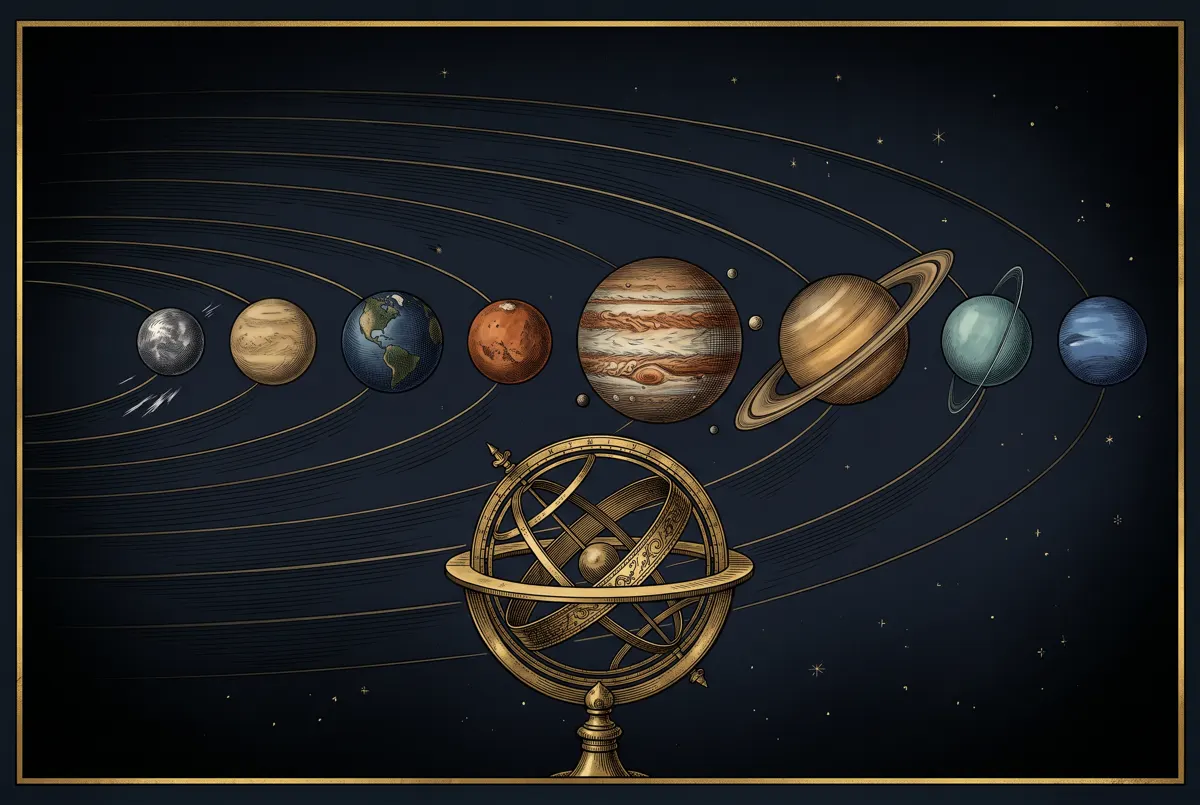
The orbit map distinguishes physical bodies, calculated points, and symbolic cycles where possible.
What does your own chart say about you?
Choose love, work or purpose. Your reading is written from your chart. Your reading uses your own birth details.
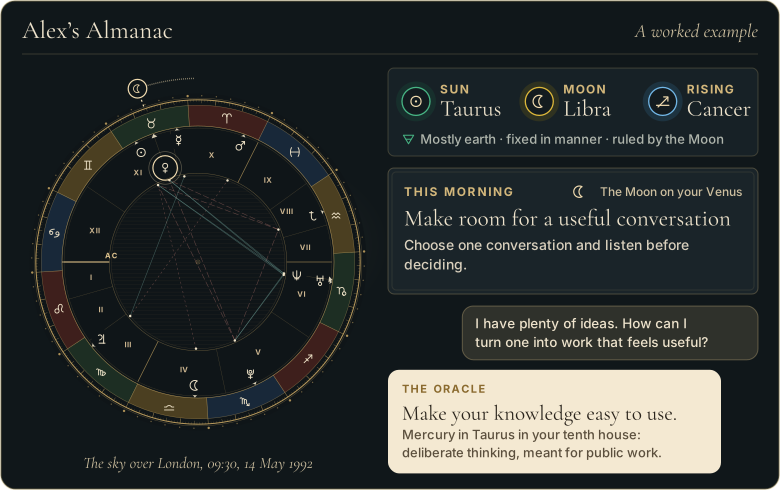
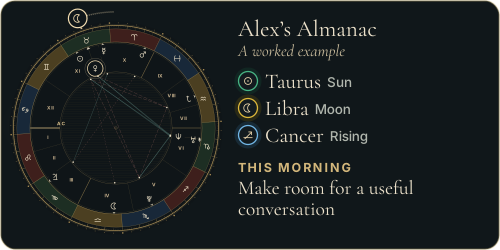
Walk through Alex’s whole example first
 The Road of AgesSee the turning points of your whole life, from your birth date
See your road's shape
The Road of AgesSee the turning points of your whole life, from your birth date
See your road's shape
Prefer to explore first?
 The Road of AgesThe turning points of your whole life, from your own chart
Walk my road
The Road of AgesThe turning points of your whole life, from your own chart
Walk my road
Free, by email
Your daily Almanac letter
One short letter at 7 each morning: the day’s theme read for your own chart, and one thing to do with it.
What sets Moon apart
The Moon is the fastest body in the chart and the one whose sign most often changes within a single birth day. It covers about 13 degrees a day, crosses a sign in roughly two and a quarter days and returns to the same star in 27.3 days, yet needs 29.5 days to return to the same phase because the Sun has moved on. Ptolemy calls it chiefly moist and the nearest to the earth, and the older texts make it the transmitter of the other planets' light: its next aspect before leaving a sign decides whether it is void of course.
- Sidereal month: 27.32 days to return to the same place among the stars
- Synodic month: about 29.5 days between one new Moon and the next, the Moon's own rhythm
- Daily motion: about 12 to 15 degrees a day, never retrograde
- Exaltation degree: 3 degrees of Taurus in the later tradition
- Joy and sect: joys in the third house; leader of the nocturnal sect
- Ptolemy's quality: chiefly moist, with some warmth borrowed from the Sun's light
A one-minute story
The Wandering Stars
How the moving planets were watched, named and found, and what a transit is.

Moon in the traditional textbooks
The Moon is the planet nearest the earth and the one Ptolemy blames for dampness, relaxation and decay. He gives her four phases, moist from new to first quarter, hot to full, dry to last quarter and cold to dark. Al-Qabisi adds eight properties of the Moon: conjunction, 12 degrees away, first quarter, 12 before opposition, opposition, 12 past, last quarter and the approach to disappearance. She leads the night team, and Dorotheus says she rejoices in the third house.
- Nature (Ptolemy): The Moon is chiefly moist, because she is nearest the earth, raises damp vapors, relaxes and causes putrefaction, with some warmth borrowed from the Sun's light.
- Class (Ptolemy): benefic, counted with Jupiter and Venus.
- Sex (Ptolemy): feminine. Team: the night team.
- Sphere (Firmicus): the lowest sphere, aiding seed and increased every month by the Sun.
- Orb (Abu Ma'shar): 12 degrees.
- Body (Ptolemy): the palate, throat, stomach, belly, womb and left side. Body (Burgoyne, 1896): the breast, the stomach and the whole fluid system.
Moon: dignities, bounds and strength
Where the Moon is strong, according to the same few authors:
- Domicile: Cancer. Ptolemy's reason: Cancer is, with Leo, the northernmost sign, nearest the zenith and hottest, so it goes to a luminary.
- Detriment: Capricorn, the sign opposite its own.
- Exaltation: 3 degrees of Taurus, because Taurus is the first sign of her own triplicity after she leaves the Sun in Aries, where her light first begins to grow (Ptolemy). Fall: 3 degrees of Scorpio.
- Joy by sign (Dorotheus): Cancer (added by Sahl, per Dykes). Joy by house (al-Qabisi): the third house.
- Triplicity: night lord of the earth signs (Taurus, Virgo and Capricorn); partner of the water signs (Cancer, Scorpio and Pisces) (Dorotheus).
The Moon takes no bounds, since the Sun and Moon have none.
The Moon rules 5 of the 36 decans: second decan of Taurus, third decan of Cancer, first decan of Libra, second decan of Sagittarius, third decan of Aquarius.
Moon: people, years and the limb in each sign
Burgoyne calls the Moon the handmaid and bride of the Sun, magnetic and cool, the vital force in woman and the chief control of intuition in both sexes. Firmicus has a rule for night charts: a waning Moon met by waning Venus or Mars gives good fortune, and a waxing or full Moon joined to Venus or Mars gives great misfortune, because Venus is hostile to the growing Moon by a kind of natural envy.
Ptolemy gives it the mother (with Venus). Among siblings, Dorotheus assigns it older sisters; when it rules the second house, he traces a decline in fortune to mothers and their relatives. Dorotheus's figure for the years of evil an angular planet holds off is 25 years in an angle in a feminine sign, but 25 months in a masculine one.
Al-Qabisi gives each planet a limb in each sign, the part that shows illness when it is troubled there. For the Moon:
- Aries: knees
- Taurus: legs
- Gemini: thighs
- Cancer: head
- Leo: neck
- Virgo: shoulders
- Libra: heart
- Scorpio: belly
- Sagittarius: back
- Capricorn: thighs
- Aquarius: private parts
- Pisces: thighs
The story behind Moon
The Moon is one of the seven classical planets and the fastest-moving major factor in a birth chart.
The spiritual meaning of Moon
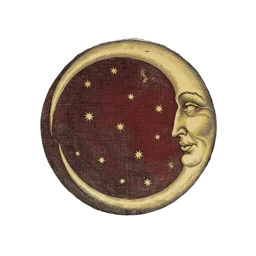
Spiritually, the Moon asks what needs tending so the soul can stay human.
Why Moon matters
The Moon matters because it shows what a person needs before they can feel safe, nourished, and emotionally present.
How to read Moon
Astrologers reach for Moon when interpreting mood, family patterns, attachment, home life, fertility symbolism, daily timing, lunar returns, and transits to the natal Moon.
Moon in practice: an example
A Moon-Pluto transit can intensify memory, attachment, grief, or the need for emotional honesty.
Sources and editorial method
This entry summarizes the tradition in the Almanac's own words; where no source is listed, it is an editorial summary rather than a primary text, and symbolic readings are named as the tradition's, not as fact.
- Source
- The Great Almanac Dictionary
- Category
- Planets & Celestial Bodies
- Aliases
- Moon astrology, Moon meaning
- Last updated
- 2026-09-26
Read your Moon placement
Moon in a book is one thing; Moon in your own birth chart is your life. The Oracle casts your real chart and tells you what it means for your love, your work, and your year ahead, in conversation. It opens with the 7-day Seeker trial.
Speak with the OracleWhere Moon moves through your own year, and what that asks of your love and your work, is written in the Cosmic Codex, month by month from your chart. Open the Cosmic Codex
Related terms
More in Planets & Celestial Bodies
From the reference page to your own chart
Every word here
is in your own chart.
- A personal reading about love, work or purpose, written from your chart
- A practical next step to consider
- It opens with 7 days free, with the AI Oracle and daily guidance
$0 today, then $12/month after 7 days. Cancel anytime.
Common questions
What is the Moon?
The Moon in astrology is the luminary of emotion, body rhythm, memory, instinct, safety, attachment, habit, and daily change.
Where does the Moon come from?
The Moon is one of the seven classical planets and the fastest-moving major factor in a birth chart.
What does the Moon mean in astrology?
Astrologers reach for Moon when interpreting mood, family patterns, attachment, home life, fertility symbolism, daily timing, lunar returns, and transits to the natal Moon.
What does the Moon look like in a birth chart?
A Moon-Pluto transit can intensify memory, attachment, grief, or the need for emotional honesty.
What does the Moon mean spiritually?
Spiritually, the Moon asks what needs tending so the soul can stay human.
Free, by email
The Almanac, in your inbox at 7
One short letter at 7 each morning: the day’s theme read for your own chart, and one thing to do with it.