Zodiac subdivisions
Decan
Direct answer
Degrees 0°00′-9°59′ belong to the first decan, 10°00′-19°59′ to the second, and 20°00′-29°59′ to the third. The boundary is mathematical, but the ruler assigned to each decan depends on the chosen tradition.
A decan is a ten-degree subdivision of a zodiac sign. Each 30-degree sign contains a first, second, and third decan.
$0 today, then $12/month after 7 days. Cancel anytime.
Quick facts
| Question | Direct answer |
|---|---|
| Size | 10 degrees of zodiacal longitude. |
| Number per sign | Three. |
| Number around the zodiac | Thirty-six. |
| Are rulers universal? | No. Egyptian decanal stars, Chaldean face rulers, triplicity schemes, and modern sign-based rulers differ. |
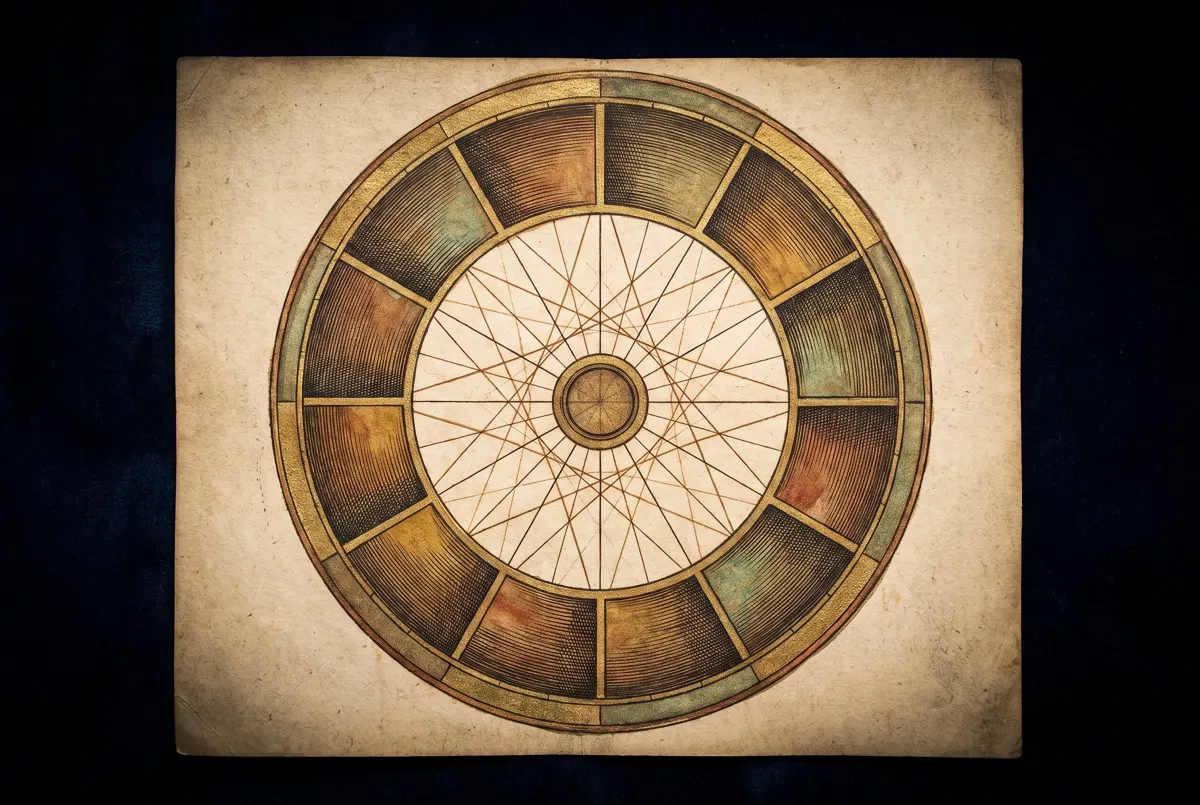
Decan divides each zodiac sign into three ten-degree sections.
A structural orientation; exact placements depend on the chart or technique being discussed.
What does your own chart say about you?
Choose love, work or purpose. Your reading is written from your chart. Your reading uses your own birth details.
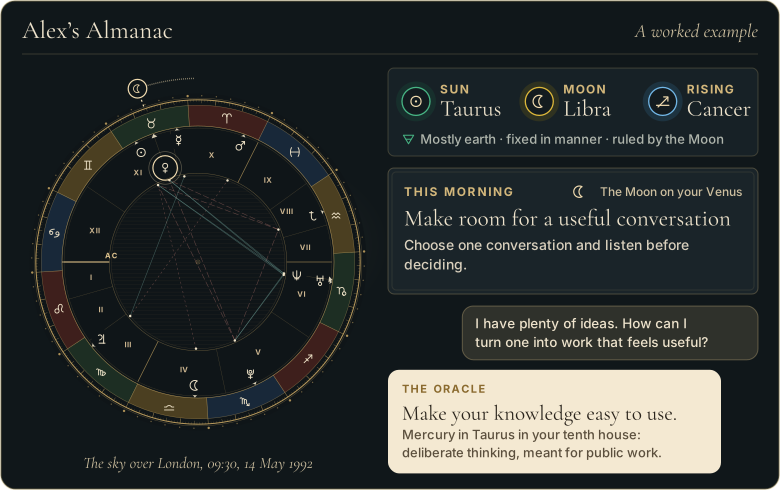
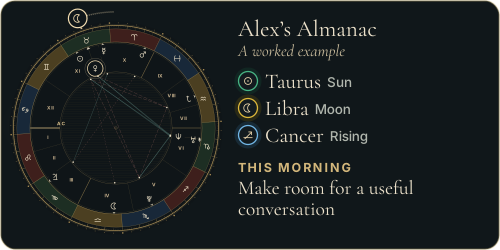
Walk through Alex’s whole example first
 The Road of AgesSee the turning points of your whole life, from your birth date
See your road's shape
The Road of AgesSee the turning points of your whole life, from your birth date
See your road's shape
Prefer to explore first?
 The Road of AgesThe turning points of your whole life, from your own chart
Walk my road
The Road of AgesThe turning points of your whole life, from your own chart
Walk my road
Free, by email
Your daily Almanac letter
One short letter at 7 each morning: the day’s theme read for your own chart, and one thing to do with it.
The simple degree division
A tropical or sidereal zodiac sign spans 30 degrees, and a decan divides that span into three equal sections. A planet at 7 degrees 14 minutes Leo is in Leo’s first decan; at 18 degrees it is in the second; at 27 degrees it is in the third. The term is related to Greek dekanos, “ten,” and older sources may call the subdivisions faces. Boundary notation matters: 10 degrees 00 minutes begins the second decan, not the end of the first. Accurate longitude is therefore necessary, but birth time usually changes the Moon and angles more than it changes slower planets.
A one-minute story
The Book of the Sky
How people learned to read the sky, from Babylon to the day you were born.

Egyptian decans before zodiacal signs
The earliest Egyptian decans were groups of stars used in systems of night-time reckoning and calendrical religion. Their risings divided portions of the night and appeared on coffin lids, astronomical ceilings, and other sources. This history predates the later twelve-sign zodiac. When Hellenistic astrology developed in Egypt and the Mediterranean world, a scheme of thirty-six ten-degree faces became integrated with zodiacal signs and planetary rulership. It is misleading to say the modern first, second, and third decans of a Sun sign are simply unchanged Egyptian personality types; the concept passed through substantial mathematical and interpretive transformation.
Why decan rulers disagree
A traditional planetary sequence often follows the Chaldean order of Saturn, Jupiter, Mars, Sun, Venus, Mercury, and Moon, continuing through the thirty-six faces from a specified starting point. Many modern popular accounts instead give each decan a ruler based on signs of the same element: for example, an Aries decan may be associated with Mars, Sun, or Jupiter through Aries, Leo, and Sagittarius. Tarot traditions add cards and images; Indian drekkana techniques use their own rules. None should be silently mixed. A reading must name its table and then use that table consistently.
How much weight should a decan carry?
A decan refines a placement; it does not replace the sign, planet, house, aspects, dignity, or broader chart. Traditional faces can provide imagery, minor dignity, and a more specific tone. Modern elemental sub-rulers can function as evocative descriptions but should not be presented as the only historical system. If a planet lies close to 10 or 20 degrees, use unrounded longitude before assigning it. A decan cannot establish personality from a birthday alone, and newspaper-style “early, middle, late sign” descriptions remain broad generalizations without the rest of a timed chart.
How to use Decans in Astrology responsibly
Astrological terminology is most useful when the calculation and interpretive convention are stated separately. For Decans in Astrology, a careful account identifies the chart factors, degrees, or classification rule first, then explains what astrologers have traditionally inferred from them. Different schools may use different orbs, planets, house systems, or symbolic vocabularies, so a borderline result should be described rather than forced into a label. Astrology is a historical divinatory practice, not a scientifically validated method for diagnosing personality or predicting events. Treat the interpretation as a bounded symbolic hypothesis, compare it with the full chart and lived evidence, and never use it to replace medical, legal, financial, mental-health, or safeguarding advice.
What sets Decan apart
A decan is a ten-degree third of a sign, thirty-six in all round the zodiac. Their rulers follow the Chaldean order of planets, Saturn, Jupiter, Mars, Sun, Venus, Mercury, Moon, repeating from Mars at the start of Aries, so the first decan of Leo falls to Saturn. The Egyptians had thirty-six star groups for the ten-day weeks of their calendar, and the Greek word for ten, deka, gave the name.
- Size and count: 10 degrees each, 36 around the zodiac, 3 in every sign
- Chaldean order: Saturn, Jupiter, Mars, Sun, Venus, Mercury, Moon, running on from Mars at 0 Aries
- Example: Aries is Mars, Sun, Venus; Leo is Saturn, Jupiter, Mars
- Triplicity scheme: the Indian drekkana gives the sign itself, then the next two signs of its element
- Greek name: prosopon, the face, the Latin facies, worth one point in al-Qabisi's scoring
Often mistaken for something else: A decan is a tenth-of-a-sign division with one planetary ruler. A term or bound is an uneven division of the sign, and a decan is always exactly ten degrees.
The decan lords, sign by sign
Each sign has three decans of ten degrees. The first covers 0 to 9 degrees 59 minutes, the second 10 to 19 degrees 59 minutes and the third 20 to 29 degrees 59 minutes. The Chaldean scheme, in which each decan is ruled by a planet, starts at the first degree of Aries with Mars and moves through the seven planets in Chaldean order (Saturn, Jupiter, Mars, Sun, Venus, Mercury, Moon) across all thirty-six decans:
- Aries: Mars, Sun, Venus
- Taurus: Mercury, Moon, Saturn
- Gemini: Jupiter, Mars, Sun
- Cancer: Venus, Mercury, Moon
- Leo: Saturn, Jupiter, Mars
- Virgo: Sun, Venus, Mercury
- Libra: Moon, Saturn, Jupiter
- Scorpio: Mars, Sun, Venus
- Sagittarius: Mercury, Moon, Saturn
- Capricorn: Jupiter, Mars, Sun
- Aquarius: Venus, Mercury, Moon
- Pisces: Saturn, Jupiter, Mars
Firmicus Maternus gives the same table in the fourth century, and al-Qabisi gives it in the tenth. The rulers simply run on through the Chaldean order, three to a sign, so each sign starts three planets further on than the one before. Because 36 is not a multiple of 7, the run does not close evenly: Mars rules both the last decan of Pisces and the first of Aries.
How to find your decan in ten seconds
Take the degree of the planet inside its sign and drop the minutes. Zero to nine is the first decan, ten to nineteen the second, twenty to twenty-nine the third. A Sun at 16 degrees of Virgo is in the second decan, which belongs to Venus. A Moon at 3 degrees of Pisces is in the first decan, which belongs to Saturn.
Al-Qabisi also gives a counting rule that avoids the table. Count the signs completed before the sign you are in, starting from Aries, multiply by three and add three. Remove sevens. Count that many planets from Saturn through the Chaldean order, and the planet you land on rules the first decan; the next two planets rule the second and third. His own example is 16 degrees of Virgo: five signs come before it, five times three is fifteen, add three for eighteen, subtract fourteen for four, and counting Saturn, Jupiter, Mars, Sun lands on the Sun for the first decan, which gives Venus for the second.
Why the old books call it a face
The ancient word was face. Al-Qabisi describes each decan as a face of the sign and likens a planet standing in its own face to a person in their own mastery, or in fine clothes. Firmicus says a planet in its own decan acts as if it stood in its own sign, and he mentions a second tradition that gives each decan three further deities, the 36 decanal gods, whom he declines to describe.
Do not confuse the decan with the face in Ptolemy. In the Tetrabiblos a planet is in its proper face when it makes to the Sun or Moon the aspect its own house bears to theirs, for example Venus in sextile. That is a phase condition and has nothing to do with a ten-degree slice of the sign.
Where the decan sits in the dignity system
Al-Qabisi ranks the faces last in the five-part scheme, worth one point beside domicile 5, exaltation 4, triplicity 3 and bound 2. A planet in its own face is the weakest form of support. Still, the decan is the quickest of the five to calculate and the one most often quoted in modern chart reading, where it is used to color a placement: a Sun in the second decan of Leo carries a Jupiter flavor on top of its Leo nature.
The decans are older than the zodiac as astrology uses it. The thirty-six divisions began in Egyptian star lore, and the Hellenistic astrologers fitted them to the signs. Modern readings often use a different attribution, where the three decans of a sign are ruled by the sign itself and the next two signs of the same element. That version is later, so it is worth stating which scheme you are using.
Sources and editorial method
Research and editorial references used for this page include:
- Encyclopaedia Britannica: Decan - Historical overview of Egyptian decans and their astronomical role.
- The Metropolitan Museum of Art: Egyptian Astronomical Texts - Museum context for ancient Egyptian astronomical and calendrical traditions.
These references support the factual, historical, textual, or interpretive claims on this page. Interpretive traditions are identified as such, and factual claims are kept separate from symbolic claims.
Related reading
Find your decans
Decan in a book is one thing; Decan in your own birth chart is your life. The Oracle casts your real chart and tells you what it means for your love, your work, and your year ahead, in conversation. It opens with the 7-day Seeker trial.
Speak with the OracleHow Decan lives in your own chart across your year, in love, in work, in timing, is written in the Cosmic Codex: the whole year, once. Open the Cosmic Codex
More in Astrology
- Esoteric Astrology
- Heliacal Setting
- Lot of Marriage
- Natal Chart
- Radical Chart
- Stellium
- Zodiacal Releasing
- Birth Chart
From the reference page to your own chart
Every word here
is in your own chart.
- A personal reading about love, work or purpose, written from your chart
- A practical next step to consider
- It opens with 7 days free, with the AI Oracle and daily guidance
$0 today, then $12/month after 7 days. Cancel anytime.
Common questions
What decan is 10 degrees?
Exactly 10°00′ begins the second decan under the standard three-part division.
Are decans the same as dwads?
No. Decans divide a sign into three ten-degree parts; dwads divide it into twelve 2.5-degree parts.
Why does another site give a different ruler?
It probably uses another historical or modern rulership scheme. Compare the named table.
Free, by email
The Almanac, in your inbox at 7
One short letter at 7 each morning: the day’s theme read for your own chart, and one thing to do with it.
