
Horary astrology terminology
Radical Chart
Direct answer
Radicality is not one astronomical switch. Traditional astrologers assess factors such as whether the question is genuine, whether the chart describes it, and whether warning conditions call for caution. Different authors weigh those conditions differently.
A radical chart is a horary chart considered rooted in a sincere, ripe question and sufficiently fit for astrological judgment under the practitioner’s method.
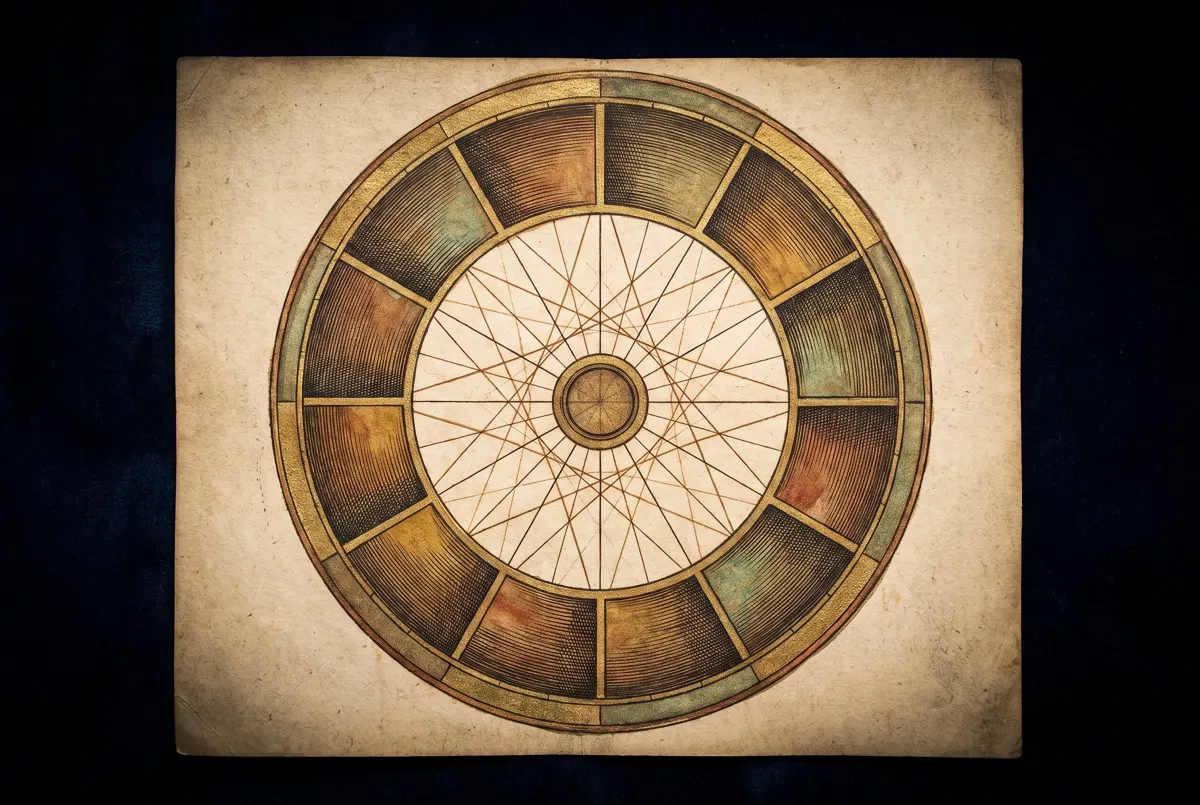
A Radical Chart is the root chart used for judgment, especially when a horary question is considered fit to read.
A structural orientation; exact placements depend on the chart or technique being discussed.Quick facts
| Question | Direct answer |
|---|---|
| Primary context | Horary astrology, where a chart is cast for the time a question is understood. |
| Literal sense | Rooted or having a sound foundation. |
| Common supporting test | Agreement between the planetary ruler of the hour and the Ascendant ruler or nature. |
| Does one warning always void the chart? | No. Many traditional and modern practitioners treat warnings as interpretive cautions. |
The Instruments
Ten readings, worked out from your own birth chart
An instrument is a reading this house works out for you. Give your birth date, time and place once, and each one reads today’s real sky against the chart you were born under. Eight are personal; two are calendars anyone can open. A free account opens one instrument a day. The plans open every instrument, every day.
- Natal Chart Every planet, house and aspect in your chart
- Active Transits Where the planets are now, read against your chart
- Daily Counsel What to pursue today, and what to leave alone
- Personal Timing Your best days to decide, weeks ahead
- Fellowship Your chart and another, read side by side
- Theme of the Day The one thing today is asking of you
- Sacred Numbers Your life path, your cycles, your name in numbers
- Aeolian Harmonics Classical music chosen to match your chart
- Mercury Retrograde Every Mercury retrograde this year, with its dates Open to all
- Void-of-Course Moon When the Moon is between signs, hour by hour Open to all







What “radical” means in horary
In horary astrology, radicality concerns whether the chart is genuinely connected to the question and can be judged with confidence. The word suggests a rooted chart rather than a random moment. It may include the querent’s seriousness, the astrologer’s clear understanding of the question, descriptive correspondence between chart and situation, and formal tests inherited from older authors. Radical does not mean that the chart is morally pure or that its predicted outcome is favorable. A difficult chart can be radical, while an attractive chart can be poorly rooted in an unclear or repeatedly manipulated question.
Planetary-hour agreement
A well-known test compares the planetary ruler of the hour with the Ascendant and its ruler. William Lilly describes forms of agreement through identity, nature, or triplicity. Later practitioners implement the rule differently because planetary-hour calculations, elemental classifications, and textual readings vary. Passing the test may support radicality, but failing it is not universally treated as an automatic rejection. Software should show the hour ruler and the rule applied instead of displaying a green or red “radical” badge with no explanation. The test belongs to a traditional symbolic framework, not to astronomical chart accuracy.
Considerations before judgment
Early or late Ascendant degrees, Saturn in or ruling the seventh house, a void-of-course Moon, and other conditions are often grouped under considerations before judgment. Their historical meanings are more nuanced than “do not read.” An early degree may suggest that circumstances are undeveloped; a late degree may show a matter already decided; seventh-house affliction can warn of astrologer error. Context can also make the condition descriptive. A question about a premature decision may appropriately produce an early Ascendant. The astrologer should explain the caution and decide whether it limits confidence, changes interpretation, or genuinely prevents judgment.
Testing whether the chart describes the question
Before predicting, compare the significators and houses with known facts that were not used to choose the time. Does the querent’s ruler describe their condition? Does the relevant house show the other party or subject plausibly? Are there contradictions that suggest the question was misunderstood? This descriptive check is not proof of astrology, but it reduces the temptation to force every chart into an answer. Avoid recasting repeatedly until a preferred chart appears. Record the exact time, location, question wording, and judgment so later review can distinguish a failed method from selective memory.
How to use Radical Chart responsibly
Astrological terminology is most useful when the calculation and interpretive convention are stated separately. For Radical Chart, a careful account identifies the chart factors, degrees, or classification rule first, then explains what astrologers have traditionally inferred from them. Different schools may use different orbs, planets, house systems, or symbolic vocabularies, so a borderline result should be described rather than forced into a label. Astrology is a historical divinatory practice, not a scientifically validated method for diagnosing personality or predicting events. Treat the interpretation as a bounded symbolic hypothesis, compare it with the full chart and lived evidence, and never use it to replace medical, legal, financial, mental-health, or safeguarding advice.
Sources and editorial method
Research and editorial references used for this page include:
- Internet Archive: Christian Astrology by William Lilly - Primary seventeenth-century source for horary method and considerations.
- Skyscript: Horary Astrology Glossary - Specialist historical reference for radicality terminology.
These references support the factual, historical, textual, or interpretive claims on this page. Interpretive traditions are identified as such, and factual claims are kept separate from symbolic claims.
Related reading
Check the root of the question
Radical Chart in a book is one thing; Radical Chart in your own birth chart is your life. The Oracle casts your real chart and tells you what it means for your love, your work, and your year ahead, in conversation, free.
Speak with the OracleHow Radical Chart lives in your own chart across your year, in love, in work, in timing, is written in the Cosmic Codex: the whole year, once. Open the Cosmic Codex
More in Astrology
- Solstice Points
- Water Signs
- Astrotheology
- Conjunction Pair
- Earth Signs
- Frustration
- Latitude in Astrology
- Negative Signs
Common questions
What makes a horary chart radical?
No single factor is universal; sincerity, descriptive fit, hour-ruler agreement, and warning conditions may all be considered.
Is an early Ascendant always unreadable?
No. It may warn that the matter is premature, but many astrologers judge it in context.
Can I ask the same question again for a better chart?
Repeated recasting to obtain a preferred answer undermines the premise that the original sincere question supplied the relevant moment.