Planets and points
Saturn
Direct answer
Saturn in astrology represents limits, time, discipline, fear, structure, responsibility, maturity, consequence, endurance, and earned authority.
$0 today, then $12/month after 7 days. Cancel anytime.
At a glance
- In astrology
- Saturn rules Capricorn and Aquarius, is exalted in Libra, falls in Aries, and is in detriment in Cancer and Leo.
- Found in
- Planets & Celestial Bodies
- Related
- Planetary Placement, Planetary Position, Birth Chart, Transit
Deeper Almanac guide: Saturn return guide. This dictionary entry is a concise definition page; the linked guide remains the long-form topic page.
Saturn represents limits, time, structure, responsibility, and maturity.
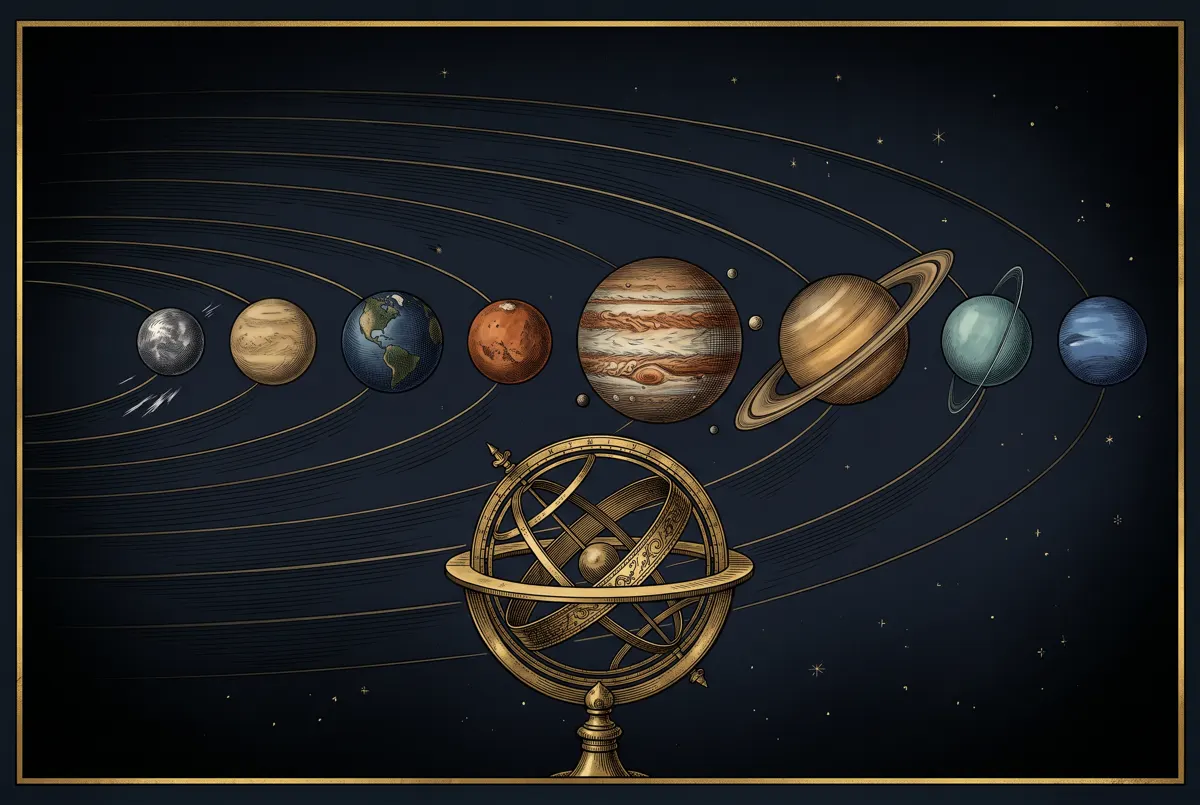
The orbit map distinguishes physical bodies, calculated points, and symbolic cycles where possible.
What does your own chart say about you?
Choose love, work or purpose. Your reading is written from your chart. Your reading uses your own birth details.
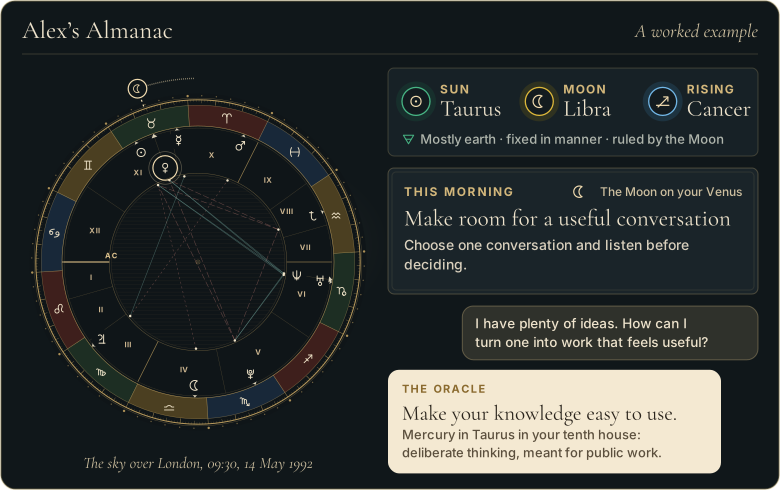
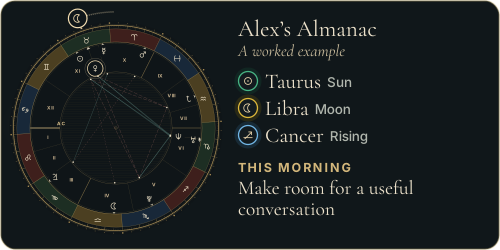
Walk through Alex’s whole example first
 The Road of AgesSee the turning points of your whole life, from your birth date
See your road's shape
The Road of AgesSee the turning points of your whole life, from your birth date
See your road's shape
Prefer to explore first?
 The Road of AgesThe turning points of your whole life, from your own chart
Walk my road
The Road of AgesThe turning points of your whole life, from your own chart
Walk my road
Free, by email
Your daily Almanac letter
One short letter at 7 each morning: the day’s theme read for your own chart, and one thing to do with it.
What sets Saturn apart
Saturn is the slowest and highest of the seven classical planets, the last in the Chaldean order before the fixed stars, and its circuit of the zodiac takes close to thirty years. Ptolemy gives it the coldest nature, more cold than dry, from its distance from the Sun. In the Hellenistic scheme it is the greater malefic yet a diurnal planet, so it is read as most manageable in a day chart. It gives its name to Saturday and to the Saturn return.
- Circuit of the zodiac: about 29.46 years, the basis of the Saturn return
- Time in a sign: about two and a half years
- Retrograde: about 4.5 months in each year
- Exaltation degree: 21 degrees of Libra in the later tradition
- Joy: the twelfth house, the Bad Spirit
- Egyptian name: Phainon, in Firmicus Maternus
A one-minute story
The Wandering Stars
How the moving planets were watched, named and found, and what a transit is.

Saturn in the traditional textbooks
Saturn stands in the highest of the seven spheres, and Ptolemy makes him a malefic by excess of cold, the first malefic in Burgoyne's ranking. He gives him the day, against his nature, so the day's heat tempers him. Dorotheus has Saturn rejoicing in Aquarius and gives him the old men, slaves and burial places of a failing fortune. Tara Mata notes that the Greek tradition made Cronus, or Saturn, the lord of Time and the ruler of the Golden Age, and she calls iron Saturn's metal and the metal of the Iron Ages.
- Nature (Ptolemy): Saturn is cold and dry, more cold than dry, because he is farthest from the Sun and from the earth's vapors.
- Class (Ptolemy): malefic, by excess of cold.
- Sex (Ptolemy): masculine. Team: the day team, deliberately against his nature, so that the day's heat tempers his cold.
- Sphere (Firmicus): the highest sphere, at the top of the sky, with a slow course.
- Egyptian name (Firmicus): Phainon.
- Color (Ptolemy, reading eclipses and comets): black or green.
- Orb (Abu Ma'shar): 9 degrees.
- Body (Ptolemy): the right ear, spleen, bladder, phlegm and bones. Body (Burgoyne, 1896): the bones, the liver and the spleen.
Saturn: dignities, bounds and strength
Where Saturn is strong, according to the same few authors:
- Domicile: Capricorn and Aquarius. Ptolemy's reason: they are opposite Cancer and Leo, cold and wintry.
- Detriment: Cancer and Leo, the signs opposite its own.
- Exaltation: 21 degrees of Libra, because he is opposite the Sun in both house and exaltation, so heat up means cold down (Ptolemy). Fall: 21 degrees of Aries.
- Joy by sign (Dorotheus): Aquarius. Joy by house (al-Qabisi): the twelfth house.
- Triplicity: partner of the fire signs (Aries, Leo and Sagittarius); day lord of the air signs (Gemini, Libra and Aquarius) (Dorotheus).
The Egyptian bounds of Saturn add up to 57 degrees of the 360. Aries 26 to 30, Taurus 23 to 27, Gemini 25 to 30, Cancer 27 to 30, Leo 12 to 18, Virgo 29 to 30, Libra 1 to 6, Scorpio 25 to 30, Sagittarius 22 to 26, Capricorn 23 to 26, Aquarius 26 to 30, Pisces 29 to 30. The widest is 7 degrees, in Leo, and the narrowest is 2, in Virgo and Pisces.
Saturn rules 5 of the 36 decans: third decan of Taurus, first decan of Leo, second decan of Libra, third decan of Sagittarius, first decan of Pisces.
- Facing (al-Qabisi, after Ptolemy): a western planet is in the facing of the Sun when it stands in the sixth sign from the Sun, as many signs as its domicile is from the Sun's.
- Face (Ptolemy, a phase and not a decan): it makes the sixth sign from the Sun's house, a quincunx of 150 degrees.
- Morning star (Firmicus): it becomes one when it precedes the Sun by 15 degrees.
Saturn: people, years and the limb in each sign
Burgoyne calls Saturn the planet of old age, sorrow and disease, cold, death-like and magnetic, and gives him the reflective and reasoning faculties, the bones, the liver and the spleen. Firmicus gives his Egyptian name as Phainon. Hill's candlestick puts him last of the three planets on the far side.
Ptolemy gives it the father (with the Sun). Among siblings, Dorotheus assigns it older brothers (with the Sun); when it rules the second house, he traces a decline in fortune to old men, slaves or freedmen, a building or a burial place. Dorotheus's figure for the years of evil an angular planet holds off is 30 years, if dominant by sect and triplicity. Ptolemy says that as lord of an eclipse he brings cold, chronic disease, exile, poverty, famine, floods and frost.
Al-Qabisi gives each planet a limb in each sign, the part that shows illness when it is troubled there. For Saturn:
- Aries: chest
- Taurus: belly
- Gemini: belly
- Cancer: manly parts
- Leo: private parts
- Virgo: feet
- Libra: knees
- Scorpio: ankles
- Sagittarius: feet
- Capricorn: head and feet
- Aquarius: head and neck
- Pisces: shoulders, arms, neck
The story behind Saturn
Saturn is a classical planet and the traditional outer boundary of the visible planets.
The spiritual meaning of Saturn
Spiritually, Saturn asks what discipline would make the soul more trustworthy.
Why Saturn matters
Saturn matters because it shows where a person must grow up, accept reality, build capacity, and transform fear into mastery.
How to read Saturn
Astrologers reach for Saturn when interpreting boundaries, career pressure, duty, aging, commitment, tests, Saturn returns, and long-term development.
Saturn in practice: an example
Saturn in the seventh house may make partnership serious, delayed, contractual, or deeply formative.
Where readings of Saturn go wrong
The usual misreading is to treat Saturn as punishment. Saturn can be the structure that makes freedom real.
A lecture on this, free to read

Sources and editorial method
This entry summarizes the tradition in the Almanac's own words; where no source is listed, it is an editorial summary rather than a primary text, and symbolic readings are named as the tradition's, not as fact.
- Source
- The Great Almanac Dictionary
- Category
- Planets & Celestial Bodies
- Aliases
- Saturn astrology, Saturn meaning
- Last updated
- 2026-09-26
Read your Saturn placement
Saturn in a book is one thing; Saturn in your own birth chart is your life. The Oracle casts your real chart and tells you what it means for your love, your work, and your year ahead, in conversation. It opens with the 7-day Seeker trial.
Speak with the OracleWhere Saturn moves through your own year, and what that asks of your love and your work, is written in the Cosmic Codex, month by month from your chart. Open the Cosmic Codex
Related terms
More in Planets & Celestial Bodies
From the reference page to your own chart
Every word here
is in your own chart.
- A personal reading about love, work or purpose, written from your chart
- A practical next step to consider
- It opens with 7 days free, with the AI Oracle and daily guidance
$0 today, then $12/month after 7 days. Cancel anytime.
Common questions
What is Saturn?
Saturn in astrology represents limits, time, discipline, fear, structure, responsibility, maturity, consequence, endurance, and earned authority.
Where does Saturn come from?
Saturn is a classical planet and the traditional outer boundary of the visible planets.
What does Saturn mean in astrology?
Astrologers reach for Saturn when interpreting boundaries, career pressure, duty, aging, commitment, tests, Saturn returns, and long-term development.
What does Saturn look like in a birth chart?
Saturn in the seventh house may make partnership serious, delayed, contractual, or deeply formative.
What does Saturn mean spiritually?
Spiritually, Saturn asks what discipline would make the soul more trustworthy.
Free, by email
The Almanac, in your inbox at 7
One short letter at 7 each morning: the day’s theme read for your own chart, and one thing to do with it.