Kp
A three-hour planetary measure of geomagnetic disturbance on a scale from 0 to 9.
Read the current planetary Kp index and GOES X-ray class, then understand what NOAA space-weather scales do and do not say.
$0 today, then $12/month after 7 days. Cancel anytime.
Space weather describes changing physical conditions from the Sun through near-Earth space. The live cards report the latest Kp and GOES soft X-ray classification returned by The Great Almanac endpoint, with observation time and direct NOAA source links.
A three-hour planetary measure of geomagnetic disturbance on a scale from 0 to 9.
Satellite measurements used to classify solar flares as A, B, C, M, or X with a numeric multiplier.
G describes geomagnetic storms, R radio blackouts, and S solar radiation storms; they are related but not interchangeable.
Physical space weather · refreshes hourly
Current instrument readings with their observation time. No personal, medical, or spiritual state is inferred.
Kp is planetary context, not a local aurora forecast. GOES X-ray class is not a geomagnetic-storm forecast. Use the linked NOAA products for operational decisions.
Solar flares can increase electromagnetic radiation within minutes. Coronal mass ejections can carry magnetized plasma that reaches Earth later and may disturb the magnetosphere. Energetic particles create another hazard channel. Because these phenomena travel differently, a flare class alone does not specify the future geomagnetic response, and a current Kp value does not tell you what the Sun emitted days earlier.
The solar card uses the latest available GOES 0.1-0.8 nanometer X-ray flux and converts it into the familiar flare class. The geomagnetic card uses NOAA’s planetary K-index product. Both carry a timestamp. If a feed is missing, the page says pending rather than replacing the observation with a typical value or symbolic guess.
The G scale classifies geomagnetic storms, the R scale classifies radio blackouts associated with X-ray flares, and the S scale classifies solar radiation storms. A number such as G2 cannot be substituted for R2 or S2. Impact descriptions are broad operational guidance; actual effects depend on technology, location, system design, and event duration.
Aurora is the most familiar visible result of geomagnetic activity, but visibility depends on the auroral oval, darkness, cloud, latitude, and horizon. Most other important impacts concern radio, navigation, satellites, power systems, and aviation operations. Personal health or mood claims are not established by the live measurements shown here.
Kp and X-ray flux are instrument measurements with definitions and units. Spiritual or astrological interpretations of solar activity are optional meaning-making and should never be blended into the source label. Do not use a space-weather reading to diagnose symptoms, predict behavior, or replace official emergency and infrastructure guidance.

Choose love, work or purpose. Your reading is written from your chart. Your reading uses your own birth details.
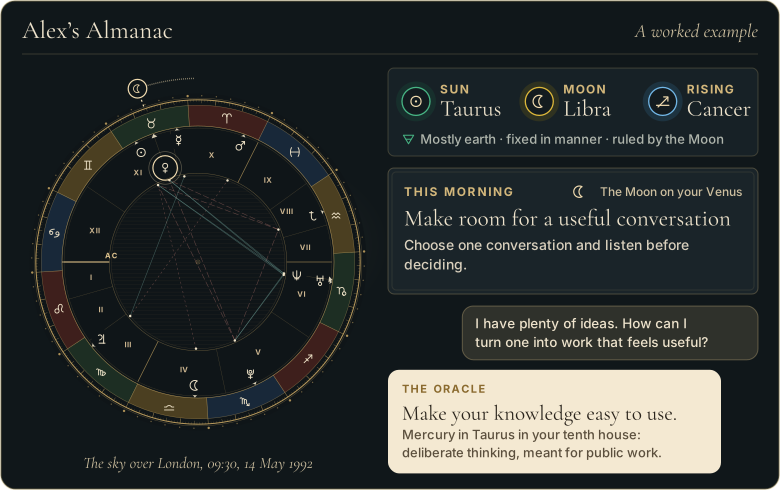
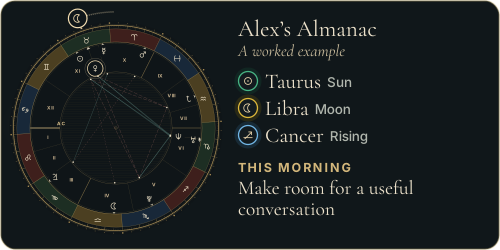
Walk through Alex’s whole example first
 The Road of AgesSee the turning points of your whole life, from your birth date
See your road's shape
The Road of AgesSee the turning points of your whole life, from your birth date
See your road's shape
 The Road of AgesThe turning points of your whole life, from your own chart
Walk my road
The Road of AgesThe turning points of your whole life, from your own chart
Walk my road
Free, by email
One short letter at 7 each morning: the day’s theme read for your own chart, and one thing to do with it.
From the reference page to your own chart
$0 today, then $12/month after 7 days. Cancel anytime.
It loads the latest endpoint snapshot when the page opens and checks again on the next UTC hour while the page remains open. The source products have their own reporting cadences.
No. X-ray flare class and geomagnetic disturbance measure different parts of the Sun-Earth system. CME direction and magnetic structure matter.
No. Kp is planetary context, not a location-specific visibility forecast. Use an aurora oval forecast plus local darkness and weather.
Free, by email
One short letter at 7 each morning: the day’s theme read for your own chart, and one thing to do with it.

Read more
Keep moving through the archive: signs, compatibility, chart timing, faith-aware discernment, and practical daily guidance.