
Class sequence
A, B, C, M, and X are logarithmic decades of peak soft X-ray flux.
See the latest GOES soft X-ray class and learn how A, B, C, M, and X flare classes differ from CMEs, geomagnetic storms, and radio-blackout scales.
$0 today, then $12/month after 7 days. Cancel anytime.
The flare card classifies the latest GOES soft X-ray flux into A, B, C, M, or X with a multiplier. Each letter is ten times the previous threshold. A flare is not the same thing as a coronal mass ejection or geomagnetic storm.
A, B, C, M, and X are logarithmic decades of peak soft X-ray flux.
M5 is five times the M1 threshold; X2 is twice the X1 threshold.
A CME is an eruption of plasma and magnetic field; it may occur with a flare but is measured and forecast separately.
Physical space weather · refreshes hourly
Current instrument readings with their observation time. No personal, medical, or spiritual state is inferred.
Kp is planetary context, not a local aurora forecast. GOES X-ray class is not a geomagnetic-storm forecast. Use the linked NOAA products for operational decisions.
Operational flare classes use peak 0.1-0.8 nanometer soft X-ray flux measured by GOES satellites. The class letter marks the power-of-ten band and the number gives the multiplier within it. This makes M2 stronger in X-rays than M1, while X1 begins the next decade above M-class. The live panel retains the subtype instead of reducing every reading to a vague letter.
Electromagnetic radiation from a flare reaches Earth at light speed and can change the ionosphere on the sunlit side. Energetic particles and CME material travel more slowly and follow different paths. That timing difference is why a current flare classification cannot by itself tell you the Kp value expected later.
NOAA’s R scale relates primarily to flare-associated X-ray effects on high-frequency radio on Earth’s sunlit side. It is separate from the G geomagnetic storm scale and S solar radiation storm scale. Use the official product for affected frequencies, areas, and timing rather than translating a flare class into an invented universal impact.
Some major flares accompany CMEs, but not every flare launches an Earth-directed CME and not every geomagnetic storm begins with an obvious large flare. CME speed, direction, density, and magnetic orientation influence coupling with Earth. Space-weather forecasters combine coronagraph, solar-wind, magnetic, and other observations.
The current X-ray class is useful factual context for radio and solar activity. It is not a direct measure of visible sunlight, weather, personal “energy,” or medical risk for a general reader at ground level. For aviation, satellite, radio, or infrastructure decisions, follow official alerts and organizational procedures.

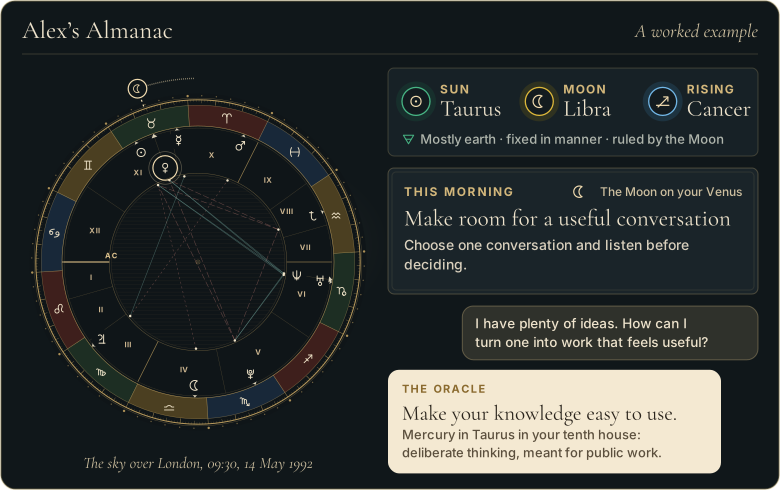
Choose love, work or purpose. Your reading is written from your chart. Your reading uses your own birth details.
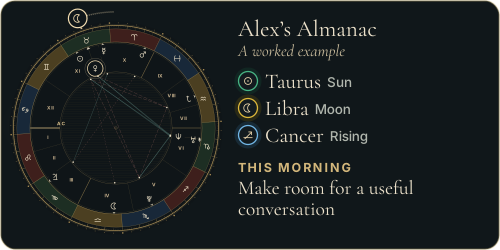
Walk through Alex’s whole example first
 The Road of AgesSee the turning points of your whole life, from your birth date
See your road's shape
The Road of AgesSee the turning points of your whole life, from your birth date
See your road's shape
 The Road of AgesThe turning points of your whole life, from your own chart
Walk my road
The Road of AgesThe turning points of your whole life, from your own chart
Walk my road
Free, by email
One short letter at 7 each morning: the day’s theme read for your own chart, and one thing to do with it.
From the reference page to your own chart
$0 today, then $12/month after 7 days. Cancel anytime.
The class thresholds differ by a factor of ten in peak soft X-ray flux. Numeric multipliers within each class also matter.
Not usually. X-rays arrive in minutes, while aurora-producing geomagnetic disturbance often involves later solar-wind or CME interaction.
No. A flare is a rapid release observed across electromagnetic wavelengths; a CME is an eruption of plasma and magnetic field. They can occur together or separately.
Free, by email
One short letter at 7 each morning: the day’s theme read for your own chart, and one thing to do with it.

Read more
Keep moving through the archive: signs, compatibility, chart timing, faith-aware discernment, and practical daily guidance.