G1 threshold
Minor geomagnetic storm conditions begin around Kp 5.
Understand NOAA’s G1-G5 geomagnetic storm scale, its Kp relationship, possible technology effects, and why current Kp is not a future local forecast.
$0 today, then $12/month after 7 days. Cancel anytime.
A geomagnetic storm is a significant disturbance of Earth’s magnetosphere caused by solar-wind energy transfer. NOAA’s G scale begins at G1 around Kp 5 and rises through G5; the scale describes broad possible impacts, not a certainty that every listed effect will occur.
Minor geomagnetic storm conditions begin around Kp 5.
Extreme conditions correspond to the top of the planetary index near Kp 9.
Latitude, duration, local geology, system design, and operating conditions affect real-world consequences.
Physical space weather · refreshes hourly
Current instrument readings with their observation time. No personal, medical, or spiritual state is inferred.
Kp is planetary context, not a local aurora forecast. GOES X-ray class is not a geomagnetic-storm forecast. Use the linked NOAA products for operational decisions.
A sustained southward component of the interplanetary magnetic field can couple efficiently with Earth’s magnetic field, allowing solar-wind energy into the magnetosphere. Fast solar wind from coronal holes and CME arrivals are common drivers. Speed alone does not determine storm strength; magnetic orientation and duration are crucial.
NOAA’s G1 through G5 categories communicate increasing geomagnetic severity. The accompanying descriptions mention potential power, spacecraft, navigation, radio, pipeline, and aurora effects. They are planning summaries across broad conditions, not a guarantee of a specific outage, navigation error, or aurora display at a particular address.
Planetary Kp is closely related to the G scale and provides a convenient global summary. Other indices and direct solar-wind measurements help specialists understand storm development. A three-hour Kp interval also smooths short changes. Preserve its timestamp and avoid presenting it as an instantaneous local magnetometer trace.
Infrastructure operators, satellite teams, aviators, radio users, and navigation professionals should use official alerts, forecasts, and internal procedures. Members of the public can use official notices for awareness and aurora planning. This educational page does not issue safety orders or predict grid failure from a single number.
Geomagnetic storms are measurable physical events, but popular claims about headaches, sleep, mood, or spiritual awakening often exceed the evidence available from an individual Kp reading. Correlation in a personal journal is not a diagnosis or causal demonstration. Seek appropriate care for symptoms rather than waiting for space weather to change.

Choose love, work or purpose. Your reading is written from your chart. Your reading uses your own birth details.
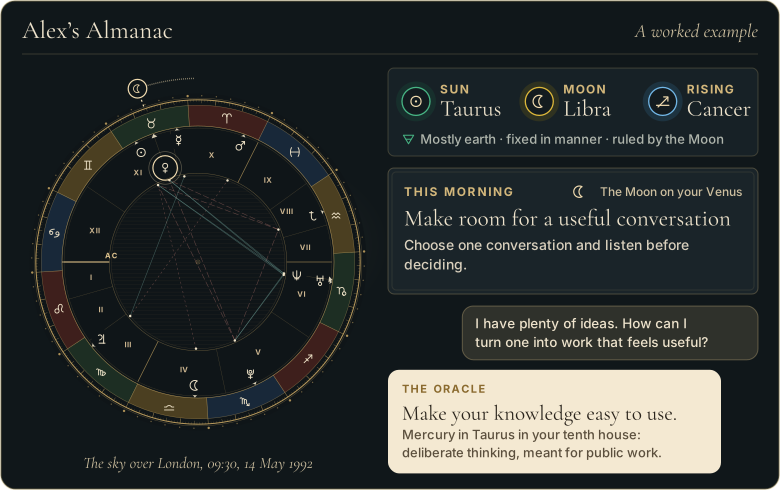
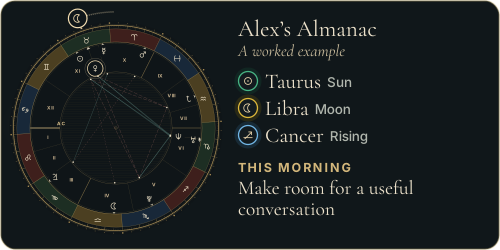
Walk through Alex’s whole example first
 The Road of AgesSee the turning points of your whole life, from your birth date
See your road's shape
The Road of AgesSee the turning points of your whole life, from your birth date
See your road's shape
 The Road of AgesThe turning points of your whole life, from your own chart
Walk my road
The Road of AgesThe turning points of your whole life, from your own chart
Walk my road
Free, by email
One short letter at 7 each morning: the day’s theme read for your own chart, and one thing to do with it.
From the reference page to your own chart
$0 today, then $12/month after 7 days. Cancel anytime.
NOAA associates G1 minor storm conditions with planetary Kp 5. Higher G categories correspond to higher Kp thresholds.
Not necessarily. NOAA scale descriptions list possible broad impacts; actual outcomes depend on location, system vulnerability, duration, and operator response.
No. A current three-hour index is an observation or nowcast. Forecasting requires upstream solar-wind and CME information and includes uncertainty.
Free, by email
One short letter at 7 each morning: the day’s theme read for your own chart, and one thing to do with it.

Read more
Keep moving through the archive: signs, compatibility, chart timing, faith-aware discernment, and practical daily guidance.