Current snapshot
One timestamp and one set of geocentric tropical longitudes, not a future table.
Understand ephemerides, ecliptic longitude, coordinate frames, time standards, retrograde notation, interpolation, and the limits of a current snapshot.
$0 today, then $12/month after 7 days. Cancel anytime.
An ephemeris is a table or service giving calculated celestial positions at specified times. To interpret one correctly, identify its time standard, coordinate origin, reference frame, observer location, zodiac or coordinate system, and precision.
One timestamp and one set of geocentric tropical longitudes, not a future table.
Time standard, coordinate system, reference frame, observer origin, and calculation method.
Apparent backward motion in a chosen coordinate as observed over time, not reversal of a planet’s orbit.
Verified current positions · refreshes hourly
Current geocentric longitudes. No local rise, set, altitude, direction, weather, or future visibility is inferred.
Angular comparisons use ecliptic longitude. They do not establish apparent separation, altitude, brightness, darkness, or local visibility.
Opening the Active Transits sky map…
Traditional printed ephemerides list daily or periodic positions for the Sun, Moon, planets, and selected points. Digital services can calculate arbitrary times and more coordinates. Columns may include longitude, latitude, right ascension, declination, distance, speed, phase, rise/set, or events. Never assume two tables use the same definitions because their rows look similar.
UTC, Terrestrial Time, Julian dates, and other time standards serve different purposes. Positions can be geocentric, topocentric, or heliocentric; apparent or geometric; tropical or sidereal; equatorial or ecliptic. Small discrepancies may be legitimate consequences of these choices rather than errors. The metadata is part of the result.
In a tropical longitude table, normalize the value from 0 to 360 degrees, divide it into twelve equal sectors, and express the remainder as degrees within the sign. For example, a longitude in the 90-120 degree sector is labeled Cancer. This notation does not state altitude, azimuth, distance, brightness, or physical location in a zodiac constellation.
Retrograde notation means the displayed geocentric coordinate is decreasing over time. A station is the transition between direct and retrograde motion in that coordinate. Exact station times require comparing positions or velocities across time; a single snapshot can report the current flag but cannot calculate when the next station will occur.
Fast lunar motion and nonlinear motion near stations make casual interpolation risky. Match the precision of the source and purpose, and do not add decimal places that the method cannot support. For observing, topocentric effects can matter; for future events, use a service designed to compute the event rather than projecting an hourly snapshot forward.

Choose love, work or purpose. Your reading is written from your chart. Your reading uses your own birth details.
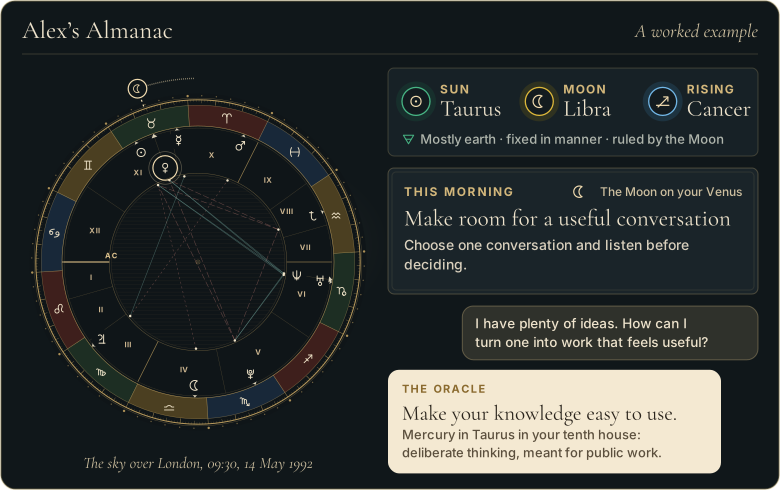
Walk through Alex’s whole example first
 The Road of AgesSee the turning points of your whole life, from your birth date
See your road's shape
The Road of AgesSee the turning points of your whole life, from your birth date
See your road's shape
 The Road of AgesThe turning points of your whole life, from your own chart
Walk my road
The Road of AgesThe turning points of your whole life, from your own chart
Walk my road
Free, by email
One short letter at 7 each morning: the day’s theme read for your own chart, and one thing to do with it.
From the reference page to your own chart
$0 today, then $12/month after 7 days. Cancel anytime.
They may use different time standards, reference frames, observer origins, zodiac definitions, corrections, or numerical precision. Compare metadata first.
No. It is apparent backward motion in a coordinate as seen from the chosen observing frame.
Not reliably. The endpoint is a verified current snapshot, not an orbital propagator or future ephemeris service.
Free, by email
One short letter at 7 each morning: the day’s theme read for your own chart, and one thing to do with it.

Read more
Keep moving through the archive: signs, compatibility, chart timing, faith-aware discernment, and practical daily guidance.