
Equinox
The Sun crosses the celestial equator; neither hemisphere is tilted most strongly toward the Sun.
Learn what equinoxes and solstices measure, why their calendar dates shift, and why daylight and season do not behave identically everywhere.
$0 today, then $12/month after 7 days. Cancel anytime.
Equinoxes and solstices are global astronomical instants defined by the Sun’s apparent position relative to Earth’s equator and axial tilt. They occur at one UTC moment, but their civil-calendar date can differ by time zone.
The Sun crosses the celestial equator; neither hemisphere is tilted most strongly toward the Sun.
The Sun reaches its greatest north or south declination for the year.
The local date can differ across time zones, and equal daylight is only approximate because of refraction and the Sun’s apparent diameter.
Earth’s rotation axis is tilted relative to its orbital plane. As Earth travels around the Sun, that fixed orientation changes which hemisphere receives more direct sunlight and longer days. Seasonal temperature is not caused by Earth simply being closer to or farther from the Sun; the hemispheres experience opposite seasons at the same time.
At an equinox the center of the Sun crosses the celestial equator. Day and night are near equal in length, but not perfectly equal at every location. Atmospheric refraction makes the Sun appear above the horizon when it is geometrically just below, and sunrise and sunset are usually defined using the upper limb of the solar disk rather than its center.
At a solstice the Sun reaches its northernmost or southernmost declination. This produces the longest or shortest daylight interval of the year for many non-equatorial locations. The earliest sunset or latest sunrise does not necessarily occur on the solstice because clock time, orbital speed, and the equation of time shift the daily schedule.
Leap-year rules and the fact that a tropical year is not an exact number of civil days make event dates shift. The astronomical instant is global, while local dates differ by time zone. Latitude changes the daylight effect dramatically: equatorial regions vary little, mid-latitudes vary clearly, and polar regions can experience continuous daylight or darkness.
Use an authoritative table for the exact UTC instant and a location-aware solar service for sunrise, sunset, and twilight. A cultural or symbolic interpretation of a seasonal turning may enrich a journal or ritual, but it should be identified as tradition. This page does not infer agricultural timing, frost risk, or local weather from the astronomical boundary.

Choose love, work or purpose. Your reading is written from your chart. Your reading uses your own birth details.
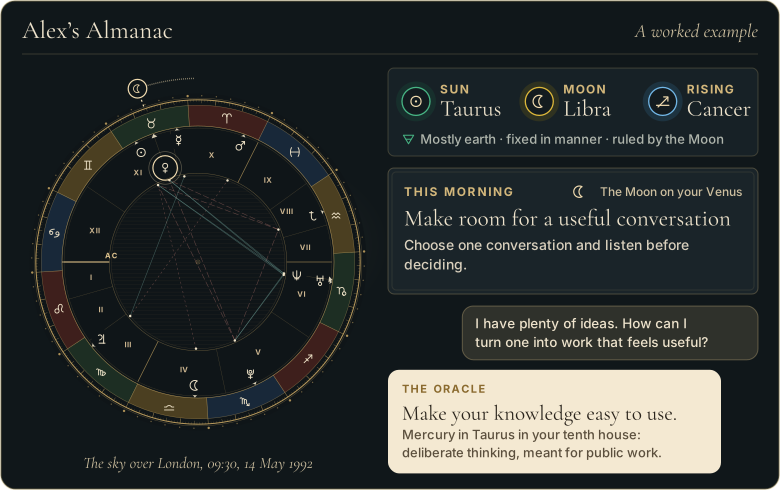
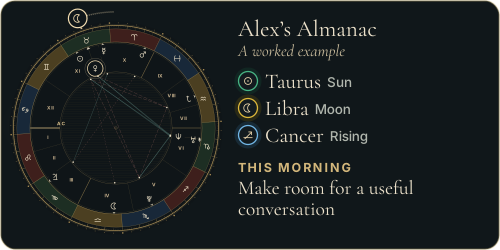
Walk through Alex’s whole example first
 The Road of AgesSee the turning points of your whole life, from your birth date
See your road's shape
The Road of AgesSee the turning points of your whole life, from your birth date
See your road's shape
 The Road of AgesThe turning points of your whole life, from your own chart
Walk my road
The Road of AgesThe turning points of your whole life, from your own chart
Walk my road
Free, by email
One short letter at 7 each morning: the day’s theme read for your own chart, and one thing to do with it.
From the reference page to your own chart
$0 today, then $12/month after 7 days. Cancel anytime.
Not usually. Refraction, the Sun’s apparent diameter, latitude, and the definitions of sunrise and sunset make the observed intervals differ.
The event is one instant, often listed in UTC. Converting that instant into different time zones can place it on different civil dates.
No. The earliest sunset and latest sunrise can fall on nearby dates because apparent solar time and civil clock time do not shift uniformly.
Free, by email
One short letter at 7 each morning: the day’s theme read for your own chart, and one thing to do with it.

Read more
Keep moving through the archive: signs, compatibility, chart timing, faith-aware discernment, and practical daily guidance.