
Official regions
The IAU recognizes 88 constellations that tile the whole sky without gaps.
Learn the difference between official constellation boundaries and familiar star patterns, plus safe, location-aware ways to begin sky navigation.
$0 today, then $12/month after 7 days. Cancel anytime.
Modern astronomy divides the entire celestial sphere into 88 official constellations with defined boundaries. The familiar line drawings are cultural star patterns or asterisms; the stars in one pattern usually are not physically close to one another.
The IAU recognizes 88 constellations that tile the whole sky without gaps.
A recognizable star pattern that may be part of one constellation or cross several, such as the Summer Triangle.
Which constellations are up depends on latitude, date, time, horizon, darkness, and weather.
For most of history, constellations were memorable patterns tied to stories, navigation, calendars, and local traditions. Modern astronomers also need unambiguous addresses. The IAU boundaries turn each constellation into a defined region, so saying an object is “in” Orion means its coordinates fall within that region, not that the object forms part of the hunter-shaped line drawing.
Stars projected near one another on the sky can lie at very different distances from Earth and move independently through the galaxy. A constellation drawing is a two-dimensional perspective from our location and era. Over very long periods, proper motion changes the pattern. The visual relationship remains useful for finding objects even though it is not a physical cluster.
Earth’s rotation carries sky regions across the local horizon each night, while Earth’s orbit changes which part of the night sky faces away from the Sun through the year. Latitude determines which declinations can rise and which stars may be circumpolar. A page without your location and observing time cannot honestly say that a named constellation is visible tonight.
Start with one unmistakable pattern appropriate to your hemisphere and season, then “star-hop” to neighboring bright stars. Use a dim red light, allow time for dark adaptation, and compare the chart orientation with the real horizon. A planisphere or location-aware sky chart is more useful than memorizing a universal list of “tonight’s constellations.”
Constellation stories belong to many cultures, not one universal mythology. Name the tradition and source rather than flattening living knowledge into generic symbolism. Also distinguish astronomical constellations from the twelve equal 30-degree tropical zodiac signs: official constellation boundaries are unequal regions and do not map one-to-one onto astrological sectors.

Choose love, work or purpose. Your reading is written from your chart. Your reading uses your own birth details.
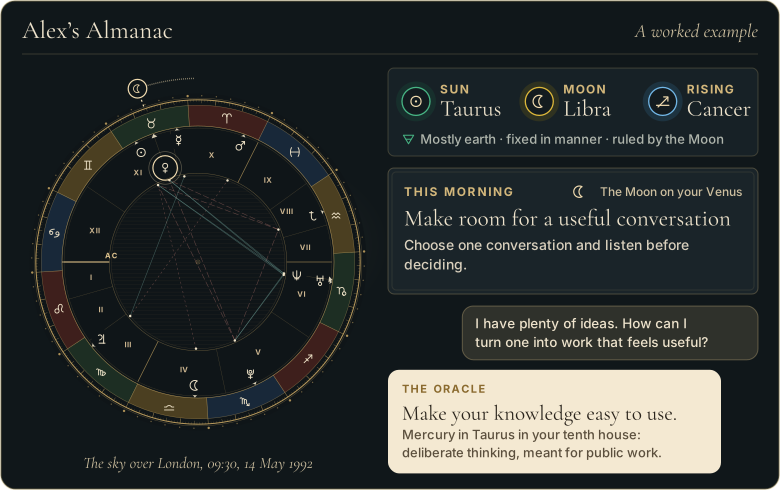
Walk through Alex’s whole example first
 The Road of AgesSee the turning points of your whole life, from your birth date
See your road's shape
The Road of AgesSee the turning points of your whole life, from your birth date
See your road's shape
 The Road of AgesThe turning points of your whole life, from your own chart
Walk my road
The Road of AgesThe turning points of your whole life, from your own chart
Walk my road
Free, by email
One short letter at 7 each morning: the day’s theme read for your own chart, and one thing to do with it.
From the reference page to your own chart
$0 today, then $12/month after 7 days. Cancel anytime.
Modern astronomy recognizes 88 constellations. Twelve names are commonly associated with the zodiac, but zodiac signs and official constellation regions are different systems.
Usually not. They appear near one another in our line of sight but can be separated by very large three-dimensional distances.
That requires your latitude, date, local time, horizon, darkness, and weather. Use a location-aware sky chart rather than a universal claim.
Free, by email
One short letter at 7 each morning: the day’s theme read for your own chart, and one thing to do with it.

Read more
Keep moving through the archive: signs, compatibility, chart timing, faith-aware discernment, and practical daily guidance.

