Update rhythm
The gateway validates a 14-body snapshot and refreshes on the UTC hour.
The live map below shows the current geocentric ecliptic longitudes used by Active Transits. It does not claim that a body is above your horizon or visible from your location.
The gateway validates a 14-body snapshot and refreshes on the UTC hour.
Geocentric ecliptic longitude, translated into a tropical zodiac sign and degree.
Local altitude, azimuth, cloud cover, rise/set time, brightness, and future visibility.
Verified current positions · refreshes hourly
Current geocentric longitudes. No local rise, set, altitude, direction, weather, or future visibility is inferred.
Angular comparisons use ecliptic longitude. They do not establish apparent separation, altitude, brightness, darkness, or local visibility.
Opening the Active Transits sky map…
A planetary longitude is a position around the 360-degree ecliptic as seen from Earth. Zero degrees begins at the tropical Aries point, and each succeeding 30-degree sector receives a zodiac sign name. This is a useful common coordinate for an ephemeris and for astrology, but it is not a local sky map. A planet can have a perfectly valid longitude while being below your horizon, washed out by daylight, or hidden by weather.
Select a body on the Sky Map to see its current detail. The tracks visualize longitude rather than physical distance or orbital scale. Aspect lines summarize angular relationships in longitude. They do not depict the planets as close together in three-dimensional space, and an apparent conjunction in longitude is not automatically a naked-eye observing event.
Every live claim should travel with its timestamp. The gateway caches a validated snapshot for the current UTC hour, labels a last-known snapshot as stale when necessary, and refuses to invent missing bodies. The page also keeps a short local cache so the mechanism can show the last verified wheel during a brief network interruption. Check the status line before treating any degree as current.
To decide what you can see, add a place, an observing time, and local conditions. Altitude and azimuth depend on latitude, longitude, and time; atmospheric transparency and horizon obstructions matter too. Use a location-aware astronomical service for rise, set, and twilight, then use a weather source for cloud and visibility. This page intentionally does not guess those values.
The position readout is an astronomical observation layer. Astrological language is a separate symbolic layer that assigns themes to signs, aspects, and cycles. You may use the wheel as a reflective prompt, but the coordinates do not demonstrate a personality effect or predict an event. Keeping the layers named makes both the measurement and the reflection easier to evaluate.

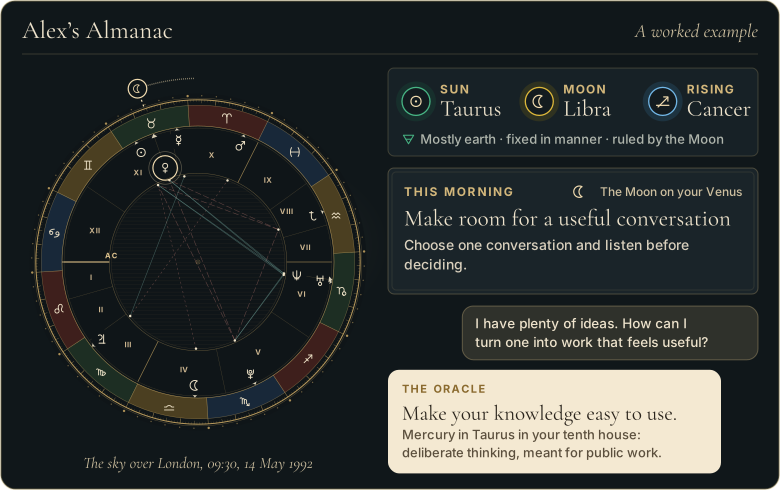
Choose love, work or purpose. Your reading is written from your chart. Your reading uses your own birth details.
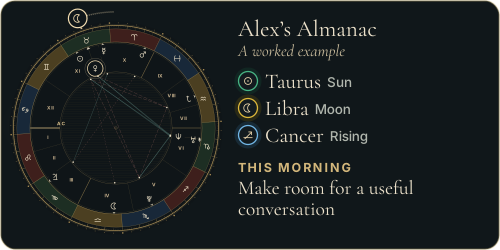
Walk through Alex’s whole example first
 The Road of AgesSee the turning points of your whole life, from your birth date
See your road's shape
The Road of AgesSee the turning points of your whole life, from your birth date
See your road's shape
 The Road of AgesThe turning points of your whole life, from your own chart
Walk my road
The Road of AgesThe turning points of your whole life, from your own chart
Walk my road
Free, by email
One short letter at 7 each morning: the day’s theme read for your own chart, and one thing to do with it.
From the reference page to your own chart
$0 today, then $12/month after 7 days. Cancel anytime.
The Almanac gateway refreshes its validated sky snapshot on the UTC hour. The page checks again at the next hour while it remains open.
No. It is a geocentric longitude wheel. Local horizon position, rise and set, darkness, and weather require your coordinates and an observing time.
No. They are an information design for longitude and angular relationships, not a physical model of orbital size or planet distance.
Free, by email
One short letter at 7 each morning: the day’s theme read for your own chart, and one thing to do with it.

Read more
Keep moving through the archive: signs, compatibility, chart timing, faith-aware discernment, and practical daily guidance.