12 Zodiac SignsDates, Elements, Modalities, and Rulers
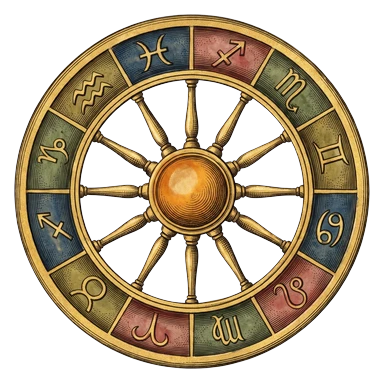
The astrological zodiac divides a 360-degree circle into twelve equal signs of 30 degrees each. In Western tropical astrology, Aries begins at the March equinox; in sidereal systems, a stellar reference is used instead. Signs are mathematical sectors and should not be confused with the unequal astronomical constellations that share their names.
Direct answer
Short version
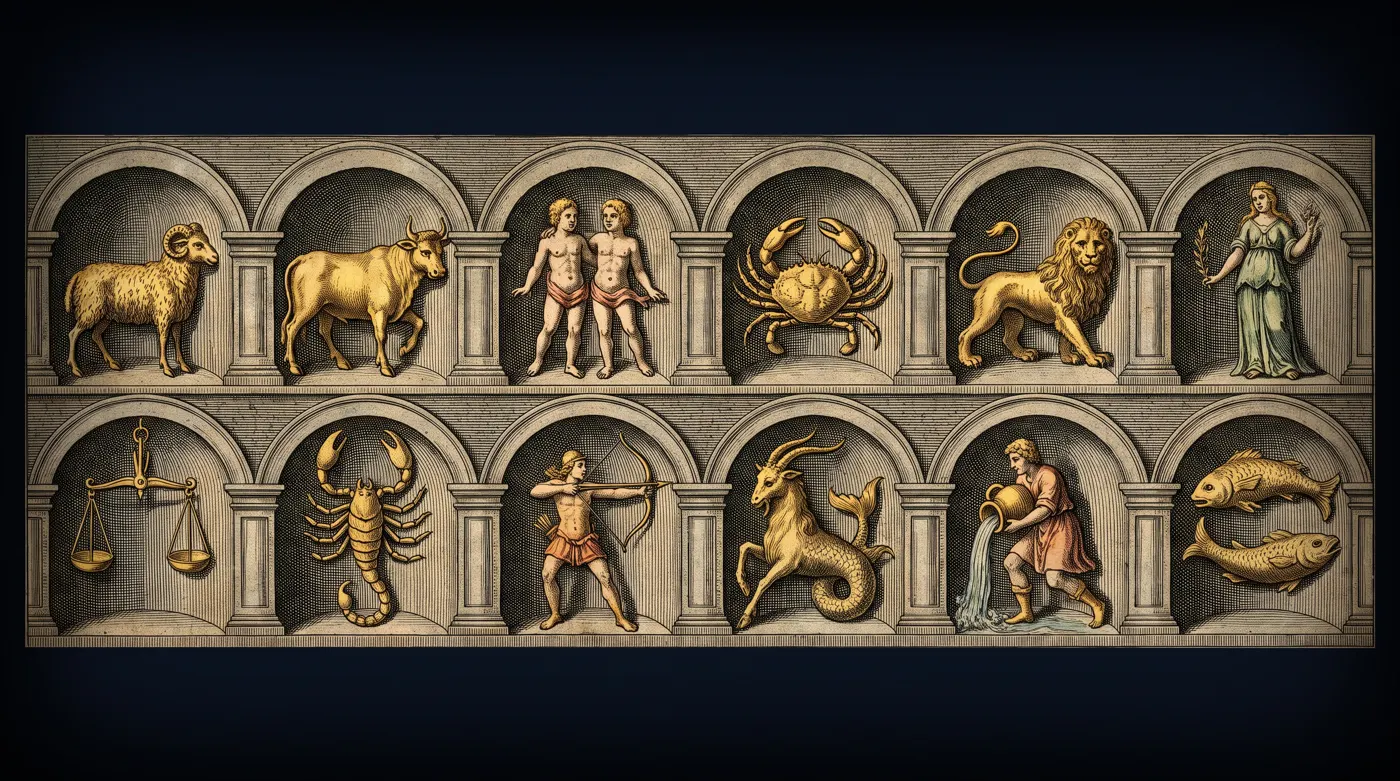
The twelve signs are Aries, Taurus, Gemini, Cancer, Leo, Virgo, Libra, Scorpio, Sagittarius, Capricorn, Aquarius, and Pisces. Each sign combines one of four elements with one of three modalities, producing twelve element-modality combinations. The familiar calendar dates are approximate Sun-sign dates in the tropical zodiac, not permanent astronomical constellation dates. An exact Sun sign near a boundary requires the exact birth date and time converted correctly to a universal instant; birthplace is useful for resolving the historical time zone and is essential for the Ascendant and houses.
The Instruments
Ten readings, worked out from your own birth chart
An instrument is a reading this house works out for you. Give your birth date, time and place once, and each one reads today’s real sky against the chart you were born under. Eight are personal; two are calendars anyone can open. A free account opens one instrument a day. The plans open every instrument, every day.
- Natal Chart Every planet, house and aspect in your chart
- Active Transits Where the planets are now, read against your chart
- Daily Counsel What to pursue today, and what to leave alone
- Personal Timing Your best days to decide, weeks ahead
- Fellowship Your chart and another, read side by side
- Theme of the Day The one thing today is asking of you
- Sacred Numbers Your life path, your cycles, your name in numbers
- Aeolian Harmonics Classical music chosen to match your chart
- Mercury Retrograde Every Mercury retrograde this year, with its dates Open to all
- Void-of-Course Moon When the Moon is between signs, hour by hour Open to all

Quick facts
| Sign | Tropical longitude | Approximate dates | Element / modality | Ruler |
|---|---|---|---|---|
| Aries | 0°–30° | Mar 21–Apr 19 | Fire / Cardinal | Mars |
| Taurus | 30°–60° | Apr 20–May 20 | Earth / Fixed | Venus |
| Gemini | 60°–90° | May 21–Jun 20 | Air / Mutable | Mercury |
| Cancer | 90°–120° | Jun 21–Jul 22 | Water / Cardinal | Moon |
| Leo | 120°–150° | Jul 23–Aug 22 | Fire / Fixed | Sun |
| Virgo | 150°–180° | Aug 23–Sep 22 | Earth / Mutable | Mercury |
| Libra | 180°–210° | Sep 23–Oct 22 | Air / Cardinal | Venus |
| Scorpio | 210°–240° | Oct 23–Nov 21 | Water / Fixed | Mars traditionally; Pluto in modern astrology |
| Sagittarius | 240°–270° | Nov 22–Dec 21 | Fire / Mutable | Jupiter |
| Capricorn | 270°–300° | Dec 22–Jan 19 | Earth / Cardinal | Saturn |
| Aquarius | 300°–330° | Jan 20–Feb 18 | Air / Fixed | Saturn traditionally; Uranus in modern astrology |
| Pisces | 330°–360° | Feb 19–Mar 20 | Water / Mutable | Jupiter traditionally; Neptune in modern astrology |
What the zodiac actually is
Zodiac can refer to a belt around the ecliptic, the apparent annual path of the Sun against the background sky. Astrology measures positions around that circle as celestial longitude. Twelve signs of exactly 30 degrees create a convenient symbolic coordinate system: 12 multiplied by 30 degrees equals the full 360-degree circle.
The sign names came from constellations encountered along the ecliptic, but a sign is not the same object as a constellation. A tropical Leo placement means a longitude between 120 and 150 degrees from the tropical Aries point. It does not mean that the planet must currently sit inside the modern International Astronomical Union boundary of the constellation Leo.
Astrological meanings are traditional interpretations rather than findings established by astronomy. The coordinates can be calculated precisely; the personality or forecasting meanings assigned to them belong to astrology’s symbolic system.
Tropical zodiac, sidereal zodiac, and constellations
Earth’s rotational axis slowly precesses, so the equinox point shifts relative to the background stars over long periods. Tropical astrology keeps its zodiac anchored to the equinoxes, while sidereal astrologies apply an offset to maintain a stellar reference. That is why the same birth moment can receive different sign labels in tropical and sidereal charts without either calculation having “forgotten” precession.
| System | Reference point | What the twelve names identify |
|---|---|---|
| Tropical zodiac | 0° Aries remains tied to the March equinox. | Twelve equal seasonal sectors of 30 degrees. |
| Sidereal zodiac | A chosen stellar reference and ayanamsha account for precession. | Twelve equal 30-degree sectors aligned more closely with a stellar framework. |
| Astronomical constellations | Boundaries standardized by the IAU for mapping the sky. | Unequal areas of the celestial sphere; they are not twelve equal signs. |
The four elements
Fire: Aries, Leo, Sagittarius
Astrological tradition associates fire with activation, confidence, appetite, inspiration, visibility, and risk. Its excess is often described as haste, domination, or burnout.
Earth: Taurus, Virgo, Capricorn
Earth symbolizes material reality, embodiment, maintenance, craft, resources, and reliability. Its excess can appear as rigidity, overcontrol, or resistance to change.
Air: Gemini, Libra, Aquarius
Air symbolizes thought, language, comparison, networks, and social exchange. Its excess can become detachment, abstraction, or talk without embodiment.
Water: Cancer, Scorpio, Pisces
Water symbolizes feeling, memory, attachment, intuition, and permeability. Its excess can become flooding, secrecy, avoidance, or weak boundaries.
An element describes a traditional symbolic category, not a literal substance inside a person or a scientifically validated personality type.
The three modalities
Modality describes how a sign is said to move energy. Cardinal signs begin each season and are associated with initiation: Aries, Cancer, Libra, and Capricorn. Fixed signs occupy the middle of each season and are associated with stabilization: Taurus, Leo, Scorpio, and Aquarius. Mutable signs close each season and are associated with adaptation: Gemini, Virgo, Sagittarius, and Pisces.
Every element appears once in each modality. Fire, for example, appears as cardinal Aries, fixed Leo, and mutable Sagittarius. This is why signs of the same element are not interchangeable: they share a symbolic substance but organize it through different rhythms.
Polarity and planetary rulers
The signs also alternate between two polarities, often called positive and negative, active and receptive, or yang and yin. Fire and air are grouped on the active side; earth and water on the receptive side. These technical labels do not mean good and bad, male and female destiny, or superior and inferior.
Rulership links each sign to a planet in astrological tradition. The classical system uses the seven visible planets, including the Sun and Moon as luminaries. Modern astrology added Uranus, Neptune, and Pluto as rulers or co-rulers of Aquarius, Pisces, and Scorpio. A transparent reference should show both systems rather than presenting the modern assignment as the only historical one.
A sign changes meaning with the placement
A person is never “only” one sign in a natal chart. Every planet occupies a sign, and its expression is further qualified by house position and aspects. A Sun-sign description is therefore an introduction to one placement, not a complete character assessment.
| Placement | Question astrologers associate with it |
|---|---|
| Sun sign | How identity, vitality, purpose, and conscious self-expression take form. |
| Moon sign | How needs, habits, memory, safety, and immediate emotional responses take form. |
| Rising sign | How the chart meets the world; it also sets the house structure and identifies the chart ruler. |
| Mercury sign | How information is noticed, organized, expressed, and exchanged. |
| Venus sign | How attraction, pleasure, aesthetics, reciprocity, and values are expressed. |
| Mars sign | How desire, assertion, effort, anger, and pursuit are expressed. |
Zodiac dates, cusps, and exact birth moments
Published date ranges are convenient approximations. The Sun changes signs at a specific astronomical moment, and that moment can fall on different local dates depending on the year and time zone. Someone born near a listed boundary should calculate the Sun’s longitude for the recorded birth time rather than choosing a sign from a generic date list.
In standard chart calculation, the Sun is in one sign or the next; it is not mathematically half in both. A person may nevertheless recognize both sign themes because Mercury, Venus, the Moon, the Ascendant, or other chart factors occupy the neighboring sign. “Born on the cusp” is useful colloquial language, but it should not replace the actual degree.
Why Ophiuchus does not create a thirteenth astrological sign
The Sun’s apparent path crosses the astronomical boundary of Ophiuchus as well as the familiar zodiac constellations. That fact concerns modern constellation boundaries. A twelve-sign astrology does not claim that its signs are twelve unequal constellations; it defines twelve equal 30-degree sectors. Adding Ophiuchus would create a different system rather than correct an arithmetic omission inside the existing one.
This distinction does not establish astrological personality claims as science. It simply explains why an astronomy fact about thirteen ecliptic constellations and an astrology fact about twelve equal signs address different classifications.
Sources and editorial method
Research and editorial references used for this page include:
- NASA Space Place: What Are Constellations? - Explains constellations and distinguishes astronomy from astrology.
- NASA/JPL Night Sky Network: Exploring the Solar System Toolkit - Explains 30-degree astrological signs, unequal constellation boundaries, precession, and Ophiuchus.
- International Astronomical Union: The Constellations - Defines astronomical constellations as bounded areas of the sky.
- Astrodienst: The Four Elements and the Signs - Reference for the traditional element and modality groupings within Western astrology.
- Astrodienst Astrowiki: Ruler - Reference for classical and modern planetary rulerships.
These references support the factual, historical, textual, or interpretive claims on this page. Interpretive traditions are identified as such, and factual claims are kept separate from symbolic claims.
Related reading
Common questions
What are the twelve zodiac signs in order?
Aries, Taurus, Gemini, Cancer, Leo, Virgo, Libra, Scorpio, Sagittarius, Capricorn, Aquarius, and Pisces.
Are zodiac signs and constellations the same?
No. Astrological signs are equal 30-degree sectors. Astronomical constellations are unequal bounded regions of the sky standardized by the IAU.
Why is my sidereal sign different from my tropical sign?
The systems use different reference points. Tropical astrology anchors Aries to the March equinox; sidereal systems apply a stellar offset to account for precession.
Can I have two Sun signs because I was born on a cusp?
A calculated Sun has one longitude and therefore one sign. Near a boundary, use the exact birth date and time with the correct time-zone conversion rather than an approximate calendar range. Birthplace helps establish the historical time zone and is required for the Ascendant and houses.
Is Ophiuchus a zodiac constellation?
Yes, the ecliptic passes through the astronomical constellation Ophiuchus. It is not one of the twelve equal signs in the conventional tropical or sidereal zodiac.
Is astrology scientifically proven?
No. Astronomical positions are measurable, but astrology’s claims that those positions describe personality or predict events are not supported as scientific findings.
Browse all 12 zodiac sign guides
Open any sign for its element, modality, rulers, chart placements, strengths, challenges, and common interpretive mistakes.
Element and modality guides
Elements describe a sign’s symbolic substance; modalities describe its rhythm. These guides show how the twelve signs fit into a coherent system.