The 36 Zodiac DecansDates for 2026 and the Ruler of Each Face
Every sign holds three decans of ten degrees each. This page lists all 36 with the dates the Sun spends in them and sets the two common ruler systems side by side, so you can see where they agree and where they part.
Direct answer
Short version
A decan is one third of a zodiac sign, ten degrees of the ecliptic. The Sun spends between 9.8 and 10.5 days in one, so the dates shift a little each year. In 2026 the first decan of Aries runs from 21 March to 30 March, and the last decan of Pisces ends on 20 March 2027. The Chaldean and triplicity ruler systems name the same planet for only nine of the 36 decans, so a reading has to say which one it uses.
What does your own chart say about you?
Choose love, work or purpose for a personal insight and a useful next step. Your reading uses your own birth details.
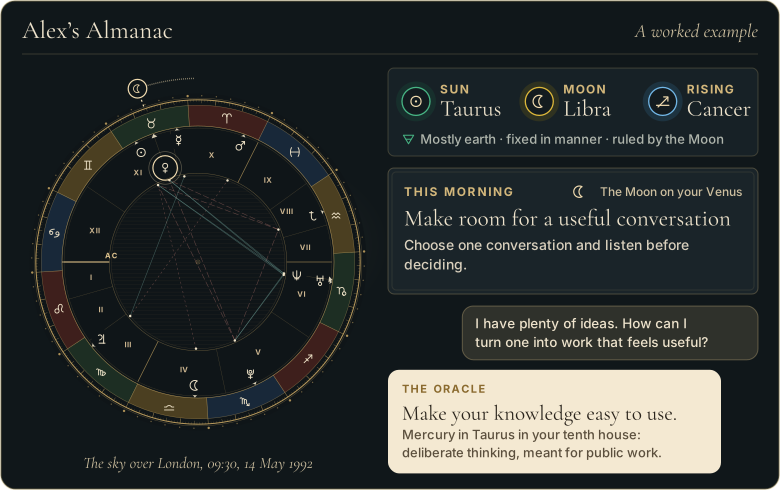
Walk through Alex’s whole example first
 The Road of AgesSee the turning points of your whole life, from your birth date
Free first look
The Road of AgesSee the turning points of your whole life, from your birth date
Free first look
Prefer to explore first?
 The Road of AgesThe turning points of your whole life, from your own chart
Walk my road
The Road of AgesThe turning points of your whole life, from your own chart
Walk my road
Visual guide
The 36 Zodiac Decans: Dates for 2026 and the Ruler of Each Face
How to read the table
The table gives, for each of the 36 decans, the dates on which the Sun is in it in 2026 and the planet that rules it in each of the two systems explained below. A date counts as belonging to the decan the Sun occupies at 12:00 UTC on that day, and the exact minute of every sign change is in the zodiac sign dates guide. In another year a boundary can move by a day, so the date column describes the Sun only. Any other planet, and the Ascendant, is placed by its own zodiac degree and not by a date.
All 36 decans, with the Sun’s dates in 2026 and both rulers
Each row is one ten-degree face of the zodiac: its sign and number with the degrees it covers, the dates the Sun is in it, and its ruler in each of the two systems explained below.
| Decan | Sun in it, 2026-27 | Chaldean ruler | Triplicity ruler |
|---|---|---|---|
| Aries, 1st decan (0° to 10°) | 21 Mar to 30 Mar | Mars | Aries (Mars) |
| Aries, 2nd decan (10° to 20°) | 31 Mar to 9 Apr | Sun | Leo (Sun) |
| Aries, 3rd decan (20° to 30°) | 10 Apr to 19 Apr | Venus | Sagittarius (Jupiter) |
| Taurus, 1st decan (0° to 10°) | 20 Apr to 29 Apr | Mercury | Taurus (Venus) |
| Taurus, 2nd decan (10° to 20°) | 30 Apr to 10 May | Moon | Virgo (Mercury) |
| Taurus, 3rd decan (20° to 30°) | 11 May to 20 May | Saturn | Capricorn (Saturn) |
| Gemini, 1st decan (0° to 10°) | 21 May to 30 May | Jupiter | Gemini (Mercury) |
| Gemini, 2nd decan (10° to 20°) | 31 May to 10 Jun | Mars | Libra (Venus) |
| Gemini, 3rd decan (20° to 30°) | 11 Jun to 20 Jun | Sun | Aquarius (Saturn) |
| Cancer, 1st decan (0° to 10°) | 21 Jun to 1 Jul | Venus | Cancer (Moon) |
| Cancer, 2nd decan (10° to 20°) | 2 Jul to 11 Jul | Mercury | Scorpio (Mars) |
| Cancer, 3rd decan (20° to 30°) | 12 Jul to 22 Jul | Moon | Pisces (Jupiter) |
| Leo, 1st decan (0° to 10°) | 23 Jul to 1 Aug | Saturn | Leo (Sun) |
| Leo, 2nd decan (10° to 20°) | 2 Aug to 12 Aug | Jupiter | Sagittarius (Jupiter) |
| Leo, 3rd decan (20° to 30°) | 13 Aug to 22 Aug | Mars | Aries (Mars) |
| Virgo, 1st decan (0° to 10°) | 23 Aug to 1 Sep | Sun | Virgo (Mercury) |
| Virgo, 2nd decan (10° to 20°) | 2 Sep to 12 Sep | Venus | Capricorn (Saturn) |
| Virgo, 3rd decan (20° to 30°) | 13 Sep to 22 Sep | Mercury | Taurus (Venus) |
| Libra, 1st decan (0° to 10°) | 23 Sep to 2 Oct | Moon | Libra (Venus) |
| Libra, 2nd decan (10° to 20°) | 3 Oct to 12 Oct | Saturn | Aquarius (Saturn) |
| Libra, 3rd decan (20° to 30°) | 13 Oct to 22 Oct | Jupiter | Gemini (Mercury) |
| Scorpio, 1st decan (0° to 10°) | 23 Oct to 1 Nov | Mars | Scorpio (Mars) |
| Scorpio, 2nd decan (10° to 20°) | 2 Nov to 11 Nov | Sun | Pisces (Jupiter) |
| Scorpio, 3rd decan (20° to 30°) | 12 Nov to 21 Nov | Venus | Cancer (Moon) |
| Sagittarius, 1st decan (0° to 10°) | 22 Nov to 1 Dec | Mercury | Sagittarius (Jupiter) |
| Sagittarius, 2nd decan (10° to 20°) | 2 Dec to 11 Dec | Moon | Aries (Mars) |
| Sagittarius, 3rd decan (20° to 30°) | 12 Dec to 21 Dec | Saturn | Leo (Sun) |
| Capricorn, 1st decan (0° to 10°) | 22 Dec to 31 Dec | Jupiter | Capricorn (Saturn) |
| Capricorn, 2nd decan (10° to 20°) | 1 Jan to 9 Jan | Mars | Taurus (Venus) |
| Capricorn, 3rd decan (20° to 30°) | 10 Jan to 19 Jan | Sun | Virgo (Mercury) |
| Aquarius, 1st decan (0° to 10°) | 20 Jan to 29 Jan | Venus | Aquarius (Saturn) |
| Aquarius, 2nd decan (10° to 20°) | 30 Jan to 8 Feb | Mercury | Gemini (Mercury) |
| Aquarius, 3rd decan (20° to 30°) | 9 Feb to 18 Feb | Moon | Libra (Venus) |
| Pisces, 1st decan (0° to 10°) | 19 Feb to 28 Feb | Saturn | Pisces (Jupiter) |
| Pisces, 2nd decan (10° to 20°) | 1 Mar to 10 Mar | Jupiter | Cancer (Moon) |
| Pisces, 3rd decan (20° to 30°) | 11 Mar to 20 Mar | Mars | Scorpio (Mars) |
Dates are for the zodiac year that opens at the March 2026 equinox. A day belongs to the decan the Sun is in at 12:00 UTC on that day, and a boundary can move by a day in another year.
The Chaldean ruler system
This system names the planets in the Chaldean order, from the slowest to the fastest as seen from Earth: Saturn, Jupiter, Mars, the Sun, Venus, Mercury and the Moon. The first decan of Aries goes to Mars, and the planets then follow in that order, one to each decan, round and round the whole zodiac. Thirty-six is not a multiple of seven, so the sequence does not close neatly. It runs through five full cycles with one decan over, which means Mars rules both the last decan of Pisces and the first decan of Aries. The Chaldean column of the table was built from that rule and not typed in.
The triplicity ruler system
Here each sign’s three decans are given to the three signs of its own element, starting with the sign itself. Aries, a fire sign, has the decans of Aries, Leo and Sagittarius, ruled in turn by Mars, the Sun and Jupiter. The water signs run through Cancer, Scorpio and Pisces, the earth signs through Taurus, Virgo and Capricorn and the air signs through Gemini, Libra and Aquarius. The table uses the traditional seven planets as sign rulers so that the two systems compare like with like. Many modern lists give Pluto, Uranus and Neptune to Scorpio, Aquarius and Pisces, and where they do, those decans carry a modern name beside the traditional one.
Where the two systems agree
The two systems name the same planet for nine of the 36 decans: the first and second decans of Aries, the third decan of Taurus, the second and third decans of Leo, the second decan of Libra, the first decan of Scorpio, the second decan of Aquarius and the third decan of Pisces. For the other 27 they differ. The first decan of Leo is Saturn’s in the Chaldean system and the Sun’s by triplicity. Neither is the single correct answer. They are separate traditions, and a reading should name the table it uses and keep to it, as the decan definition page also advises.
Why the dates are only a guide
A decan is ten degrees of longitude, not ten days. The Sun moves fastest in winter and slowest in summer, so in 2026 it spends 9.81 days in the second decan of Capricorn and 10.49 days in the second decan of Cancer. A leap day and the time zone move each boundary by up to a day between years. A birth close to a boundary cannot be sorted by date alone. It needs the Sun’s degree at the birth moment, which the birth chart gives.
Where the decans came from
The earliest decans were not zodiac divisions at all. They were groups of stars in Egypt whose risings marked stretches of the night, and they appear on coffin lids and astronomical ceilings. The word decan comes from the Greek for ten. When astrology developed in Egypt and the wider Mediterranean, a scheme of thirty-six ten-degree faces was joined to the twelve signs and to planetary rulership. The personality descriptions of a first, second and third decan that circulate today are later still, and they should not be read back into the Egyptian material.
Reading a decan without over-reading it
A decan can add a shade of tone to a placement, and some astrologers use the face ruler as a minor dignity. It cannot establish character from a birthday alone. If a planet sits within a fraction of a degree of 10 or 20 degrees, use its unrounded longitude before choosing a decan, because 10°00′ begins the second decan and does not end the first. Astrology is a symbolic tradition and not a validated way to predict personality or events, so treat a decan as one more question to ask of a chart.
Concrete examples
| Example | What it means in practice |
|---|---|
| The Sun at 14 degrees of Leo | That is the second decan of Leo. Its Chaldean ruler is Jupiter, and by triplicity it is read through Sagittarius, ruled by Jupiter. Here the two systems agree. |
| A planet at 9°59′ Aries and at 10°00′ | The first decan of Aries ends and the second begins at exactly 10°00′. A planet at 9°59′ is still in the first decan, ruled by Mars in both systems. At 10°00′ it is in the second, ruled by the Sun in both. Near a boundary, use the unrounded degree. |
| A birth on 15 August 2026 | The Sun is in the third decan of Leo from 13 August to 22 August in 2026. Both systems give it to Mars. In another year the boundary can fall a day either side, so a birth within a day of it needs the exact chart. |
Related Almanac guides
More from the journal
Sources and editorial method
Research and editorial references used for this page include:
- Encyclopaedia Britannica: Decan - Historical overview of Egyptian decans and their astronomical role.
- The Metropolitan Museum of Art: Egyptian Astronomical Texts - Museum context for ancient Egyptian astronomical and calendrical traditions.
- Astrodienst Astrowiki: Ruler - Classical and modern planetary rulerships of the signs.
- Swiss Ephemeris programmer documentation - The positions behind the date column.
- The Almanac’s calculation and interpretation method
The date column comes from the minute the Sun’s apparent longitude reaches each tenth degree, solved on the Swiss Ephemeris and checked against a second ephemeris, then assigned to calendar days by the Sun’s position at 12:00 UTC. The rulers are derived from the two rules stated on this page, the Chaldean order starting with Mars at the first decan of Aries and the same-element sign order with the traditional rulers, and were compared with the standard printed tables. Where sources differ, the differences are named and not resolved. This page does not claim that a decan predicts character.
From the reference page to your own chart
Every word here
is in your own chart.
- Your chart and numbers, read for you in about a minute
- Ask the Oracle anything about them
- Every personal tool and daily guidance
Free reading, no card needed. Optional membership: payment details required, 7 days free, then $12/month. Cancel before it renews and you pay nothing.
Common questions
How do I find my decan?
Take the zodiac degree of the planet or point you are asking about. From 0 to 9°59′ of a sign is the first decan, 10° to 19°59′ the second and 20° to 29°59′ the third. For the Sun alone, the date table gives the decan for most birth dates, and a birth within a day of a boundary needs the exact chart.
Which decan ruler system is correct?
Neither is the single correct one. The Chaldean system runs the planets in a fixed order through the 36 faces, and the triplicity system reads each decan through a sign of the same element. They name the same planet for only nine of the 36 decans, so a reading should state which table it uses and stay with it.
Is a decan ten days long?
Only roughly. A decan is ten degrees, and the Sun covers ten degrees in between 9.8 and 10.5 days depending on the season. In 2026 the shortest is the second decan of Capricorn and the longest the second decan of Cancer.