How to Evaluate an Astrology Reading
A useful reading should help you think more clearly. Separate its calculations, interpretations and suggestions before deciding what to keep.
Direct answer
Short version
Evaluate a reading in three layers: check its birth data and chart settings, identify which statements are symbolic interpretations, and choose one practical suggestion you can assess in ordinary life. Accurate planetary positions do not, by themselves, prove a claim about your personality or future.

What does your own chart say about you?
Choose love, work or purpose for a personal insight and a useful next step. Your reading uses your own birth details.
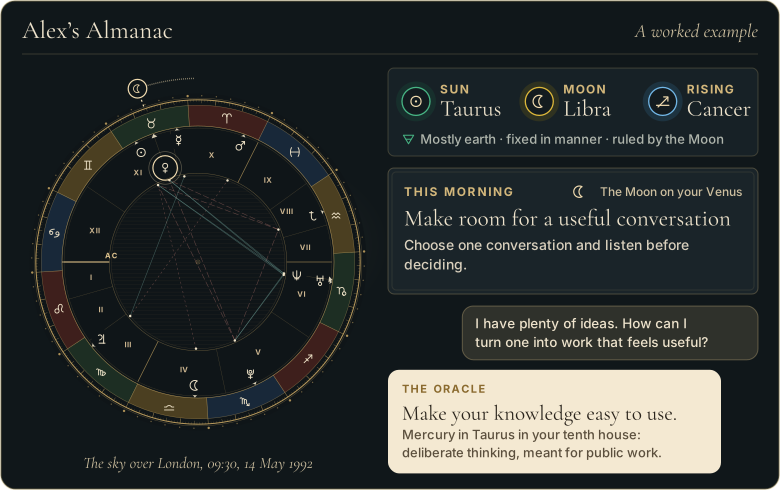
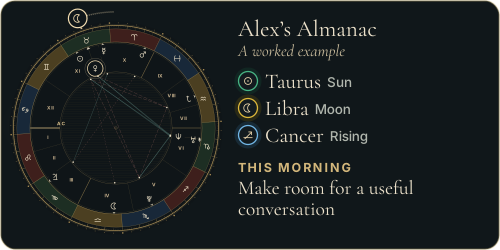
Walk through Alex’s whole example first
 The Road of AgesSee the turning points of your whole life, from your birth date
Free first look
The Road of AgesSee the turning points of your whole life, from your birth date
Free first look
Prefer to explore first?
 The Road of AgesThe turning points of your whole life, from your own chart
Walk my road
The Road of AgesThe turning points of your whole life, from your own chart
Walk my road
Visual guide
How to Evaluate an Astrology Reading
Start with what can be checked
Keep a copy of the birth details used. A wrong city, a twelve-hour clock mistake or an estimated birth time can change the calculation. If the time is unknown, the reading should state which parts remain uncertain rather than assigning a confident rising sign. Ask for the chart settings if you want to compare results with another calculator.
Separate observation from interpretation
A planet at a stated zodiac position is a calculation. A sentence about needing reassurance is an interpretation. A suggestion to ask your partner a direct question is advice. These are different kinds of statement. A good reading makes the connection visible without treating a symbolic association as proof that an event must happen.
Look for useful meaning without false certainty
Specificity can mean naming a pattern, explaining when it appears and offering a question that helps you examine it. It does not require promising a career outcome. Be cautious when a description could apply to almost anyone but is presented as a uniquely verified discovery about you. You can find a prompt useful without accepting every claim around it.
Keep a short record of what helped
Write a claim in your own words, note one example that supports it and one that challenges it, then choose a small action. Review what happened a week later. Did the action improve a conversation or help you organise your thoughts? Record misses as well as matches. This evaluates usefulness; it does not validate astrology as a predictive method.
Concrete examples
| Example | What it means in practice |
|---|---|
| You avoid conflict | Recall a disagreement and a situation where you spoke directly before deciding whether this pattern fits. |
| A fresh start is suggested | Define a reversible step, such as drafting a plan, rather than making a major commitment because of a prediction. |
| An exact rising sign is named | Check whether the birth time was recorded or assumed. |
Related Almanac guides
More from the journal
Sources and editorial method
Research and editorial references used for this page include:
- NASA JPL: Horizons system - An example of astronomical calculation, not validation of astrological interpretation.
The checklist is editorial guidance for evaluating a reading. The reference concerns calculated positions only; practical examples are illustrative.
From the reference page to your own chart
Every word here
is in your own chart.
- Your chart and numbers, read for you in about a minute
- Ask the Oracle anything about them
- Every personal tool and daily guidance
Free reading, no card needed. Optional membership: payment details required, 7 days free, then $12/month. Cancel before it renews and you pay nothing.
Common questions
Does a precise chart make every interpretation accurate?
No. Calculation and symbolic interpretation are separate. Precision in the first does not establish the truth of the second.
What if a reading does not describe me?
You do not need to make it fit. Check the inputs, consider other explanations and set aside interpretations that are not useful.
What should I do after a reading?
Choose one modest action you control and review its result. Keep ordinary evidence and your own judgement central.