The Seven Hermetic Principles
The seven laws of the Kybalion, one by one, and the true story of the book that named them.
The lecture, painted and spoken
Watch The Seven Hermetic Principles
The first three ideas play for anyone. Members watch all twelve, and every idea is written out below.
Your plan plays the whole lecture, all twelve ideas.

The twelve ideas
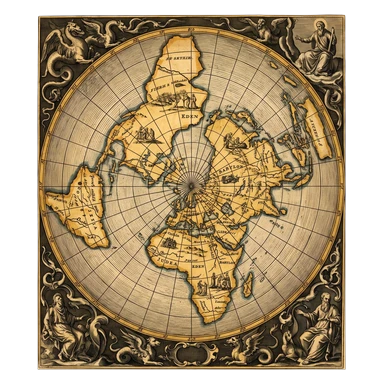
Each idea is one chapter of the film: its headline is the caption on the painting, and its words are what the Oracle says. The tag says what kind of claim it is: a fact from history, what a tradition teaches, what a symbol stands for, or a question for you.
-
Fact
Seven principles, from a book of 1908.
The seven Hermetic principles come from a small book published in Chicago in 1908, The Kybalion, signed only by Three Initiates.
-
Fact
Its likely author: William Walker Atkinson.
Most researchers think its chief author was William Walker Atkinson, a prolific writer of the American New Thought movement, who published under many names.
-
Tradition
Mentalism: the All is Mind.
The first principle is Mentalism: the All is Mind, and the universe is mental. Everything that exists, the book says, is held within an infinite living mind.
-
Tradition
Correspondence: as above, so below.
The second is Correspondence: as above, so below; as below, so above. The same patterns repeat on every plane, so the small can teach you the great.
-
Tradition
Vibration: nothing rests, everything moves.
The third is Vibration: nothing rests, everything moves, everything vibrates. Matter, energy and mind, the book says, differ only in their rates of vibration.
-
Tradition
Polarity: opposites are one thing in degrees.
The fourth is Polarity: everything has its pair of opposites. Hot and cold are one thing in different degrees, the book says, and so are love and hate.
-
Tradition
Rhythm: everything flows out, and in.
The fifth is Rhythm: everything flows out and in, rises and falls. The swing to the right, it says, is the measure of the swing to the left.
-
Tradition
Cause and effect: nothing happens by chance.
The sixth is Cause and Effect: every cause has its effect and every effect its cause. Chance, the book says, is only a name for a law not yet recognised.
-
Tradition
Gender: the two principles in everything.
The seventh is Gender: the masculine and feminine principles are at work in everything, the book says, not only in bodies, as the forces that generate and create.
-
Fact
Not found in the ancient books.
Honesty matters here. These seven principles are not listed in the ancient Hermetica. They are the Kybalion's own summary, shaped by the ideas of its day.
-
Fact
Why the little book still travels.
It still travels because it is short, bold and usable. For many readers today it is the first door into Hermeticism, and some go on through it to the older books.
-
Reflection
Which principle is moving in you?
Rhythm, polarity, cause and effect. Which of the seven is at work in your life right now, and what might it be teaching you?
Sources
- The Kybalion, by Three Initiates (Chicago, 1908)
- Philip Deslippe, introduction to The Kybalion: The Definitive Edition (2011)
- Wouter J. Hanegraaff (ed.), Dictionary of Gnosis and Western Esotericism (2006)
What this lecture does not claim. The seven principles are the Kybalion's own summary, written in 1908. They are not listed in the ancient Hermetic texts, and the book's authorship is attributed, not certain.
The Hermetic Path
From the legend of Hermes to the book that named his seven laws.
In the dictionary
Common questions
Can I watch this lecture for free?
The first three ideas play for anyone. Members watch all twelve, and every idea is written out below. Every plan opens the whole lecture, and every other lecture in the hall, and a plan begins with seven free days.
Who made this lecture?
The Great Almanac wrote it from the sources listed on this page and tagged every idea, so history is never passed off as teaching. The paintings were made with an image model and the voice is the Oracle’s synthesized voice, as how we use AI explains.
Does watching send anything about me anywhere?
No. The only request the film makes is each idea’s spoken line, by its fixed number, and only after you press Play. Nothing about you goes with it.