Hermes the Thrice-Great
Who the Thrice-Great was said to be, and how his books came to rule the Renaissance.
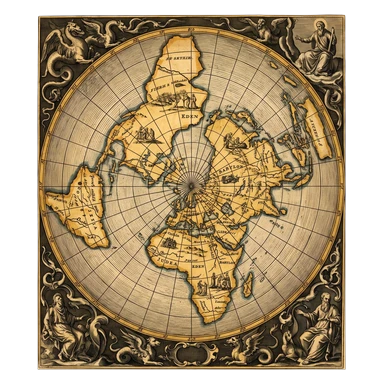
The lecture, painted and spoken
Watch Hermes the Thrice-Great
The first three ideas play for anyone. Members watch all twelve, and every idea is written out below.
Your plan plays the whole lecture, all twelve ideas.

The twelve ideas
Each idea is one chapter of the film: its headline is the caption on the painting, and its words are what the Oracle says. The tag says what kind of claim it is: a fact from history, what a tradition teaches, what a symbol stands for, or a question for you.
-
Fact
Two gods of wisdom became one.
In Egypt, Thoth was the ibis-headed god of writing and reckoning. When Greeks ruled Egypt, they saw their own Hermes in him, and the two became one.
-
Fact
Thrice-great: an old Egyptian honour.
Trismegistus means thrice-great. The name seems to echo the Egyptian custom of praising Thoth as great, great, great, the highest praise their language could give.
-
Fact
His books were written in Greek.
The writings we call the Hermetica were composed in Greek, in Roman Egypt, in the first centuries after Christ. In them Hermes teaches his son Tat and his pupil Asclepius.
-
Tradition
Poimandres: a vision of the Mind.
The first book opens with a vision. A vast being named Poimandres, the Mind of the Sovereignty, shows the seeker how light, the word and the world came to be.
-
Tradition
The soul climbs home through seven heavens.
In Poimandres, the soul returning home rises through seven heavens, the realms of the seven planets, and at each one leaves behind some part of its earthly nature.
-
Fact
Cosimo said: translate Hermes first.
Around 1460 a monk brought a Greek manuscript of Hermes to Florence. Cosimo de' Medici, old and ill, told Marsilio Ficino to set Plato aside and translate Hermes first.
-
Tradition
Older than Moses, the Renaissance believed.
Ficino and his readers believed Hermes was truly ancient, as old as Moses, and that his wisdom had flowed down through the ages to Plato. They called it the ancient theology.
-
Fact
Hermes on a cathedral floor.
In 1488 his figure was set into the marble floor of Siena Cathedral, at the very entrance, where every visitor walks. The inscription calls him a contemporary of Moses.
-
Fact
In 1614, Casaubon dated the books.
In 1614 the scholar Isaac Casaubon showed from their Greek that the books were written after Christ, not before Moses. The ancient sage was far younger than anyone had believed.
-
Fact
Younger, and no less influential.
Even dated, the Hermetica kept their pull. Alchemists, astrologers and mystics went on reading them, and the saying as above, so below still carries the name of Hermes.
-
Fact
Hermes was found buried in Egypt too.
In 1945, among the books dug up at Nag Hammadi in Egypt, were three Hermetic writings. One, a discourse on the eighth and ninth heavens, had been lost for centuries.
-
Reflection
Know yourself, and go toward the divine.
Poimandres teaches that whoever truly understands himself goes toward the divine. So the oldest Hermetic question returns to you: what do you know of yourself?
Sources
- Corpus Hermeticum I, Poimandres, in Brian Copenhaver's translation, Hermetica (1992)
- Marsilio Ficino's Latin Pimander (translated 1463, printed 1471)
- Isaac Casaubon, De rebus sacris et ecclesiasticis exercitationes XVI (1614)
- The pavement of Siena Cathedral, the Hermes panel (1488)
- Nag Hammadi Codex VI, the Discourse on the Eighth and Ninth
- Garth Fowden, The Egyptian Hermes (1986)
What this lecture does not claim. Hermes Trismegistus is a figure of legend. The writings under his name are Greek texts from the first centuries after Christ, not the work of an ancient Egyptian sage.
The Hermetic Path
From the legend of Hermes to the book that named his seven laws.
In the dictionary
Common questions
Can I watch this lecture for free?
The first three ideas play for anyone. Members watch all twelve, and every idea is written out below. Every plan opens the whole lecture, and every other lecture in the hall, and a plan begins with seven free days.
Who made this lecture?
The Great Almanac wrote it from the sources listed on this page and tagged every idea, so history is never passed off as teaching. The paintings were made with an image model and the voice is the Oracle’s synthesized voice, as how we use AI explains.
Does watching send anything about me anywhere?
No. The only request the film makes is each idea’s spoken line, by its fixed number, and only after you press Play. Nothing about you goes with it.