The Emerald Tablet
The shortest, strangest text in alchemy, and where "as above, so below" comes from.
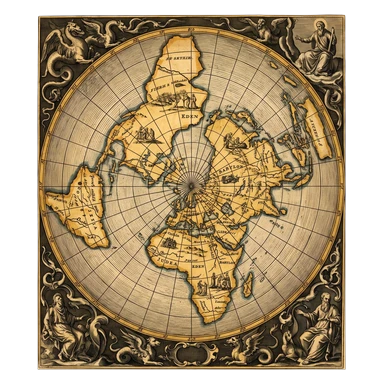
The lecture, painted and spoken
Watch The Emerald Tablet
The first three ideas play for anyone. Members watch all twelve, and every idea is written out below.
Your plan plays the whole lecture, all twelve ideas.

The twelve ideas
Each idea is one chapter of the film: its headline is the caption on the painting, and its words are what the Oracle says. The tag says what kind of claim it is: a fact from history, what a tradition teaches, what a symbol stands for, or a question for you.
-
Fact
A dozen lines, read for a thousand years.
The Emerald Tablet is only a dozen or so lines long. For a thousand years, alchemists read it as the whole secret of their art, folded very small.
-
Tradition
The legend: found in the hands of Hermes.
Legend says it was found in a vault beneath a statue of Hermes, held in the hands of the dead sage himself, cut in a single green stone.
-
Fact
It first appears in Arabic.
The oldest known copies are Arabic, in books of the eighth or ninth century, one of them credited to Balinas, the Arabic name for Apollonius of Tyana.
-
Fact
Latin Europe met it in the 1100s.
In the twelfth century it was put into Latin, and it spread through the workshops and libraries of Europe as the Tabula Smaragdina, the Emerald Tablet.
-
Tradition
That which is below is like that above.
Its famous line says that which is below is like that which is above, and that which is above is like that below, to work the miracles of one thing.
-
Tradition
Its father the Sun, its mother the Moon.
Of that one thing the Tablet says: its father is the Sun, its mother the Moon, the wind carried it in its belly, and its nurse is the earth.
-
Tradition
Separate the subtle from the gross.
It tells the worker to separate the earth from the fire, the subtle from the gross, gently and with great skill. Alchemists read it as a recipe.
-
Tradition
It rises to heaven, and comes down again.
The one thing rises from earth to heaven and comes down again, taking the power of things above and below. So, it says, you will have the glory of the whole world.
-
Fact
Isaac Newton made his own translation.
Isaac Newton wrote about a million words on alchemy. Among his papers is his own English translation of the Tablet, in his own hand, kept today in Cambridge.
-
Tradition
Three parts of the wisdom of the world.
The Tablet closes with its author's name: Hermes, thrice great, because he holds the three parts of the wisdom of the whole world.
-
Tradition
Why astrologers still quote it.
Astrology rests on the same idea: that the heavens above and life below answer one another. That is why the Tablet's line is quoted wherever charts are read.
-
Reflection
What was above you when you arrived?
If what is above is like what is below, then the sky over your birth still speaks of you. What was standing above you on the day you were born?
Sources
- Kitab sirr al-khaliqa, the Book of the Secret of Creation, attributed to Balinas (eighth or ninth century)
- The Latin Tabula Smaragdina (twelfth century)
- Isaac Newton's translation, Keynes MS 28, King's College, Cambridge
- Lawrence M. Principe, The Secrets of Alchemy (2013)
What this lecture does not claim. Where the Tablet was first written is unknown. The oldest copies are Arabic, and the stories of its discovery are legends.
The Hermetic Path
From the legend of Hermes to the book that named his seven laws.
In the dictionary
Common questions
Can I watch this lecture for free?
The first three ideas play for anyone. Members watch all twelve, and every idea is written out below. Every plan opens the whole lecture, and every other lecture in the hall, and a plan begins with seven free days.
Who made this lecture?
The Great Almanac wrote it from the sources listed on this page and tagged every idea, so history is never passed off as teaching. The paintings were made with an image model and the voice is the Oracle’s synthesized voice, as how we use AI explains.
Does watching send anything about me anywhere?
No. The only request the film makes is each idea’s spoken line, by its fixed number, and only after you press Play. Nothing about you goes with it.