Astrology
Melothesia
Direct answer
Melothesia is the traditional assignment of each zodiac sign to a part of the body, running from Aries at the head to Pisces at the feet.
7 days free, $0 today. Your reading is written from your chart, then opens with a Seeker trial: payment details required, then $12/month. We email you 2 days before it ends; cancel on your billing page before then and you pay nothing.
At a glance
- Also called
- zodiac man, zodiacal man, astrological body map, zodiac signs and body parts
- In astrology
- Each sign has one region, and each planet is also tied to organs and limbs.
- Found in
- Astrology
- Related
- Planets and the Body, Medical Astrology, Hyleg, Aries
Melothesia is the traditional assignment of each zodiac sign to a part of the body, running from Aries at the head to Pisces at the feet.
A structural orientation; exact placements depend on the chart or technique being discussed.
What does your own chart say about you?
Choose love, work or purpose. Your reading is written from your chart. Your reading uses your own birth details.
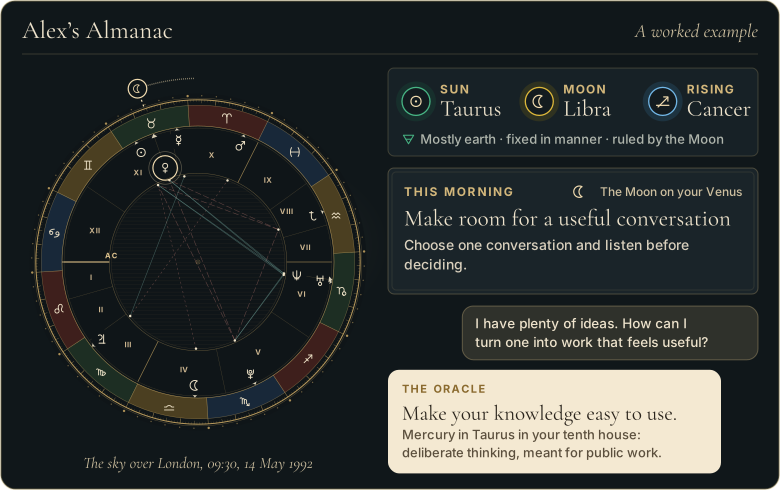
Walk through Alex’s whole example first
 The Road of AgesSee the turning points of your whole life, from your birth date
See your road's shape
The Road of AgesSee the turning points of your whole life, from your birth date
See your road's shape
Prefer to explore first?
 The Road of AgesThe turning points of your whole life, from your own chart
Walk my road
The Road of AgesThe turning points of your whole life, from your own chart
Walk my road
What is melothesia?
Melothesia is the old doctrine that the twelve signs rule the twelve regions of the human body, in order from the head down to the feet. Aries holds the head and face, Taurus the neck and throat, and so on down to Pisces, which holds the feet.
The map is not identical in every source. The medieval authors Abu Ma'shar and al-Qabisi agree on the shape but give different parts for several signs, and later calendars drew the scheme as a picture, the zodiac man. It is presented here as a historical and symbolic scheme, not as medical information.
A one-minute story
The Book of the Sky
How people learned to read the sky, from Babylon to the day you were born.

The map, sign by sign
The two medieval textbooks translated by Benjamin Dykes agree on the order and differ on the detail. The list gives Abu Ma'shar's Abbreviation first, and al-Qabisi's wording in brackets where it differs.
- Aries: head and face
- Taurus: neck and throat (al-Qabisi: neck, Adam's apple)
- Gemini: chest and arms (al-Qabisi: shoulders, arms, hands)
- Cancer: breasts, heart, stomach, sides, spleen, lungs
- Leo: upper stomach, heart, sinews, sides, ribs (al-Qabisi: stomach, heart, flanks, back)
- Virgo: buttocks, intestines, diaphragm (al-Qabisi: belly, innards, diaphragm)
- Libra: backbone, lower belly, pubic area (al-Qabisi adds navel, hips, intestines, buttocks)
- Scorpio: private parts and sperm (al-Qabisi: testicles, bladder, anus, thighs)
- Sagittarius: legs (al-Qabisi: thighs)
- Capricorn: knees
- Aquarius: shins to feet (al-Qabisi: legs and lower ankles)
- Pisces: feet
Notice what the sources do not say. Neither gives Libra the kidneys, though many modern lists do, and neither gives Virgo simply the bowels. Check an author before repeating a modern table.
A second layer: each planet has a limb in each sign
Al-Qabisi adds a finer rule. In every sign each of the seven planets has its own limb, the limb that indicates illness. This is the table, in the order Saturn, Jupiter, Mars, Sun, Venus, Mercury, Moon, as Dykes translated it:
- Aries: Saturn chest; Jupiter belly; Mars head; Sun thighs; Venus feet; Mercury legs; Moon knees
- Taurus: Saturn belly; Jupiter chest; Mars neck; Sun knees; Venus head; Mercury feet; Moon legs
- Gemini: Saturn belly; Jupiter private parts; Mars chest; Sun legs and ankles; Venus neck; Mercury head; Moon thighs
- Cancer: Saturn manly parts; Jupiter thighs; Mars chest; Sun feet; Venus arms and shoulders; Mercury eyes; Moon head
- Leo: Saturn private parts; Jupiter thighs and knees; Mars belly; Sun head; Venus heart; Mercury shoulders and throat; Moon neck
- Virgo: Saturn feet; Jupiter knees; Mars belly; Sun neck; Venus belly; Mercury heart; Moon shoulders
- Libra: Saturn knees; Jupiter eyes; Mars private parts; Sun shoulders; Venus belly and head; Mercury belly; Moon heart
- Scorpio: Saturn ankles; Jupiter feet; Mars head, arms, thighs; Sun heart; Venus private parts; Mercury back; Moon belly
- Sagittarius: Saturn feet; Jupiter legs and head; Mars feet and hands; Sun belly; Venus thighs and arms; Mercury private parts and heart; Moon back
- Capricorn: Saturn head and feet; Jupiter knees and eyes; Mars legs and shoulders; Sun back; Venus thighs and heart; Mercury private parts; Moon thighs
- Aquarius: Saturn head and neck; Jupiter shoulders, chest, feet; Mars ankles, heart; Sun private parts; Venus knees; Mercury thighs and heart; Moon private parts
- Pisces: Saturn shoulders, arms, neck; Jupiter heart and head; Mars ankles and belly; Sun thighs; Venus neck and back; Mercury legs and private parts; Moon thighs
Dykes flags one doubt: for Jupiter in Taurus the Arabic says thighs and the Latin says chest. The table shows how finely the tradition divided the body: a different part for every planet in every sign, eighty-four entries in all.
The body as a small heaven
The idea beneath the table is that the body is a copy of the sky. Burgoyne put it in 1896 as man being "a universe in miniature, a perfect epitome of the heavens", and quoted the Hermetic law of correspondence, as it is above, so it is below, as the grand key. Tara Mata made the same move in the 1930s with the pulse: 72 beats a minute against 72 years a degree of precession, and "each man is a miniature zodiac". The pulse comparison is her own argument, and physiologists and astronomers do not accept it.
The same writers seldom agree on details. Burgoyne says the twelve signs correspond to twelve divisions of the human organism but does not tabulate them in the pages we have. The names of the parts vary because the authors counted the body differently.
How to read a melothesia list
Treat it as a lookup of symbols and ask whose list it is. The head-to-feet order is shared by every source we have, so that part is safe. The detail below the order, for example the position of the kidneys, the bowels or the hips, changes with the author.
In the old books the list was a tool for a physician-astrologer working inside the medicine of his time, which rested on the four humors. A modern reader should use it as history and as a symbolic vocabulary and take any health concern to a qualified clinician.
The story behind Melothesia
The doctrine is ancient and was standard in the medieval textbooks. Abu Ma'shar (ninth century) and al-Qabisi (tenth century) set it out in their introductions to astrology, which Benjamin Dykes translated into English. In the 1890s Thomas Burgoyne described the human body as a universe in miniature and a perfect epitome of the heavens.
The spiritual meaning of Melothesia
Melothesia belongs to the old idea that the human body is a small copy of the heavens. It is read here as a symbolic tradition worth understanding, not as a map of real organs or a way to read health.
Melothesia in the Bible
Some Bible-astrology writers read the human body as a temple that mirrors the zodiac.
Melothesia in astrology
See Planets and the Body for the planet lists, and Medical Astrology for how astrologers used both.
Melothesia in numerology
Melothesia’s numbers (twelve signs, seven planets) are the usual ones of astrology.
How to read Melothesia
Melothesia is used in the study of traditional astrology and the history of medicine, and sometimes as a symbolic vocabulary for reflection. It is not used to judge a real body.
Melothesia in practice: an example
Abu Ma'shar gives Libra the backbone, lower belly and pubic area, while al-Qabisi adds the navel, hips, intestines and buttocks. Two medieval authors, one sign, different lists.
Sources and editorial method
This entry summarizes the tradition in the Almanac's own words; where no source is listed, it is an editorial summary rather than a primary text, and symbolic readings are named as the tradition's, not as fact.
Historical and symbolic reference only. It cannot diagnose or treat anything. Health concerns belong with a qualified clinician.
- Source
- The Great Almanac Dictionary
- Category
- Astrology
- Aliases
- zodiac man, zodiacal man, astrological body map, zodiac signs and body parts, signs and body parts
- Last updated
- 2026-09-26
See Melothesia in your personal almanac
Melothesia in a book is one thing; Melothesia in your own birth chart is your life. The Oracle casts your real chart and tells you what it means for your love, your work, and your year ahead, in conversation. Your first ten written questions are answered free.
Speak with the OracleHow Melothesia lives in your own chart across your year, in love, in work, in timing, is written in the Cosmic Codex: the whole year, once. Open the Cosmic Codex
Related terms
More in Astrology
- Planetary Phase
- Seesaw Chart Shape
- Triple Conjunction
- Apex Planet
- Chart Ruler
- Dominant Sign
- Firdaria
- Kali Yuga
From the reference page to your own chart
Every word here
is in your own chart.
- A personal reading about love, work or purpose, written from your chart
- A practical next step to consider
- It opens with 7 days free, with the AI Oracle and daily guidance
7 days free, $0 today. Your reading is written from your chart, then opens with a Seeker trial: payment details required, then $12/month. We email you 2 days before it ends; cancel on your billing page before then and you pay nothing.
Common questions
What is melothesia?
It is the traditional assignment of each zodiac sign to a region of the body, from Aries at the head to Pisces at the feet.
Which sign rules which body part?
In order: Aries head and face, Taurus neck and throat, Gemini arms and shoulders, Cancer chest and stomach, Leo heart and back, Virgo belly and intestines, Libra lower back and lower belly, Scorpio the private parts, Sagittarius thighs or legs, Capricorn knees, Aquarius shins to feet, Pisces feet. Authors differ on several.
Is the zodiac body map medical?
No. It is a historical symbolic system. It cannot diagnose or treat anything, and health questions belong with a qualified clinician.
What is a zodiac man?
A picture, common in medieval and Renaissance calendars, of a figure with each sign marked on its body part. It is a visual form of melothesia.