Astrology
Planets and the Body
Direct answer
Planets and the Body: Planets and the body is the traditional assignment of body parts, organs and temperaments to the seven planets, which differs between Ptolemy in the second century and Burgoyne in the 1890s.
7 days free, $0 today. Your reading is written from your chart, then opens with a Seeker trial: payment details required, then $12/month. We email you 2 days before it ends; cancel on your billing page before then and you pay nothing.
At a glance
- Also called
- planetary body parts, planets and body parts, planetary rulership of the body, which planet rules which organ
- In astrology
- Each planet in the traditional scheme has a temperament, a gender, a team (day or night) and a list of body parts.
- Found in
- Astrology
- Related
- Melothesia, Medical Astrology, Sect, Planetary Day
Planets and the body is the traditional assignment of body parts, organs and temperaments to the seven planets, which differs between Ptolemy in the second century and Burgoyne in the 1890s.
A structural orientation; exact placements depend on the chart or technique being discussed.
What does your own chart say about you?
Choose love, work or purpose. Your reading is written from your chart. Your reading uses your own birth details.
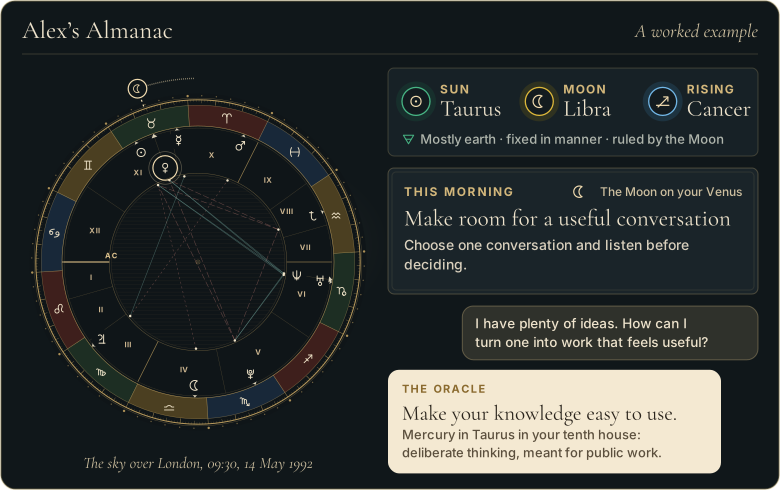
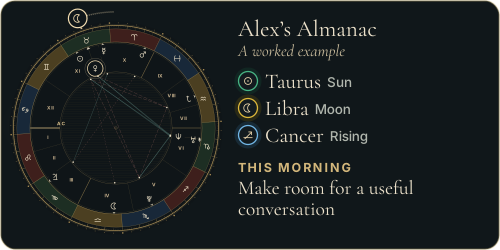
Walk through Alex’s whole example first
 The Road of AgesSee the turning points of your whole life, from your birth date
See your road's shape
The Road of AgesSee the turning points of your whole life, from your birth date
See your road's shape
Prefer to explore first?
 The Road of AgesThe turning points of your whole life, from your own chart
Walk my road
The Road of AgesThe turning points of your whole life, from your own chart
Walk my road
Which planet rules which part of the body?
Traditional astrology gives each of the seven planets a set of body parts, organs and temperaments. Ptolemy lists them in the Tetrabiblos in the second century. The medieval textbooks add a planet-by-sign table, and Thomas Burgoyne published a longer list in 1896.
The lists overlap in places and disagree in others. For example Ptolemy gives the liver to Venus and Burgoyne gives it to Saturn. The lists are given here as historical symbolism and never as medical information.
A one-minute story
The Book of the Sky
How people learned to read the sky, from Babylon to the day you were born.

Ptolemy's list
Ptolemy gives the planets their parts at the start of the chapter on diseases of the body in Book III. In the Ashmand translation:
- Saturn: right ear, spleen, bladder, phlegm, bones
- Jupiter: hand, lungs, arteries, seed
- Mars: left ear, kidneys, veins, genitals
- Sun: eyes, brain, heart, nerves, right side
- Venus: nostrils, liver, flesh
- Mercury: speech, understanding, bile, tongue, buttocks
- Moon: palate, throat, stomach, belly, womb, left side
He judges hurts to the body from the angles on the horizon, the ascendant and the western angle with the sixth house, and from malefics aspecting them. The list stands on his theory of the qualities: Saturn is cold and dry, Mars dry and strongly heating, Jupiter warm and moist, Venus temperate with moisture leading, the Moon chiefly moist, the Sun heating and moderately drying, and Mercury equally dry or moist, swinging quickly.
Burgoyne's list, 1896
Burgoyne's Celestial Dynamics gives a later list, with each planet's role in the body:
- Sun: the heart
- Moon: the breast, the stomach and the whole fluid system
- Mercury: the tongue and the nervous system
- Venus: the internal sex and generative functions, the ovaries and the venous system
- Mars: the external sexual organism, the muscles and the sinews
- Jupiter: the arterial system
- Saturn: the bones, the liver and the spleen
- Uranus: the magnetic aura and occult medicine
- Neptune: mind only, never the physical body
He also classes the planets as electric (Sun, Jupiter, Mars) or magnetic (Moon, Saturn, Venus), with Mercury taking either, and calls masculine signs electric and feminine signs magnetic. Uranus is electro-magnetic. The classification belongs to his own system.
The two lists side by side
Where Ptolemy and Burgoyne agree, the tradition looks stable. Where they differ, you are seeing two authors.
- Agree: Saturn rules the bones and the spleen. Jupiter rules the arteries. The Sun rules the heart. The Moon rules the stomach. Mercury rules the tongue.
- Differ: Ptolemy gives the liver to Venus, Burgoyne to Saturn. Ptolemy gives veins to Mars, Burgoyne gives muscles and sinews. Ptolemy gives the Sun the eyes and brain, Burgoyne leaves those out.
- Added: Burgoyne's Uranus and Neptune, discovered long after Ptolemy, and the electric and magnetic split.
The medieval authors add a third layer. Al-Qabisi gives each planet a different limb in each sign, as set out in Melothesia.
Temperament and the look of the body
Ptolemy also uses the planets to describe the form of the body from the planet that rules the ascendant and the Moon. A planet that rises before the Sun (oriental) gives a different look from one that sets after it (occidental). A few of his entries:
- Saturn oriental: yellowish, good constitution, black curly hair, broad chest, moist and cold. Occidental: dark, thin, small, scanty hair, dark eyes, dry and cold.
- Mars oriental: ruddy-fair, large, healthy, blue or gray eyes, sturdy, hot and dry. Occidental: simply ruddy, middle height, small eyes, hairless body, light or red straight hair.
- Jupiter oriental: fair clear complexion, large eyes, good stature, hot and moist.
The Sun adds nobility and health to any of these, and the Moon adds proportion, delicacy and moisture. This is ancient physiognomy, an attempt to read a person's type from the sky.
The story behind Planets and the Body
Ptolemy gives his planetary body parts at the start of the chapter on diseases of the body in Book III of the Tetrabiblos. Thomas Burgoyne gave a longer list in Celestial Dynamics (1896), adding Uranus and Neptune and an electric and magnetic classification.
The spiritual meaning of Planets and the Body
Planets and the Body belongs to the old idea that the human body is a small copy of the heavens. It is read here as a symbolic tradition worth understanding, not as a map of real organs or a way to read health.
Planets and the Body in the Bible
Some Bible-astrology writers read the human body as a temple that mirrors the zodiac.
Planets and the Body in astrology
The sign a planet stands in adds a second rule, covered in Melothesia.
Planets and the Body in numerology
Planets and the Body’s numbers (twelve signs, seven planets) are the usual ones of astrology.
How to read Planets and the Body
Planets and the Body is used in the study of traditional astrology and the history of medicine, and sometimes as a symbolic vocabulary for reflection. It is not used to judge a real body.
Planets and the Body in practice: an example
Ptolemy gives the Sun the eyes, brain, heart, nerves and right side, and the Moon the palate, throat, stomach, belly, womb and left side. Burgoyne gives the Sun the heart and the Moon the breast, stomach and the whole fluid system.
Where readings of Planets and the Body go wrong
Planets and the Body is a historical symbolism, not medical science.
Sources and editorial method
This entry summarizes the tradition in the Almanac's own words; where no source is listed, it is an editorial summary rather than a primary text, and symbolic readings are named as the tradition's, not as fact.
Historical and symbolic reference only. It cannot diagnose or treat anything. Health concerns belong with a qualified clinician.
- Source
- The Great Almanac Dictionary
- Category
- Astrology
- Aliases
- planetary body parts, planets and body parts, planetary rulership of the body, which planet rules which organ
- Last updated
- 2026-09-26
See Planets and the Body in your personal almanac
Planets and the Body in a book is one thing; Planets and the Body in your own birth chart is your life. The Oracle casts your real chart and tells you what it means for your love, your work, and your year ahead, in conversation. Your first ten written questions are answered free.
Speak with the OracleHow Planets and the Body lives in your own chart across your year, in love, in work, in timing, is written in the Cosmic Codex: the whole year, once. Open the Cosmic Codex
Related terms
More in Astrology
- Singleton Planet
- Tropical Zodiac
- Ascendant
- Co-Significator
- Dwad
- Frustration
- Latitude in Astrology
- Minor Grand Trine
From the reference page to your own chart
Every word here
is in your own chart.
- A personal reading about love, work or purpose, written from your chart
- A practical next step to consider
- It opens with 7 days free, with the AI Oracle and daily guidance
7 days free, $0 today. Your reading is written from your chart, then opens with a Seeker trial: payment details required, then $12/month. We email you 2 days before it ends; cancel on your billing page before then and you pay nothing.
Common questions
Which planet rules which part of the body?
It depends on the author. In Ptolemy, Saturn has the right ear, spleen, bladder and bones, Jupiter the hand, lungs and arteries, Mars the left ear, kidneys and veins, the Sun the eyes, brain and heart, Venus the liver and flesh, Mercury the tongue, and the Moon the stomach, womb and left side.
Do Ptolemy and later astrologers agree?
Partly. Both give Saturn the bones and spleen and Jupiter the arteries. They differ on Venus and the liver, which Ptolemy gives to Venus and Burgoyne to Saturn.
Is this medical advice?
No. It is a historical symbolic system and cannot diagnose or treat anything.