
Astrological aspects
Minor Grand Trine
Direct answer
Find two planets in trine, then check whether a third planet is sextile to both. The third body is the focal planet. The ideal geometry is 120 degrees between the trine planets and 60 degrees from each of them to the focal planet.
A Minor Grand Trine is a three-planet aspect pattern made from one trine and two sextiles. The planet receiving both sextiles is the focal planet, while the other two planets form the trine.
$0 today, then $12/month after 7 days. Cancel anytime.
Quick facts
| Connection | Ideal angle | Role |
|---|---|---|
| Planet A to Planet B | 120° trine | Provides the broad compatible relationship. |
| Planet A to focal planet | 60° sextile | Creates an opportunity to express the trine. |
| Planet B to focal planet | 60° sextile | Completes the triangular pattern. |
| Focal planet | Receives both sextiles | Acts as the practical outlet or point of development. |
Minor Grand Trine combines one trine with two sextiles.
A structural orientation; exact placements depend on the chart or technique being discussed.
What does your own chart say about you?
Choose love, work or purpose. Your reading is written from your chart. Your reading uses your own birth details.
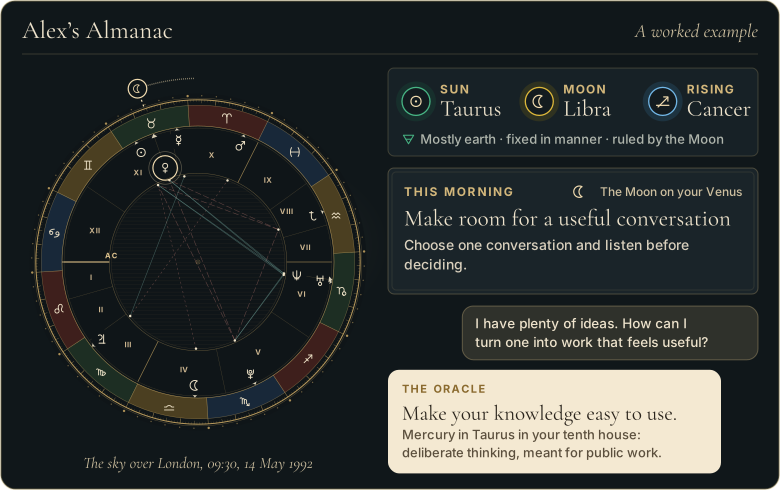
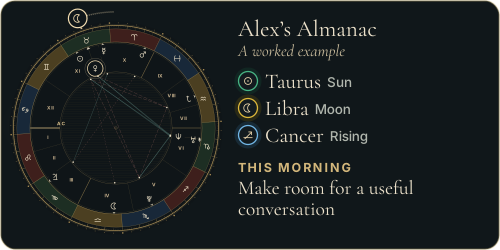
Walk through Alex’s whole example first
 The Road of AgesSee the turning points of your whole life, from your birth date
See your road's shape
The Road of AgesSee the turning points of your whole life, from your birth date
See your road's shape
Prefer to explore first?
 The Road of AgesThe turning points of your whole life, from your own chart
Walk my road
The Road of AgesThe turning points of your whole life, from your own chart
Walk my road
Free, by email
Your daily Almanac letter
One short letter at 7 each morning: the day’s theme read for your own chart, and one thing to do with it.
The exact pattern
A Minor Grand Trine uses three planets and three aspect links. Two planets are approximately 120 degrees apart, forming a trine. A third planet sits approximately 60 degrees from each, forming two sextiles. On a chart wheel it appears as a narrow isosceles triangle. It is also called a Small Talent Triangle in some modern schools.
The word “minor” does not mean insignificant. It distinguishes the pattern from a Grand Trine, which consists of three trines and forms an equilateral triangle. A Minor Grand Trine combines the relative ease associated with a trine and the possibility-oriented quality astrologers assign to sextiles. Whether it is prominent depends on orb, planets, angularity, repetition, and the rest of the chart.
A one-minute story
The Book of the Sky
How people learned to read the sky, from Babylon to the day you were born.

How to identify it reliably
- Calculate accurate longitudes for the planets and choose a declared aspect-orb policy.
- Find a valid trine between two planets. Those planets form the base of the pattern.
- Test every third planet for a sextile to both ends of that trine.
- Confirm all three links independently. A trine plus only one sextile is not a Minor Grand Trine.
- Mark the planet receiving both sextiles as the focal or apex planet.
- Show each measured separation and orb. Do not rely only on a colored triangle drawn by chart software.
There is no single universal orb. Tighter patterns are usually more visually and interpretively coherent. Luminaries may receive wider aspect orbs in some traditions, while other practitioners use one limit for every planet.
How the focal planet is read
Astrologers commonly treat the trine as an established flow between two planetary functions and the focal planet as the place where that flow can be developed or applied. Because sextiles traditionally imply an opportunity that benefits from participation, the pattern is often read as usable talent rather than effortless good fortune. The person may need to choose, practice, or make contact before the potential becomes visible.
Start with the three planets. Then add their signs, houses, rulerships, dignity, speed, and other aspects. A focal Mercury can emphasize articulation, learning, mediation, or technical connection; a focal Mars can emphasize decisive action or craft; a focal Saturn can turn compatible abilities into disciplined structure. A hard aspect striking the focal planet does not cancel the pattern, it may make the outlet more urgent, demanding, or consequential.
Worked example
Suppose the Moon is at 14 degrees Taurus, Venus at 16 degrees Virgo, and Mars at 15 degrees Cancer. Moon and Venus are close to a 120-degree trine. Mars is approximately 60 degrees from each, so Mars is the focal planet. An astrologer might explore how emotional steadiness and aesthetic or relational discernment become actionable through Mars: protecting, initiating, competing, building, or advocating.
The houses would determine where that outlet is most apparent. Mars in the sixth could focus the pattern through work, health routines, service, or skill; Mars in the tenth could make action more public and vocational. This is symbolic interpretation, not proof of a fixed talent or outcome.
Minor Grand Trine, Grand Trine, and Kite
| Pattern | Aspect structure | Key distinction |
|---|---|---|
| Minor Grand Trine | One trine and two sextiles | One focal planet receives both sextiles. |
| Grand Trine | Three trines | Three planets form a broad equilateral triangle, usually in one element. |
| Kite | Grand Trine plus an opposition and two sextiles | A fourth planet opposes one corner and becomes a directional focal point. |
| Single sextile | One 60° link | Does not create a closed three-planet pattern. |
What the pattern cannot establish
A Minor Grand Trine is part of astrological symbolism, not a scientifically validated measure of talent or fate. It does not guarantee artistic skill, intelligence, wealth, ease, or spiritual status. An accurate page should provide geometry before interpretation, name the orb method, and invite comparison with lived experience. If one link is extremely wide or a different aspect describes it better, the chart should not be forced into the pattern.
What sets Minor Grand Trine apart
Three planets form this figure: two are 120 degrees apart in trine, and a third stands halfway between them, 60 degrees from each, in sextile to both. It is an isosceles triangle with one long side, the trine, and two short sides. The third planet is the apex, the only one that touches both others by sextile, so the figure cannot be read from the trine alone.
- Planets: three, in an isosceles triangle
- Aspects: one trine (120) and two sextiles (60)
- Apex: the planet that sextiles both ends of the trine
- Elements: the trine pair share an element; the apex stands in a compatible one
- Base of the triangle: the trine, the longest side at 120 degrees
Often mistaken for something else: The Grand Trine has three planets in a triangle of three trines (120 each). The Minor Grand Trine replaces two of those trines with sextiles around a central planet.
Sources and editorial method
Research and editorial references used for this page include:
- Astrology King: Minor Grand Trine - Illustrated modern description of the trine-and-two-sextile geometry.
- Astrodienst Astrowiki: Aspect Pattern - Reference overview for interpreting aspect patterns as complete geometric structures.
These references support the factual, historical, textual, or interpretive claims on this page. Interpretive traditions are identified as such, and factual claims are kept separate from symbolic claims.
Related reading
Find your supportive patterns
Minor Grand Trine in a book is one thing; Minor Grand Trine in your own birth chart is your life. The Oracle casts your real chart and tells you what it means for your love, your work, and your year ahead, in conversation. It opens with the 7-day Seeker trial.
Speak with the OracleHow Minor Grand Trine lives in your own chart across your year, in love, in work, in timing, is written in the Cosmic Codex: the whole year, once. Open the Cosmic Codex
More in Astrology
- Planets and the Body
- Singleton Planet
- Tropical Zodiac
- Ascendant
- Chronocrator
- Dwad
- Frustration
- Latitude in Astrology
From the reference page to your own chart
Every word here
is in your own chart.
- A personal reading about love, work or purpose, written from your chart
- A practical next step to consider
- It opens with 7 days free, with the AI Oracle and daily guidance
$0 today, then $12/month after 7 days. Cancel anytime.
Common questions
Which planet is the apex?
The planet sextile to both ends of the trine is the focal or apex planet. The two planets in trine form the base.
Must all three planets share the same element?
No. The trine pair often shares an element in sign-based astrology, while the focal planet usually occupies a sign whose element can sextile both. Degree-based aspects can cross sign boundaries.
Do angles or asteroids count?
Some astrologers include them, but methods vary. State the object list clearly and begin with planets if you want a result comparable with standard aspect-pattern definitions.
Free, by email
The Almanac, in your inbox at 7
One short letter at 7 each morning: the day’s theme read for your own chart, and one thing to do with it.
