
Planets and points
Mercury
Direct answer
Mercury in astrology represents mind, language, perception, learning, trade, messages, translation, humor, and the way information moves.
Mercury represents thought, speech, learning, and exchange.
$0 today, then $12/month after 7 days. Cancel anytime.
At a glance
- In astrology
- Mercury rules Gemini and Virgo, is exalted in Virgo, falls in Pisces, and is in detriment in Sagittarius and Pisces.
- Found in
- Planets & Celestial Bodies
- Related
- Planetary Placement, Planetary Position, Birth Chart, Transit
Deeper Almanac guide: Mercury retrograde guide. This dictionary entry is a concise definition page; the linked guide remains the long-form topic page.
Mercury represents thought, speech, learning, and exchange.
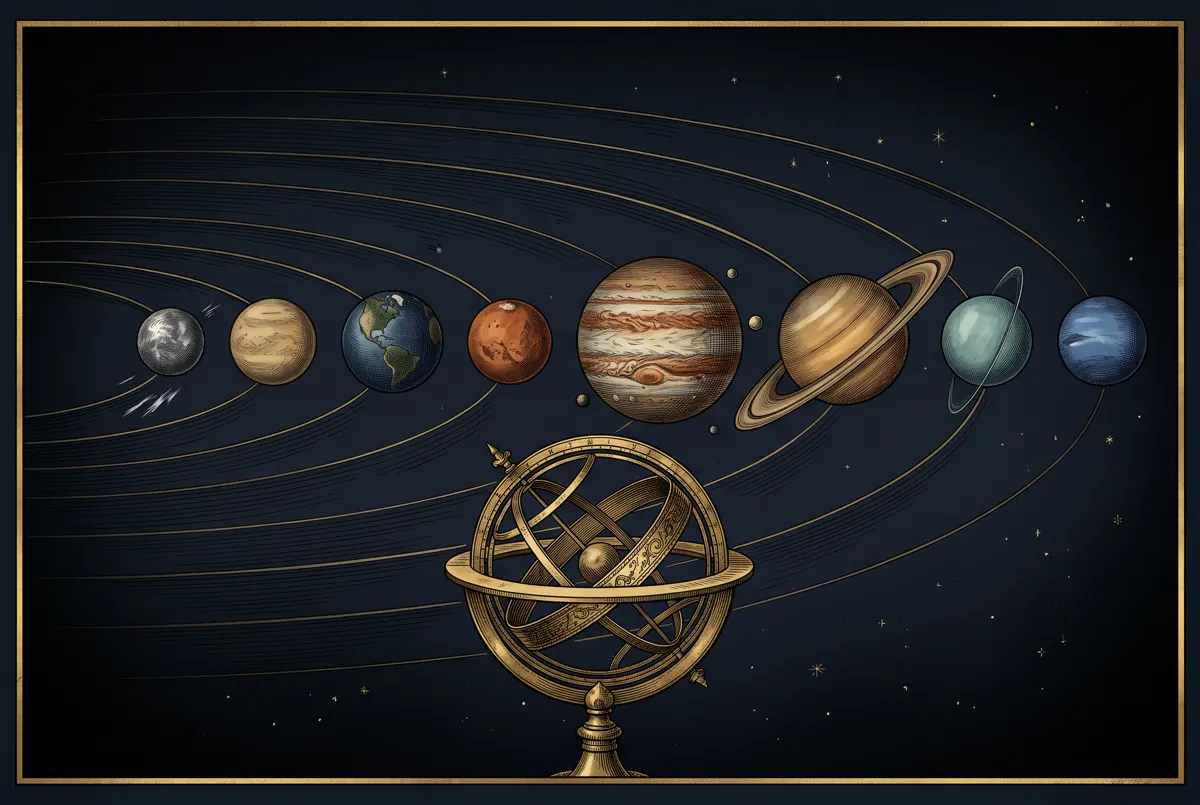
The orbit map distinguishes physical bodies, calculated points, and symbolic cycles where possible.
What does your own chart say about you?
Choose love, work or purpose. Your reading is written from your chart. Your reading uses your own birth details.
Walk through Alex’s whole example first


 The Road of AgesSee the turning points of your whole life, from your birth date
See your road's shape
Prefer to explore first?
 The Road of AgesThe turning points of your whole life, from your own chart
Walk my road
Free, by email
Your daily Almanac letter
One short letter at 7 each morning: the day’s theme read for your own chart, and one thing to do with it.
What sets Mercury apart
Mercury never strays more than about 28 degrees from the Sun, so it can stand only in the Sun's own sign or the one before or after, and it is seen only low in the dawn or dusk sky. Ptolemy makes that nearness the root of its character: it is equally dry or moist, swings quickly and takes on the nature of the planets it meets. It is the planet that turns retrograde most often, about three or four times a year, and its sect is not fixed but follows its position, diurnal rising before the Sun and nocturnal setting after it.
- Greatest elongation: about 28 degrees from the Sun, at most one sign away
- Orbit and cycle: about 88 days to circle; 116 days from one meeting with the Sun to the next
- Retrograde: three or four times a year, each lasting about three weeks
- Exaltation degree: 15 degrees of Virgo in the later tradition, in the sign it also rules
- Joy: the first house, in the lists of al-Qabisi and the Abbreviation
- Chaldean place: sixth of seven, above only the Moon
A one-minute story
The Wandering Stars
How the moving planets were watched, named and found, and what a transit is.

Mercury in the traditional textbooks
Mercury is the planet that changes sides. Ptolemy makes it equally dry or moist and swinging quickly, counts it common, and says it is masculine or feminine according to its sign and phase. Ptolemy makes it diurnal when it rises before the Sun and nocturnal when it follows it, and Dykes notes that in the medieval texts its team depends on where it stands. Dorotheus has Mercury rejoicing in Virgo and gives it gain through commerce, science and calculation.
- Nature (Ptolemy): Mercury is equally dry or moist, swinging quickly, because it never strays far from the Sun and borders the Moon's sphere.
- Class (Ptolemy): common: it does good or ill with whatever it joins.
- Sex (Ptolemy): both: masculine or feminine according to its sign and phase. Team: the day team when it rises before the Sun and the night team when it follows it.
- Sphere (Firmicus): a faithful companion of the Sun, with Venus.
- Egyptian name (Firmicus): Stilbon.
- Color (Ptolemy, reading eclipses and comets): mixed colors.
- Orb (Abu Ma'shar): 7 degrees.
- Body (Ptolemy): speech, understanding, bile, the tongue and the buttocks. Body (Burgoyne, 1896): the tongue and the nervous system.
Mercury: dignities, bounds and strength
Where Mercury is strong, according to the same few authors:
- Domicile: Gemini and Virgo. Ptolemy's reason: it is never more than one sign from the Sun, nearest to both luminaries.
- Detriment: Sagittarius and Pisces, the signs opposite its own.
- Exaltation: 15 degrees of Virgo, because autumnal dryness first appears there (Ptolemy). Fall: 15 degrees of Pisces.
- Joy by sign (Dorotheus): Virgo. Joy by house (al-Qabisi): the first house.
- Triplicity: night lord of the air signs (Gemini, Libra and Aquarius) (Dorotheus).
The Egyptian bounds of Mercury add up to 76 degrees of the 360. Aries 13 to 20, Taurus 9 to 14, Gemini 1 to 6, Cancer 14 to 19, Leo 19 to 24, Virgo 1 to 7, Libra 7 to 14, Scorpio 12 to 19, Sagittarius 18 to 21, Capricorn 1 to 7, Aquarius 1 to 7, Pisces 17 to 19. The widest is 8 degrees, in Aries and Libra and Scorpio, and the narrowest is 3, in Pisces.
Mercury rules 5 of the 36 decans: first decan of Taurus, second decan of Cancer, third decan of Virgo, first decan of Sagittarius, second decan of Aquarius.
- Facing (al-Qabisi, after Ptolemy): a western planet is in the facing of the Sun when it stands in the second sign from the Sun, as many signs as its domicile is from the Sun's.
- Face (Ptolemy, a phase and not a decan): it makes one sign from the Sun.
- Morning star (Firmicus): it becomes one when it precedes the Sun by 18 degrees.
Mercury: people, years and the limb in each sign
Burgoyne calls Mercury the interpreter and messenger that takes the character of whatever it aspects at birth, and gives it the chief rule of the mental qualities, the tongue and the nervous system. Firmicus gives its Egyptian name as Stilbon. Hill's candlestick puts it with the Moon and Venus on the side of the Sun nearest the earth.
Among siblings, Dorotheus assigns it younger brothers; when it rules the second house, he traces a decline in fortune to a book or a reckoning. Dorotheus's figure for the years of evil an angular planet holds off is 20 years, if dominant by sect and triplicity. Ptolemy says that as lord of an eclipse it adds to its partners, with skill in business, theft, treachery, dry diseases, thunder and earthquakes.
Al-Qabisi gives each planet a limb in each sign, the part that shows illness when it is troubled there. For Mercury:
- Aries: legs
- Taurus: feet
- Gemini: head
- Cancer: eyes
- Leo: shoulders and throat
- Virgo: heart
- Libra: belly
- Scorpio: back
- Sagittarius: private parts and heart
- Capricorn: private parts
- Aquarius: thighs and heart
- Pisces: legs and private parts
The story behind Mercury
Mercury is a classical planet associated with the messenger figure Hermes or Mercury.
The spiritual meaning of Mercury

Spiritually, Mercury asks whether speech is becoming clearer, kinder, and truer.
Why Mercury matters
Mercury matters because it shows how a person thinks, speaks, notices, worries, explains, negotiates, and changes mental direction.
How to read Mercury
Astrologers reach for Mercury when interpreting communication, writing, study, business, nervous energy, siblings, short travel, and Mercury retrograde cycles.
Mercury in practice: an example
Mercury in Scorpio may speak fewer words but listen for hidden motives and emotional subtext.
Where readings of Mercury go wrong
A common error is to judge intelligence from Mercury alone. Education, context, neurodiversity, and the whole chart matter.
A lecture on this, free to read

Sources and editorial method
This entry summarizes the tradition in the Almanac's own words; where no source is listed, it is an editorial summary rather than a primary text, and symbolic readings are named as the tradition's, not as fact.
- Source
- The Great Almanac Dictionary
- Category
- Planets & Celestial Bodies
- Aliases
- Mercury astrology, Mercury meaning
- Last updated
- 2026-09-26
Read your Mercury placement
Mercury in a book is one thing; Mercury in your own birth chart is your life. The Oracle casts your real chart and tells you what it means for your love, your work, and your year ahead, in conversation. It opens with the 7-day Seeker trial.
Speak with the OracleWhere Mercury moves through your own year, and what that asks of your love and your work, is written in the Cosmic Codex, month by month from your chart. Open the Cosmic Codex
Related terms
More in Planets & Celestial Bodies
From the reference page to your own chart
Every word here
is in your own chart.
- A personal reading about love, work or purpose, written from your chart
- A practical next step to consider
- It opens with 7 days free, with the AI Oracle and daily guidance
$0 today, then $12/month after 7 days. Cancel anytime.
Common questions
What is Mercury?
Mercury in astrology represents mind, language, perception, learning, trade, messages, translation, humor, and the way information moves.
Where does Mercury come from?
Mercury is a classical planet associated with the messenger figure Hermes or Mercury.
What does Mercury mean in astrology?
Astrologers reach for Mercury when interpreting communication, writing, study, business, nervous energy, siblings, short travel, and Mercury retrograde cycles.
What does Mercury look like in a birth chart?
Mercury in Scorpio may speak fewer words but listen for hidden motives and emotional subtext.
What does Mercury mean spiritually?
Spiritually, Mercury asks whether speech is becoming clearer, kinder, and truer.
Free, by email
The Almanac, in your inbox at 7
One short letter at 7 each morning: the day’s theme read for your own chart, and one thing to do with it.


