Outer Solar System
Leleakuhonua
Direct answer
Leleakuhonua is a small icy body on a very elongated orbit in the outer Solar System. Its unusually distant closest approach makes ordinary scattering by Neptune unlikely today and gives astronomers evidence about the architecture of the distant Solar System.
Leleakuhonua, numbered (541132) and provisionally designated 2015 TG387, is an extreme trans-Neptunian object with a perihelion far beyond Neptune.
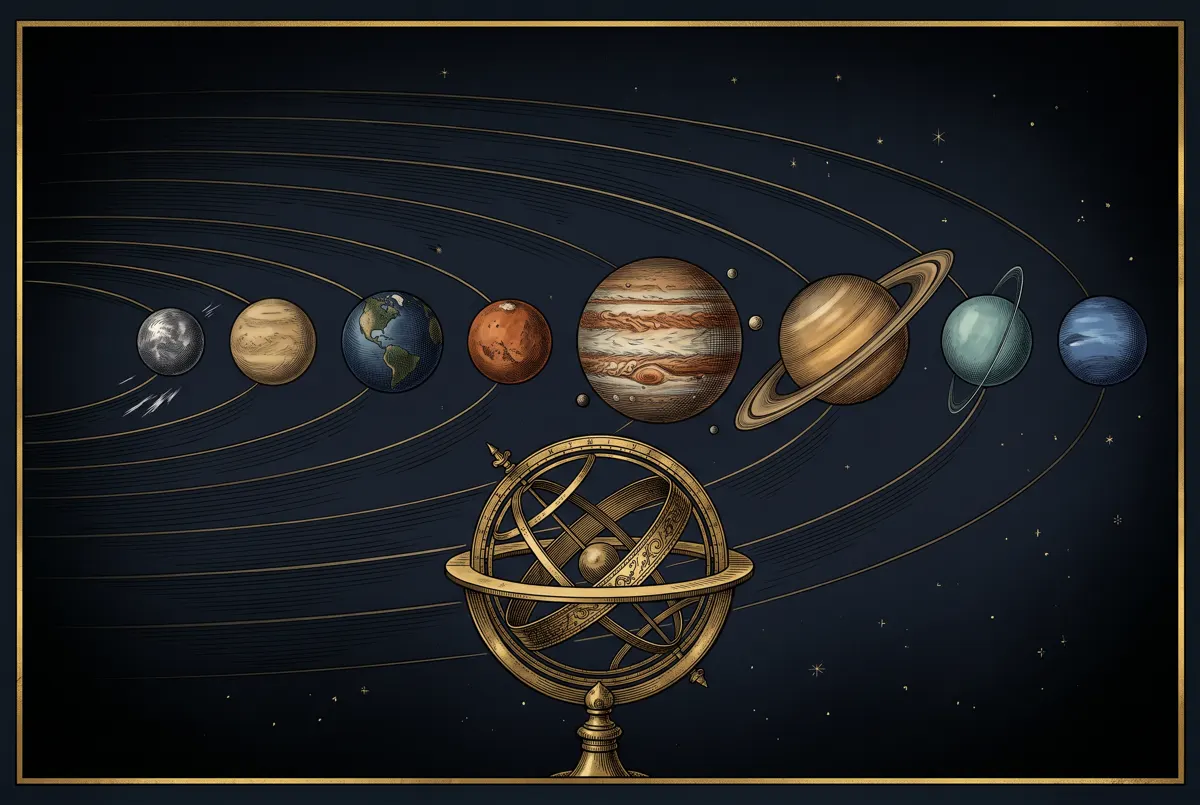
Leleakuhonua means an extreme trans-Neptunian object whose name evokes a Hawaiian creation chant.
The orbit map distinguishes physical bodies, calculated points, and symbolic cycles where possible.Quick facts
| Question | Direct answer |
|---|---|
| Other designations | (541132) Leleakuhonua and 2015 TG387. |
| Object class | An extreme trans-Neptunian object, often discussed as an inner Oort Cloud or detached object. |
| Why is it unusual? | Even perihelion lies at roughly 65 astronomical units, well beyond Neptune. |
| Does its orbit prove another planet exists? | No. It is part of a debated pattern that motivates hypotheses and further surveys. |
The Instruments
Ten readings, worked out from your own birth chart
An instrument is a reading this house works out for you. Give your birth date, time and place once, and each one reads today’s real sky against the chart you were born under. Eight are personal; two are calendars anyone can open. A free account opens one instrument a day. The plans open every instrument, every day.
- Natal Chart Every planet, house and aspect in your chart
- Active Transits Where the planets are now, read against your chart
- Daily Counsel What to pursue today, and what to leave alone
- Personal Timing Your best days to decide, weeks ahead
- Fellowship Your chart and another, read side by side
- Theme of the Day The one thing today is asking of you
- Sacred Numbers Your life path, your cycles, your name in numbers
- Aeolian Harmonics Classical music chosen to match your chart
- Mercury Retrograde Every Mercury retrograde this year, with its dates Open to all
- Void-of-Course Moon When the Moon is between signs, hour by hour Open to all






What Leleakuhonua is
Leleakuhonua is the proper name approved for minor planet 541132, originally announced under the provisional designation 2015 TG387. It belongs to a sparse population whose orbits remain far outside Neptune even at closest approach. The discovery team described it as the third known high-perihelion inner Oort Cloud object after Sedna and 2012 VP113 under their classification. “Goblin,” a nickname derived from the provisional letters TG and its October discovery announcement, appears frequently in news coverage but is not the official name. The object is too faint and distant for surface features to be directly resolved in ordinary images.
Why its orbit interests astronomers
Its orbit is extraordinarily elongated. Perihelion is about 65 astronomical units from the Sun, while aphelion extends vastly farther; one revolution takes tens of thousands of years, with exact values depending on the fitted orbit. Because Neptune orbits near 30 astronomical units, Leleakuhonua does not currently pass close enough for routine encounters with Neptune to explain every feature of its path. That makes it useful for testing models of early planetary migration, galactic tides, passing stars, and possible undiscovered massive bodies. One object cannot distinguish these explanations, so survey selection effects and additional discoveries are crucial.
Discovery and observation
The object was detected in images taken in 2015 during a wide, deep survey led by Scott Sheppard, Chad Trujillo, and David Tholen, then tracked over multiple years to establish an orbit. At such distances, apparent movement against background stars is small and an initial short arc leaves large uncertainty. Follow-up astrometry extends the observed arc and improves estimates. A predicted stellar occultation was observed in 2018, providing an independent constraint on size, although a single chord cannot uniquely recover the full shape. Diameter estimates also depend on assumed reflectivity when thermal measurements are unavailable.
Meaning and use of the Hawaiian name
The Hawaiian name Leleakuhonua was developed through the A Hua He Inoa program, which connects Hawaiian language and cultural knowledge with astronomical discoveries made using telescopes in Hawaiʻi. Public explanations render the name through the image of something that flies or leaps toward the earth, reflecting the object's immense orbit and eventual return toward the inner part of its path. The diacritics and full spelling matter. The name should not be treated as a free-floating mystical keyword or assigned an invented planetary rulership; it is a culturally grounded proper name for an astronomical body.
Evidence and uncertainty around Leleakuhonua
Astronomical knowledge about Leleakuhonua comes from repeatable observations, measured positions, orbital models, and published uncertainty ranges. A provisional designation, estimated diameter, or orbital element can change when a longer observational arc becomes available, so the date and source of a value matter. Scientific descriptions should distinguish directly observed quantities from model-dependent estimates and should not turn a distant object's nickname into an astrological personality claim. When symbolic interpretations are discussed, they should be clearly identified as later cultural uses rather than properties discovered by astronomy. For current technical values, consult the Minor Planet Center or JPL Small-Body Database rather than copying an undated infographic.
Sources and editorial method
Research and editorial references used for this page include:
- Discovery paper: A New High Perihelion Inner Oort Cloud Object - Scientific discovery paper describing 2015 TG387 and its orbit.
- JPL Small-Body Database Lookup - Current orbital and identification data for numbered minor planet 541132.
These references support the factual, historical, textual, or interpretive claims on this page. Interpretive traditions are identified as such, and factual claims are kept separate from symbolic claims.
Related reading
Check it in your skymap
Leleakuhonua in a book is one thing; Leleakuhonua in your own birth chart is your life. The Oracle casts your real chart and tells you what it means for your love, your work, and your year ahead, in conversation, free.
Speak with the OracleWhere Leleakuhonua moves through your own year, and what that asks of your love and your work, is written in the Cosmic Codex, month by month from your chart. Open the Cosmic Codex
More in Planets & Celestial Bodies
Common questions
Is Leleakuhonua a planet?
No. It is catalogued as a minor planet and is far smaller than the eight planets.
Is it the same object as the Goblin?
Yes. “The Goblin” was an informal nickname for 2015 TG387; Leleakuhonua is the approved proper name.
Does it confirm Planet Nine?
No. Its orbit is relevant to the hypothesis, but observational bias and other dynamical explanations remain under study.