
Planets and points
Mars
Direct answer
Mars in astrology represents action, desire, heat, conflict, courage, assertion, defense, anger, libido, and the way energy cuts through resistance.
$0 today, then $12/month after 7 days. Cancel anytime.
At a glance
- In astrology
- Mars rules Aries and Scorpio, is exalted in Capricorn, falls in Cancer, and is in detriment in Taurus and Libra.
- Found in
- Planets & Celestial Bodies
- Related
- Planetary Placement, Planetary Position, Birth Chart, Transit
Mars represents action, courage, conflict, desire, and drive.
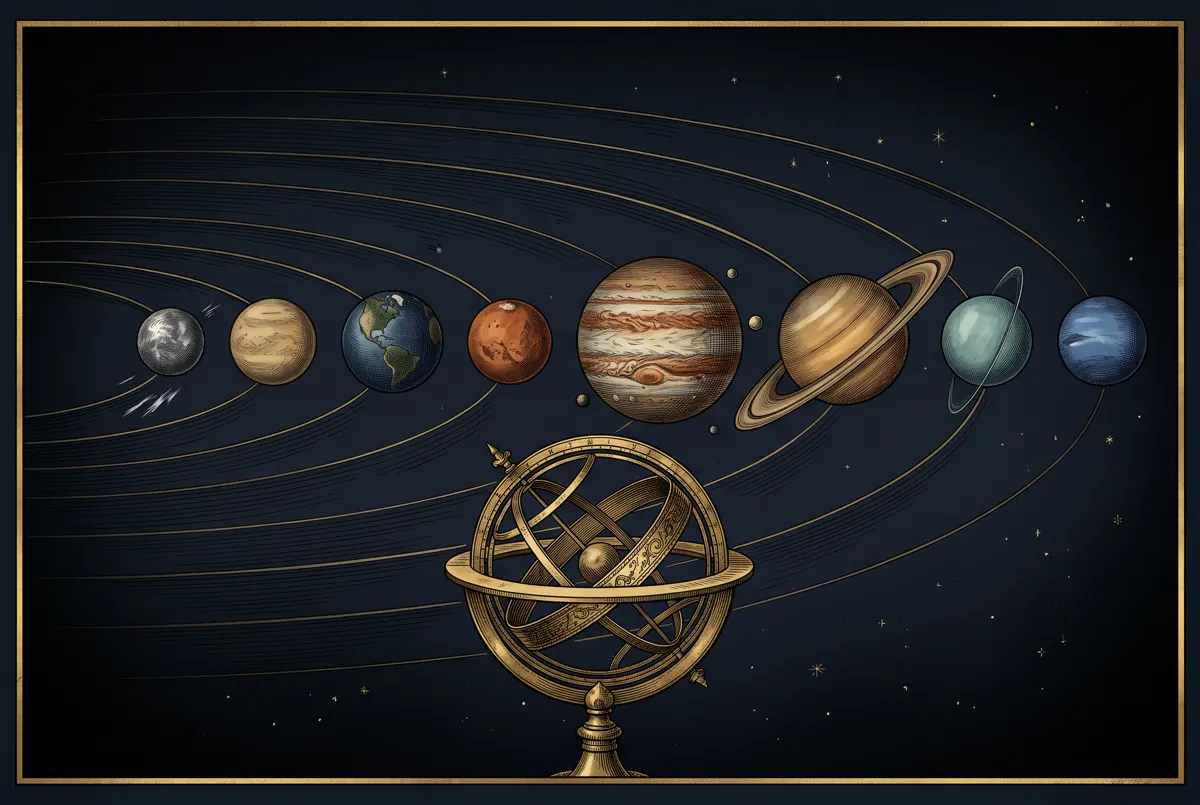
The orbit map distinguishes physical bodies, calculated points, and symbolic cycles where possible.
What does your own chart say about you?
Choose love, work or purpose. Your reading is written from your chart. Your reading uses your own birth details.
Walk through Alex’s whole example first


 The Road of AgesSee the turning points of your whole life, from your birth date
See your road's shape
Prefer to explore first?
 The Road of AgesThe turning points of your whole life, from your own chart
Walk my road
Free, by email
Your daily Almanac letter
One short letter at 7 each morning: the day’s theme read for your own chart, and one thing to do with it.
What sets Mars apart
Mars is the first planet beyond the Sun in the Chaldean order, the nearest of the three that can stand opposite it, and the one Ptolemy calls dry and strongly heating, from its fiery colour. It takes 687 days to circle the zodiac, but 780 to return to the same place against the Sun, and it turns retrograde only once in about 26 months. The Hellenistic texts call it the lesser malefic and give it the nocturnal sect, so a night chart is read as restraining it and a day chart as leaving it out of sect.
- Circuit of the zodiac: about 687 days, or 1.88 years
- Synodic cycle: about 780 days between oppositions to the Sun
- Retrograde: about two to two and a half months, once every 26 months or so
- Exaltation degree: 28 degrees of Capricorn in the later tradition
- Joy: the sixth house, which Firmicus calls Mars's place, Bad Fortune
- Egyptian name: Pyrois, in Firmicus Maternus
A one-minute story
The Wandering Stars
How the moving planets were watched, named and found, and what a transit is.

Mars in the traditional textbooks
Mars is the dry malefic, the second in Burgoyne's ranking. Ptolemy places him nearest below the Sun's sphere, with a fiery color, and gives him the night, against his nature, so that the night's moisture tempers him. Firmicus calls the sixth house Bad Fortune because it is Mars's place. Dorotheus says Mars' portion is the night.
- Nature (Ptolemy): Mars is dry and strongly heating, because he is nearest below the Sun's sphere, with a fiery color.
- Class (Ptolemy): malefic, by excess of dryness.
- Sex (Ptolemy): masculine. Team: the night team, deliberately against his nature, so that the night's moisture tempers his dryness.
- Sphere (Firmicus): the sphere below Jupiter.
- Egyptian name (Firmicus): Pyrois.
- Color (Ptolemy, reading eclipses and comets): red.
- Orb (Abu Ma'shar): 8 degrees.
- Body (Ptolemy): the left ear, kidneys, veins and genitals. Body (Burgoyne, 1896): the external sexual organism, the muscles and the sinews.
Mars: dignities, bounds and strength
Where Mars is strong, according to the same few authors:
- Domicile: Aries and Scorpio. Ptolemy's reason: he is dry, and his distances from the houses of the luminaries are discordant.
- Detriment: Libra and Taurus, the signs opposite its own.
- Exaltation: 28 degrees of Capricorn, because Capricorn is the most southerly point, where fire is at its greatest intensity (Ptolemy). Fall: 28 degrees of Cancer.
- Joy by sign (Dorotheus): Scorpio. Joy by house (al-Qabisi): the sixth house.
- Triplicity: partner of the earth signs (Taurus, Virgo and Capricorn); night lord of the water signs (Cancer, Scorpio and Pisces) (Dorotheus).
The Egyptian bounds of Mars add up to 66 degrees of the 360. Aries 21 to 25, Taurus 28 to 30, Gemini 18 to 24, Cancer 1 to 7, Leo 25 to 30, Virgo 22 to 28, Libra 29 to 30, Scorpio 1 to 7, Sagittarius 27 to 30, Capricorn 27 to 30, Aquarius 21 to 25, Pisces 20 to 28. The widest is 9 degrees, in Pisces, and the narrowest is 2, in Libra.
Mars rules 6 of the 36 decans: first decan of Aries, second decan of Gemini, third decan of Leo, first decan of Scorpio, second decan of Capricorn, third decan of Pisces.
- Facing (al-Qabisi, after Ptolemy): a western planet is in the facing of the Sun when it stands in the fourth sign from the Sun, as many signs as its domicile is from the Sun's.
- Face (Ptolemy, a phase and not a decan): it makes square to the Sun.
- Morning star (Firmicus): it becomes one when it precedes the Sun by 8 degrees.
Mars: people, years and the limb in each sign
Burgoyne calls Mars the planet of strife, energy and combativeness, electric and fiery. Firmicus gives his Egyptian name as Pyrois. Hill's candlestick places him with Jupiter and Saturn on the far side from the Sun.
Among siblings, Dorotheus assigns it middle brothers (with Jupiter); when it rules the second house, he traces a decline in fortune to violence, theft or fire. Dorotheus's figure for the years of evil an angular planet holds off is 15 years. Ptolemy says that as lord of an eclipse he brings war, civil strife, fevers, tertian agues, hemorrhage, drought, fire, lightning and the early death of the young.
Al-Qabisi gives each planet a limb in each sign, the part that shows illness when it is troubled there. For Mars:
- Aries: head
- Taurus: neck
- Gemini: chest
- Cancer: chest
- Leo: belly
- Virgo: belly
- Libra: private parts
- Scorpio: head, arms, thighs
- Sagittarius: feet and hands
- Capricorn: legs and shoulders
- Aquarius: ankles, heart
- Pisces: ankles and belly
The story behind Mars
Mars is a classical planet associated with the war god Ares or Mars.
The spiritual meaning of Mars
Spiritually, Mars asks how force can be made clean, protective, and purposeful.
Why Mars matters
Mars matters because it shows how a person pursues, fights, protects, separates, competes, and moves when something matters.
How to read Mars
Astrologers reach for Mars when interpreting motivation, anger, boundaries, sexuality, athletics, conflict, courage, and Mars transits.
Mars in practice: an example
Mars in Virgo may act by diagnosing the problem, improving the method, and working with precision.
Where readings of Mars go wrong
A common error is to call Mars bad because it brings conflict. Without Mars, there is no boundary, courage, or decisive action.
Sources and editorial method
This entry summarizes the tradition in the Almanac's own words; where no source is listed, it is an editorial summary rather than a primary text, and symbolic readings are named as the tradition's, not as fact.
- Source
- The Great Almanac Dictionary
- Category
- Planets & Celestial Bodies
- Aliases
- Mars astrology, Mars meaning
- Last updated
- 2026-09-26
Read your Mars placement
Mars in a book is one thing; Mars in your own birth chart is your life. The Oracle casts your real chart and tells you what it means for your love, your work, and your year ahead, in conversation. It opens with the 7-day Seeker trial.
Speak with the OracleWhere Mars moves through your own year, and what that asks of your love and your work, is written in the Cosmic Codex, month by month from your chart. Open the Cosmic Codex
Related terms
More in Planets & Celestial Bodies
From the reference page to your own chart
Every word here
is in your own chart.
- A personal reading about love, work or purpose, written from your chart
- A practical next step to consider
- It opens with 7 days free, with the AI Oracle and daily guidance
$0 today, then $12/month after 7 days. Cancel anytime.
Common questions
What is Mars?
Mars in astrology represents action, desire, heat, conflict, courage, assertion, defense, anger, libido, and the way energy cuts through resistance.
Where does Mars come from?
Mars is a classical planet associated with the war god Ares or Mars.
What does Mars mean in astrology?
Astrologers reach for Mars when interpreting motivation, anger, boundaries, sexuality, athletics, conflict, courage, and Mars transits.
What does Mars look like in a birth chart?
Mars in Virgo may act by diagnosing the problem, improving the method, and working with precision.
What does Mars mean spiritually?
Spiritually, Mars asks how force can be made clean, protective, and purposeful.
Free, by email
The Almanac, in your inbox at 7
One short letter at 7 each morning: the day’s theme read for your own chart, and one thing to do with it.


