Birth chart fundamentals
Planetary Placement
Direct answer
“Venus in Scorpio” is only part of a placement. A complete record might say Venus at 14°32′ Scorpio in the sixth house, direct, near the Descendant, with specified aspects and a named tropical or sidereal zodiac.
A planetary placement is a planet’s calculated position in a chart, usually described by zodiac sign, exact degree, house, motion, and relationships to other factors.
$0 today, then $12/month after 7 days. Cancel anytime.
Quick facts
| Question | Direct answer |
|---|---|
| What is measured? | The planet’s apparent longitude for a stated time and reference system. |
| What adds local context? | Houses and angles calculated from time, place, and house system. |
| What describes relationships? | Aspects based on angular separation from other chart factors. |
| Why can calculators differ? | Zodiac, house system, coordinates, time-zone handling, ephemeris, and rounding may differ. |
Planetary Placement is a planet's location and condition inside an astrology chart.
A structural orientation; exact placements depend on the chart or technique being discussed.
What does your own chart say about you?
Choose love, work or purpose. Your reading is written from your chart. Your reading uses your own birth details.
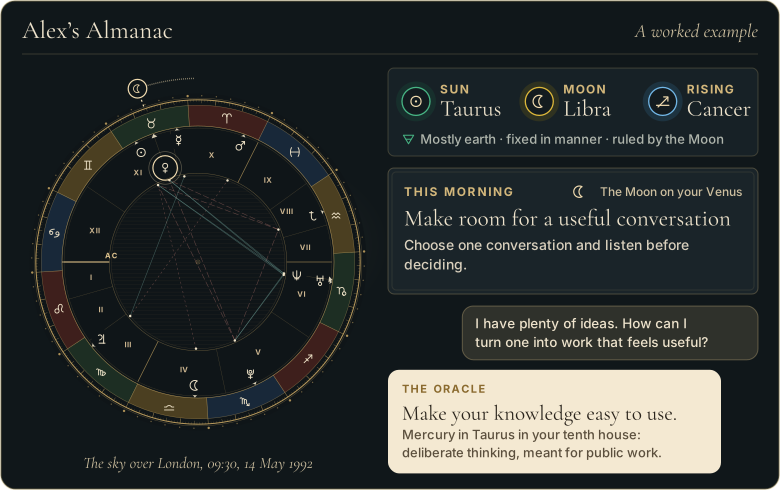
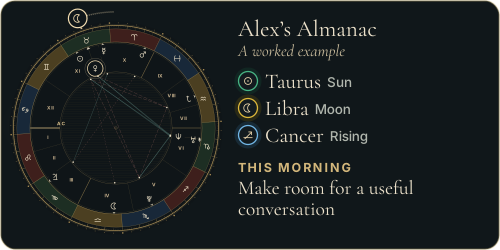
Walk through Alex’s whole example first
 The Road of AgesSee the turning points of your whole life, from your birth date
See your road's shape
The Road of AgesSee the turning points of your whole life, from your birth date
See your road's shape
Prefer to explore first?
 The Road of AgesThe turning points of your whole life, from your own chart
Walk my road
The Road of AgesThe turning points of your whole life, from your own chart
Walk my road
Free, by email
Your daily Almanac letter
One short letter at 7 each morning: the day’s theme read for your own chart, and one thing to do with it.
The components of a full placement
The planet names the symbolic function in astrology; the sign describes its zodiacal environment; the degree supplies precision; the house locates it in a local chart sector; and aspects connect it with other factors. Motion may be direct, retrograde, or near a station. Declination, latitude, sect, dignity, speed, phase, and rulership add further layers in particular traditions. A short phrase such as “Mars in Gemini” is therefore an entry point, not a complete chart statement. Reliable interpretation says which layers are actually known and avoids inventing houses when birth time is uncertain.
A one-minute story
The Book of the Sky
How people learned to read the sky, from Babylon to the day you were born.

How the astronomical position is obtained
An ephemeris or numerical model calculates a body’s apparent position for a precise instant, then expresses its ecliptic longitude in the chosen zodiac. Birth records use local civil time, which must be converted with the correct historical time zone and daylight-saving rule. The birthplace coordinates determine the local horizon and meridian used for angles and houses; they do not materially change ordinary geocentric planetary longitude. High-quality software identifies its ephemeris and settings. A location spelling error, wrong AM/PM value, or assumed time zone can shift houses dramatically even when the sign placement remains unchanged.
A disciplined interpretation order
First state the planet, sign, degree, and house. Next assess sign dignity or condition within the chosen tradition, then the house ruler and angularity. Add only aspects inside a declared orb. Finally look for repetition: does the same planet rule the Ascendant, lead a chart pattern, or connect several important houses? This order prevents a catchy sign keyword from swallowing the rest of the chart. For example, Saturn in Pisces can appear very differently in the first house conjunct the Ascendant than in the eleventh house trine Venus, even though both share the same sign phrase.
What changes when birth time is unknown
The Moon can change degree substantially during a day and occasionally changes sign; faster angles and houses change far more quickly. If no trustworthy time exists, calculate a range across the plausible day and mark what stays stable. Do not present the Ascendant, Midheaven, house position, or exact Moon placement as certain. Rectification is an interpretive attempt to infer time from events, not a substitute for a record, and its assumptions should be disclosed. Precision in display is not the same as accuracy in input. A chart to the second cannot repair a guessed birth time.
How to use Planetary Placement responsibly
Astrological terminology is most useful when the calculation and interpretive convention are stated separately. For Planetary Placement, a careful account identifies the chart factors, degrees, or classification rule first, then explains what astrologers have traditionally inferred from them. Different schools may use different orbs, planets, house systems, or symbolic vocabularies, so a borderline result should be described rather than forced into a label. Astrology is a historical divinatory practice, not a scientifically validated method for diagnosing personality or predicting events. Treat the interpretation as a bounded symbolic hypothesis, compare it with the full chart and lived evidence, and never use it to replace medical, legal, financial, mental-health, or safeguarding advice.
Sources and editorial method
Research and editorial references used for this page include:
- JPL Horizons System - Authoritative astronomical ephemeris service for Solar System positions.
- Astrodienst FAQ: Natal Charts - Chart-calculation context for time, place, houses, and aspects.
These references support the factual, historical, textual, or interpretive claims on this page. Interpretive traditions are identified as such, and factual claims are kept separate from symbolic claims.
Related reading
Find your planetary placements
Planetary Placement in a book is one thing; Planetary Placement in your own birth chart is your life. The Oracle casts your real chart and tells you what it means for your love, your work, and your year ahead, in conversation. It opens with the 7-day Seeker trial.
Speak with the OracleHow Planetary Placement lives in your own chart across your year, in love, in work, in timing, is written in the Cosmic Codex: the whole year, once. Open the Cosmic Codex
More in Astrology
- Sidereal Zodiac
- Triplicity
- Arabic Parts
- Why Christmas Is on December 25
- Doryphory
- Fire Signs
- Karmic Astrology
- Microcosm and Macrocosm
From the reference page to your own chart
Every word here
is in your own chart.
- A personal reading about love, work or purpose, written from your chart
- A practical next step to consider
- It opens with 7 days free, with the AI Oracle and daily guidance
$0 today, then $12/month after 7 days. Cancel anytime.
Common questions
Is a planetary placement just a sign?
No. Sign is one component; degree, house, motion, aspects, and calculation settings provide essential context.
Why did my house placement change on another site?
The sites may use different house systems, coordinates, time-zone data, or birth times. Compare settings.
Can a placement diagnose a condition?
No. Astrological placements are not medical or psychological diagnostic instruments.
Free, by email
The Almanac, in your inbox at 7
One short letter at 7 each morning: the day’s theme read for your own chart, and one thing to do with it.
