Astrology
Arabic Parts
Direct answer
Arabic Parts: Arabic parts, also called lots, are calculated points in a birth chart, each found by measuring the arc between two points and laying it off from the Ascendant, and each tied to one topic of life.
7 days free, $0 today. Your reading is written from your chart, then opens with a Seeker trial: payment details required, then $12/month. We email you 2 days before it ends; cancel on your billing page before then and you pay nothing.
At a glance
- Also called
- astrological parts, parts of fortune list
- In astrology
- Every part depends on the Ascendant, so every part needs a known birth time.
- Found in
- Astrology
- Related
- Part of Fortune, Hermetic Lots, Lot of Spirit, Lot of the Father
Arabic parts, also called lots, are calculated points in a birth chart, each found by measuring the arc between two points and laying it off from the Ascendant, and each tied to one topic of life.
A structural orientation; exact placements depend on the chart or technique being discussed.
What does your own chart say about you?
Choose love, work or purpose. Your reading is written from your chart. Your reading uses your own birth details.
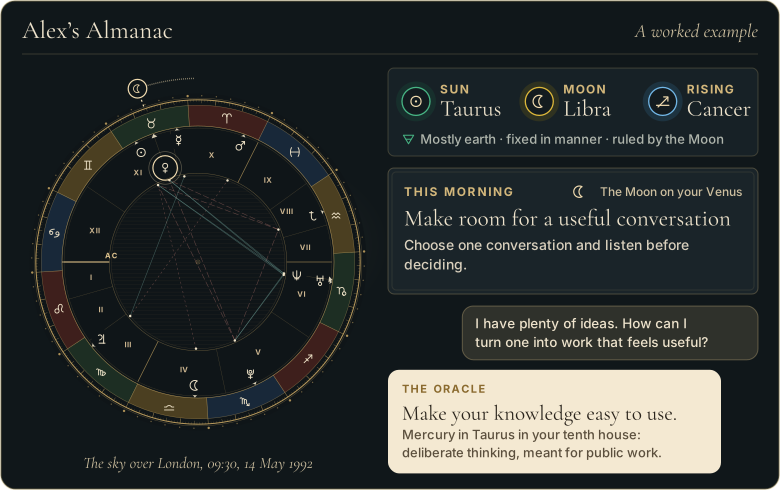
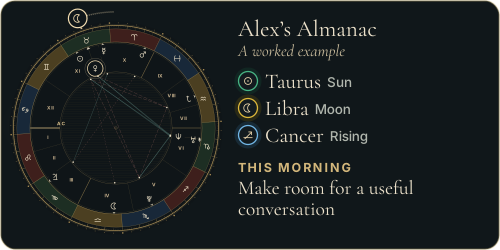
Walk through Alex’s whole example first
 The Road of AgesSee the turning points of your whole life, from your birth date
See your road's shape
The Road of AgesSee the turning points of your whole life, from your birth date
See your road's shape
Prefer to explore first?
 The Road of AgesThe turning points of your whole life, from your own chart
Walk my road
The Road of AgesThe turning points of your whole life, from your own chart
Walk my road
What are Arabic parts?
Every part is found the same way: measure the arc between two points, usually two planets, and lay it off from the Ascendant. The result is a point that stands for one topic, such as fortune, marriage or the father.
The name is a medieval one. The technique is older than Arabic astrology: Greek astrologers of the first centuries called these points lots, and the Arabic and Persian authors who inherited them multiplied them, until a handbook could list close to a hundred.
Only a small set is computed here, all from the Greek authors; the rest are reported as history.
A one-minute story
The Book of the Sky
How people learned to read the sky, from Babylon to the day you were born.

The parts the Almanac computes
With a known birth time, the Almanac computes these, by sign only, and shows them with the Rising sign in the chart panels:
- The Lot of Fortune and the Lot of Spirit, the pair the others are built on.
- Paulus Alexandrinus's five more Hermetic lots: Eros, Necessity, Courage, Victory and Nemesis.
- The Lot of Basis and the Lot of Exaltation.
- The lots of the father, the mother and siblings, read only for the person's own side of those bonds.
The parts it reports but does not compute
- The parts of marriage, because their formula depends on the person's sex and assumes a husband and wife.
- The lot for counting siblings and the lot of children, because no chart can count a family, and a wrong count would hurt.
- Parts for illness and death, because the Almanac does not forecast either.
- The long medieval house-by-house lists and the mundane parts for the prices of goods, because their formulas vary between authors and the Almanac's library does not hold a readable catalogue.
Why every part is given by sign only
A part moves degree for degree with the Ascendant, and the Ascendant moves about a degree every four minutes. A birth time recorded to the nearest quarter hour can shift a part by three or four degrees. The Almanac therefore gives each part by sign, names its ruler, and gives none at all when the Sun sits so close to the horizon that a few minutes could change a day chart into a night chart.
The story behind Arabic Parts
Dorotheus of Sidon (first century) gives Fortune and the family lots; Vettius Valens (second century) gives many more, and Paulus Alexandrinus (378) gives the seven Hermetic lots as a set. The Arabic and Persian astrologers of the eighth to eleventh centuries extended the lists house by house and into mundane astrology, and al-Biruni's Book of Instruction (1029) gives a long catalogue. Medieval Latin authors such as Guido Bonatti passed the lists on to Europe as "parts".
Arabic Parts in astrology
Most reverse their arc between day and night charts; a few are the same in both; one pair, the parts of marriage, turns on the person's sex instead.
Arabic Parts in practice: an example
The Part of Fortune runs from the Sun to the Moon by day. In a chart with the Ascendant at 10 degrees of Libra, the Sun at 20 degrees of Aries and the Moon at 5 degrees of Gemini, it falls at 25 degrees of Scorpio.
Sources and editorial method
This entry summarizes the tradition in the Almanac's own words; where no source is listed, it is an editorial summary rather than a primary text, and symbolic readings are named as the tradition's, not as fact.
- Source
- The Great Almanac Dictionary
- Category
- Astrology
- Aliases
- arabic parts list, arabic parts astrology, astrological parts, lots in astrology, what are arabic parts, parts of fortune list
- Last updated
- 2026-09-26
See Arabic Parts in your personal almanac
Arabic Parts in a book is one thing; Arabic Parts in your own birth chart is your life. The Oracle casts your real chart and tells you what it means for your love, your work, and your year ahead, in conversation. Your first ten written questions are answered free.
Speak with the OracleHow Arabic Parts lives in your own chart across your year, in love, in work, in timing, is written in the Cosmic Codex: the whole year, once. Open the Cosmic Codex
Related terms
More in Astrology
- Why Christmas Is on December 25
- Draconic Chart
- Fixed Signs
- Kite Aspect
- Microcosm and Macrocosm
- Planetary Placement
- Sidereal Zodiac
- Triplicity
From the reference page to your own chart
Every word here
is in your own chart.
- A personal reading about love, work or purpose, written from your chart
- A practical next step to consider
- It opens with 7 days free, with the AI Oracle and daily guidance
7 days free, $0 today. Your reading is written from your chart, then opens with a Seeker trial: payment details required, then $12/month. We email you 2 days before it ends; cancel on your billing page before then and you pay nothing.
Common questions
What are Arabic parts?
Calculated chart points, each found by laying off the arc between two points from the Ascendant, each tied to a topic of life. They are also called lots.
Are Arabic parts actually Arabic?
Only by name. The Greek astrologers of the first centuries already used them; Arabic and Persian authors expanded the lists and passed them on to medieval Europe.
How many Arabic parts are there?
There is no fixed number. Medieval catalogues run to close to a hundred, including parts for every house and for the prices of goods. The Great Almanac uses fewer than twenty.
Which Arabic parts does the Almanac show?
Fortune, the six other Hermetic lots, Basis and Exaltation, and the lots of the father, the mother and siblings, each by sign and each as a topic, never as a forecast.