Specialized astrology techniques
Draconic Chart
Direct answer
Subtract the north node’s longitude from every natal longitude, then add or subtract 360 degrees until each result falls from 0° to under 360°. State whether the true or mean node was used; different node values rotate the entire chart by different amounts.
A draconic chart rotates all zodiacal longitudes by the same amount so the chosen north lunar node becomes 0° Aries. It preserves angular distances among planets while changing their zodiac signs and their cross-chart contacts with natal points.
$0 today, then $12/month after 7 days. Cancel anytime.
Quick facts
| Feature | Effect |
|---|---|
| Reference point | North lunar node reset to 0° Aries. |
| Formula | Draconic longitude = natal longitude − node longitude, normalized to 0°-360°. |
| Internal aspects | Unchanged, because every point receives the same rotation. |
| Key comparison | Draconic-to-natal conjunctions and oppositions are often emphasized by practitioners. |
Draconic Chart is an advanced nodal chart technique used alongside the natal chart.
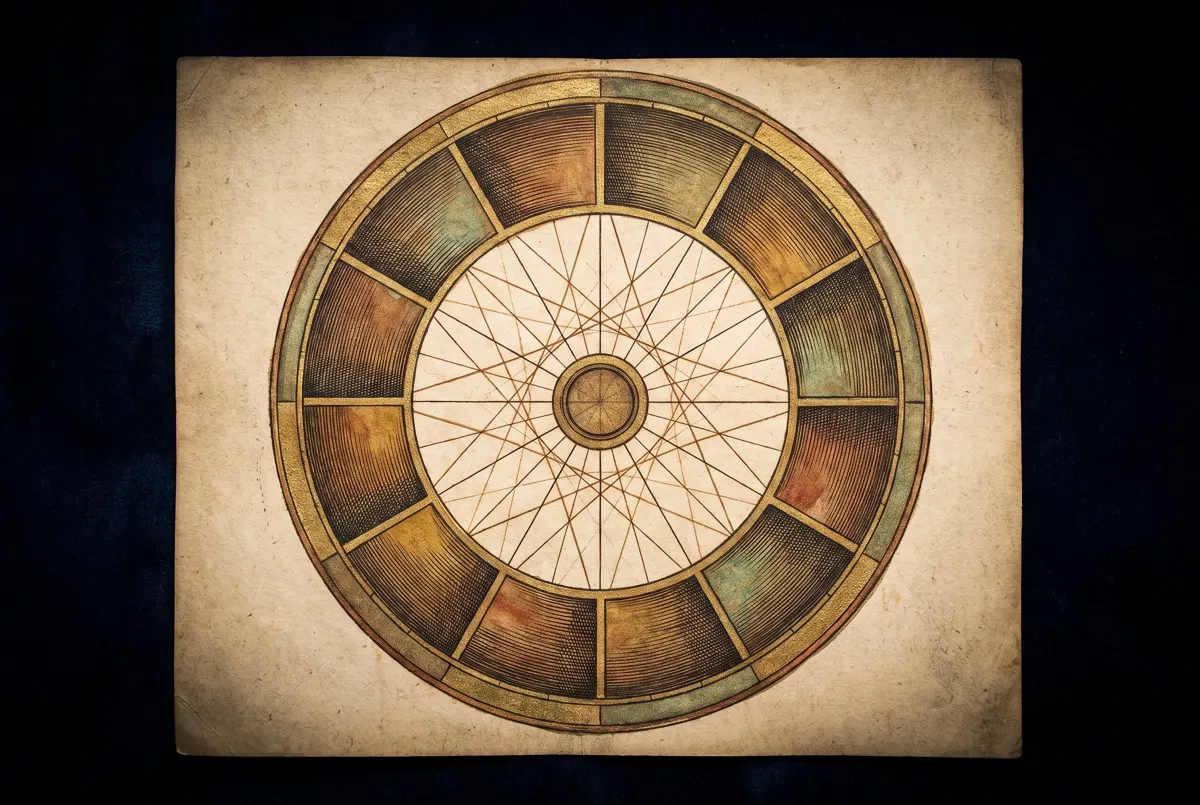
A structural orientation; exact placements depend on the chart or technique being discussed.
What does your own chart say about you?
Choose love, work or purpose. Your reading is written from your chart. Your reading uses your own birth details.
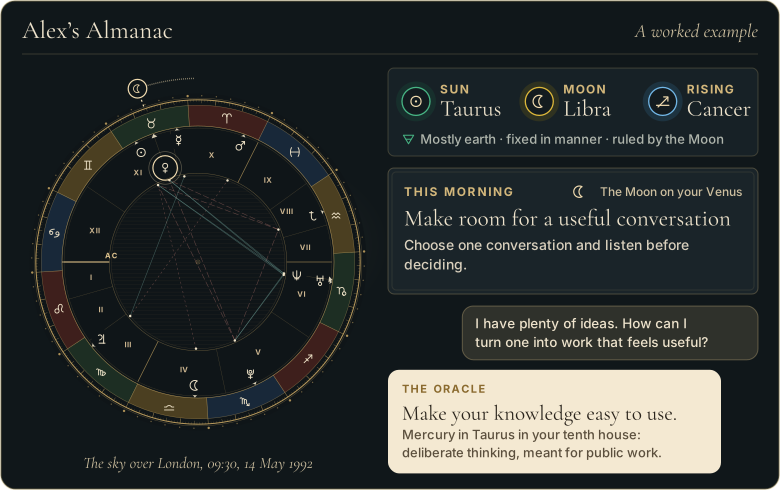
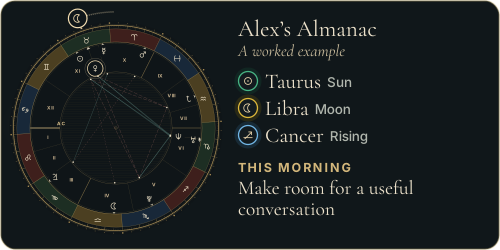
Walk through Alex’s whole example first
 The Road of AgesSee the turning points of your whole life, from your birth date
See your road's shape
The Road of AgesSee the turning points of your whole life, from your birth date
See your road's shape
Prefer to explore first?
 The Road of AgesThe turning points of your whole life, from your own chart
Walk my road
The Road of AgesThe turning points of your whole life, from your own chart
Walk my road
Free, by email
Your daily Almanac letter
One short letter at 7 each morning: the day’s theme read for your own chart, and one thing to do with it.
How to calculate a draconic longitude
Convert signs to absolute longitude: Aries begins at 0°, Taurus 30°, Gemini 60°, and so on. If the north node is 17° Cancer, its longitude is 107°. A natal Venus at 2° Sagittarius is 242°; subtracting gives 135°, or 15° Leo in the draconic chart. A natal planet earlier than the node may produce a negative result, so add 360°. The operation is a rigid rotation of the zodiac, not a new astronomical position of the planet.
A one-minute story
The Book of the Sky
How people learned to read the sky, from Babylon to the day you were born.

True node, mean node, and house choices
The Moon’s nodes are calculated intersections rather than physical bodies. The true node includes short-period oscillation, while the mean node smooths that motion. Either convention can be used, but the choice shifts every draconic point and should appear in the chart metadata. Some astrologers rotate the Ascendant, Midheaven, and house cusps with the same formula; others focus only on planets or recalculate houses differently. Since practices vary, a diagram without method details cannot be reproduced accurately.
What changes and what stays the same
Because each longitude moves by one constant arc, the angular distance between any two natal planets remains identical. A natal square remains a draconic square, so interpreting internal draconic aspects as newly formed geometry is a mistake. What changes are sign positions and relationships between the rotated chart and the unrotated natal chart. Practitioners often overlay the wheels and inspect tight draconic-to-natal contacts, especially conjunctions to the Sun, Moon, angles, ruler, and nodes. Orbs should be declared and kept narrow for specialized comparison.
Soul language, symbolism, and evidential limits
Modern astrology sometimes calls the draconic chart a soul chart, karmic map, or record of past lives. Those descriptions are metaphysical interpretations, not consequences of the rotation formula and not scientifically validated discoveries. A more careful reading treats it as a node-centered symbolic perspective: What natal functions become highlighted when the ascending node is used as zero? Compare themes with biography and avoid telling someone that a placement proves reincarnation, trauma, destiny, or a hidden identity. The exact mathematics can be checked even when the meaning remains interpretive.
Sources and editorial method
Research and editorial references used for this page include:
- Astrodienst Astrowiki: Lunar node - Reference context for true and mean lunar nodes in chart calculation.
- NASA JPL: Horizons system manual - Technical background for coordinate conventions and astronomical position data.
These references support the factual, historical, textual, or interpretive claims on this page. Interpretive traditions are identified as such, and factual claims are kept separate from symbolic claims.
Related reading
Compare your chart layers
Draconic Chart in a book is one thing; Draconic Chart in your own birth chart is your life. The Oracle casts your real chart and tells you what it means for your love, your work, and your year ahead, in conversation. It opens with the 7-day Seeker trial.
Speak with the OracleHow Draconic Chart lives in your own chart across your year, in love, in work, in timing, is written in the Cosmic Codex: the whole year, once. Open the Cosmic Codex
More in Astrology
- Fixed Signs
- Kite Aspect
- Midheaven
- Planetary Position
- Sidereal Zodiac
- Triplicity
- Arabic Parts
- Why Christmas Is on December 25
From the reference page to your own chart
Every word here
is in your own chart.
- A personal reading about love, work or purpose, written from your chart
- A practical next step to consider
- It opens with 7 days free, with the AI Oracle and daily guidance
$0 today, then $12/month after 7 days. Cancel anytime.
Common questions
Does a draconic chart change planetary aspects?
Not within the rotated chart. Applying the same angular shift to every point preserves all pairwise distances. Cross-chart aspects to natal positions do change.
Should I use the true or mean north node?
Both conventions exist. Choose one, label it, and use it for every point; otherwise two calculations will not match.
Is the draconic chart an ancient technique?
The modern node-zero chart and its soul-oriented interpretation are specialized later practices, not a standard technique documented across ancient astrology.
Free, by email
The Almanac, in your inbox at 7
One short letter at 7 each morning: the day’s theme read for your own chart, and one thing to do with it.
