Astrology
Why Christmas Is on December 25
Direct answer
Why Christmas Is on December 25: Christmas falls on 25 December, a few days after the winter solstice, and there are two main explanations for the date: a link to the Roman festival of the sun, and a calculation from 25 March, the day counted as the conception.
7 days free, $0 today. Your reading is written from your chart, then opens with a Seeker trial: payment details required, then $12/month. We email you 2 days before it ends; cancel on your billing page before then and you pay nothing.
At a glance
- Also called
- christmas december 25, why is christmas on december 25, date of christmas, christmas and the winter solstice
- In astrology
- The winter solstice is the point where the Sun reaches its lowest noon height and, for about three days, seems to stand still before the days begin to lengthen.
- Found in
- Astrology
- Related
- December Solstice, Solstice, Capricorn, Virgo
Christmas falls on 25 December, a few days after the winter solstice, and there are two main explanations for the date: a link to the Roman festival of the sun, and a calculation from 25 March, the day counted as the conception.
A structural orientation; exact placements depend on the chart or technique being discussed.
What does your own chart say about you?
Choose love, work or purpose. Your reading is written from your chart. Your reading uses your own birth details.
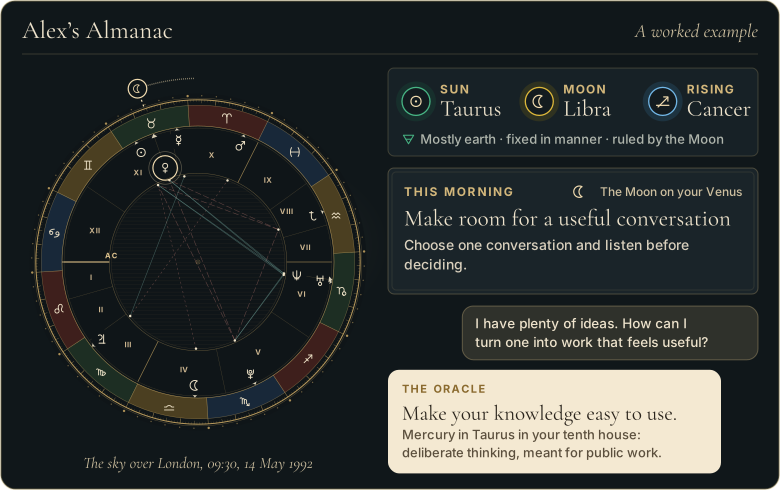
Walk through Alex’s whole example first
 The Road of AgesSee the turning points of your whole life, from your birth date
See your road's shape
The Road of AgesSee the turning points of your whole life, from your birth date
See your road's shape
Prefer to explore first?
 The Road of AgesThe turning points of your whole life, from your own chart
Walk my road
The Road of AgesThe turning points of your whole life, from your own chart
Walk my road
Why is Christmas on December 25?
The Gospels give no date for the birth of Jesus, and the church did not celebrate one for its first centuries. The first record of a Christmas on 25 December comes from Rome in the fourth century.
Two explanations are argued. One links the date to the winter solstice and the Roman festival of the unconquered sun, which fell on the same day. The other counts nine months forward from 25 March, the day the church came to keep as the Annunciation. The sun-myth writers, J. H. Hill among them, read the date as the birth of the sun, three days after it stands still at the solstice.
A one-minute story
The Book of the Sky
How people learned to read the sky, from Babylon to the day you were born.

The two explanations historians argue
The first record of Christmas on 25 December is from Rome in the fourth century, and the Roman calendar of 354 also lists that day as the birthday of the unconquered sun, Sol Invictus. That coincidence is the basis of the history-of-religions explanation: the church chose the date to take over a popular festival of the sun.
The calculation explanation points at the other end of the year. The church came to keep 25 March as the day of the Annunciation, the conception, and nine months later is 25 December. Hill's festival table lists both days, the Annunciation on 25 March and the Nativity on 25 December. Scholars still argue which came first, and the two explanations are not exclusive.
The Gospels themselves give no date, and nothing in them ties the birth to midwinter.
Hill's reading: the birth of the sun
J. H. Hill's Astral Worship, written in the 1890s, puts the Nativity inside the solar year. He says the sun stands still for three days at the winter solstice, and 25 December is the third day after, the birth of the sun. He reads Virgo as the mother, rising at midnight on 24 December with the infant sun, and he calls the child God Sol.
Hill then hangs the rest of the Christian year on the same solar frame:
- 24 June, St John the Baptist, the first day the days shorten, "he must decrease", against 25 December, the first day they lengthen.
- 21 December, St Thomas, "the Doubter", the genius of the twelfth month.
- 6 January, Epiphany, the star the Magi saw, with gold for the sun and frankincense and myrrh as sun gums.
These are his arguments. Mainstream historians reject the claim that the Gospel story is an astronomical allegory, and the feasts have documented histories of their own.
The Virgin in the sky
The sun-myth writers lean on the constellation. Virgo is shown in old zodiacs holding an ear of wheat, and some medieval and Arabic zodiacs show her with a child. Hill reads Genesis 3:15, the heel of Hercules on the head of Draco, as the sky picture of the serpent and the woman, and the woman as Virgo.
The picture of Virgo with a child is documented in some medieval and Arabic zodiacs. The reading of the Nativity story from it is Hill's own, and writers after him such as Gerald Massey and Acharya S make similar arguments. Scholars of the Gospels do not accept them.
The story behind Why Christmas Is on December 25
The earliest evidence of Christmas on 25 December is from Rome in the 330s, and the Roman calendar of 354 lists the same day as the birthday of the unconquered sun. Hill, in the 1890s, set the Nativity, Epiphany and the rest of the church year inside a solar calendar and argued that the feasts were the old festivals of the sun renamed.
Why Christmas Is on December 25 in practice: an example
Hill counts 25 December as the third day after the solstice so the sun stands still for three days and then rises.
Sources and editorial method
This entry summarizes the tradition in the Almanac's own words; where no source is listed, it is an editorial summary rather than a primary text, and symbolic readings are named as the tradition's, not as fact.
- Source
- The Great Almanac Dictionary
- Category
- Astrology
- Aliases
- christmas december 25, why is christmas on december 25, date of christmas, christmas and the winter solstice, christmas sun myth
- Last updated
- 2026-09-26
See Why Christmas Is on December 25 in your personal almanac
Why Christmas Is on December 25 in a book is one thing; Why Christmas Is on December 25 in your own birth chart is your life. The Oracle casts your real chart and tells you what it means for your love, your work, and your year ahead, in conversation. Your first ten written questions are answered free.
Speak with the OracleHow Why Christmas Is on December 25 lives in your own chart across your year, in love, in work, in timing, is written in the Cosmic Codex: the whole year, once. Open the Cosmic Codex
Related terms
More in Astrology
- Draconic Chart
- Fixed Signs
- Kite Aspect
- Midheaven
- Planetary Placement
- Sidereal Zodiac
- Triplicity
- Arabic Parts
From the reference page to your own chart
Every word here
is in your own chart.
- A personal reading about love, work or purpose, written from your chart
- A practical next step to consider
- It opens with 7 days free, with the AI Oracle and daily guidance
7 days free, $0 today. Your reading is written from your chart, then opens with a Seeker trial: payment details required, then $12/month. We email you 2 days before it ends; cancel on your billing page before then and you pay nothing.
Common questions
Why is Christmas on December 25?
Nobody knows for certain. Two explanations are argued: the date matches the Roman festival of the unconquered sun on the winter solstice, and it falls nine months after 25 March, the day the church kept as the Annunciation.
Is Christmas the winter solstice?
Not exactly. The solstice falls around 21 December. Christmas follows it by about three days, which is the point sun-myth writers like Hill make about the sun standing still.
Was Jesus born on December 25?
The Gospels give no date, and the church of the early centuries did not celebrate a birthday. The 25 December date is first recorded in Rome in the fourth century.
Did Christmas come from a pagan festival?
The date coincides with a Roman festival of the sun, and some scholars think the church chose it for that reason. Others argue the date came from the March calculation and the festival coincidence is accidental. The question is still debated.