
Planets and points
Venus
Direct answer
Venus in astrology represents love, attraction, pleasure, beauty, harmony, values, art, desire for ease, and the way a person receives or offers affection.
$0 today, then $12/month after 7 days. Cancel anytime.
At a glance
- In astrology
- Venus rules Taurus and Libra, is exalted in Pisces, falls in Virgo, and is in detriment in Aries and Scorpio.
- Found in
- Planets & Celestial Bodies
- Related
- Planetary Placement, Planetary Position, Birth Chart, Transit
Venus represents love, beauty, pleasure, values, and attraction.
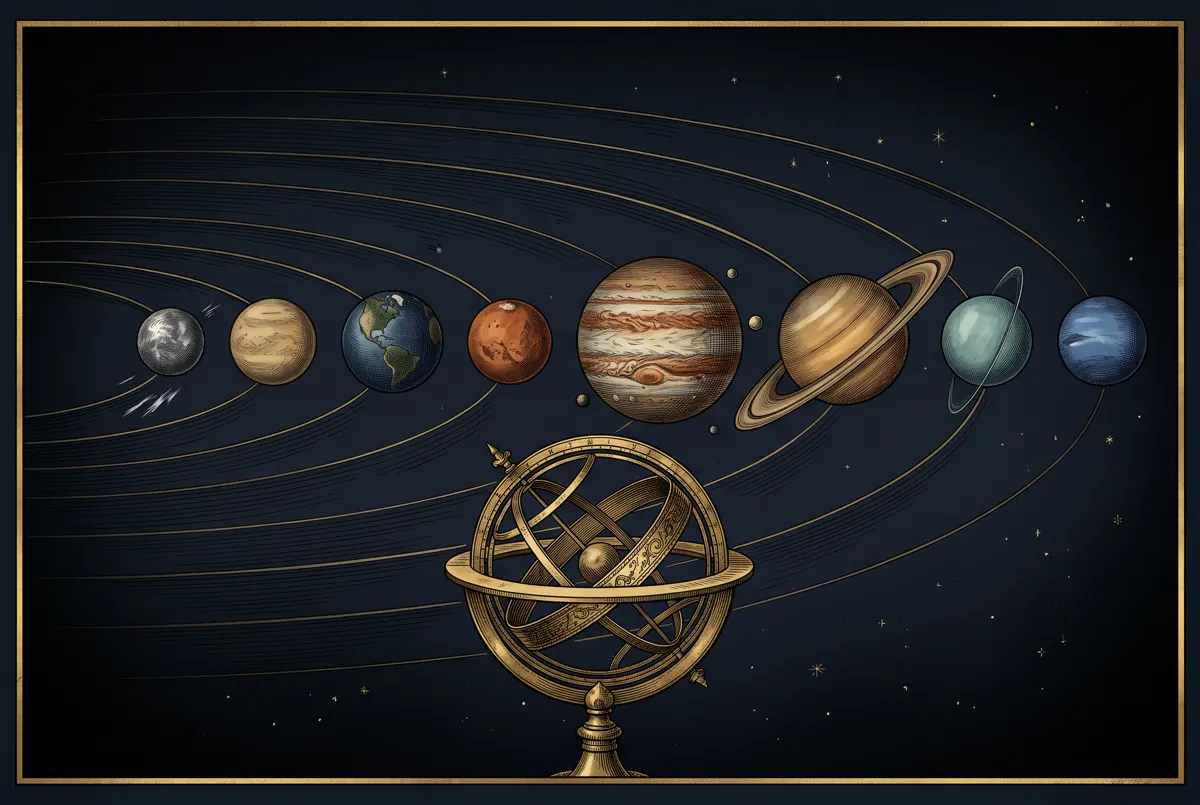
The orbit map distinguishes physical bodies, calculated points, and symbolic cycles where possible.
Understand your own relationship patterns.
Explore what you need in love and a next step for your situation. Your reading uses your own birth details.
Walk through Alex’s whole example first


 The Road of AgesSee the turning points of your whole life, from your birth date
See your road's shape
Prefer to explore first?
 The Road of AgesThe turning points of your whole life, from your own chart
Walk my road
Free, by email
Your daily Almanac letter
One short letter at 7 each morning: the day’s theme read for your own chart, and one thing to do with it.
What sets Venus apart
Venus is the brightest planet and the only one that alternates openly between morning and evening, the Greeks naming the two phases Phosphoros and Hesperos. It never leaves the Sun by more than about 47 degrees, which Ptolemy turns into a rule that it is never more than two signs from the Sun. Her retrograde returns in a pattern of five loops over almost exactly eight years. In sect she is nocturnal, and she is the lesser benefic, the planet Ptolemy calls temperate, with moisture greater than heat.
- Greatest elongation: about 47 degrees from the Sun, at most two signs away
- Synodic cycle: about 584 days from one meeting with the Sun to the next
- Retrograde: about 40 days, once every 19 months or so
- Eight-year pattern: five synodic cycles come to within a few days of eight years
- Exaltation degree: 27 degrees of Pisces in the later tradition
- Joy: the fifth house, in the lists of al-Qabisi and the Abbreviation
A one-minute story
The Wandering Stars
How the moving planets were watched, named and found, and what a transit is.

Venus in the traditional textbooks
Venus is the second benefic in Burgoyne's ranking. Ptolemy calls her temperate, with moisture leading heat, and says Jupiter's good gentles down in her hands into marriages, children and reverence. Firmicus calls the fifth house Good Fortune because it is Venus's place, and Dorotheus assigns her gain through women. She is a night planet, and Firmicus has her hostile to the waxing Moon by natural envy.
- Nature (Ptolemy): Venus is temperate, with moisture leading heat, because her large light draws vapors from the earth as the Moon's does.
- Class (Ptolemy): benefic.
- Sex (Ptolemy): feminine. Team: the night team.
- Sphere (Firmicus): a faithful companion of the Sun, with Mercury.
- Egyptian name (Firmicus): Phosphoros.
- Color (Ptolemy, reading eclipses and comets): yellow.
- Orb (Abu Ma'shar): 7 degrees.
- Body (Ptolemy): the nostrils, liver and flesh. Body (Burgoyne, 1896): the internal sex and generative functions, the ovaries and the venous system.
Venus: dignities, bounds and strength
Where Venus is strong, according to the same few authors:
- Domicile: Taurus and Libra. Ptolemy's reason: she is in sextile to the houses of the luminaries and never more than two signs from the Sun.
- Detriment: Scorpio and Aries, the signs opposite its own.
- Exaltation: 27 degrees of Pisces, because moisture sets in with Pisces (Ptolemy). Fall: 27 degrees of Virgo.
- Joy by sign (Dorotheus): Taurus. Joy by house (al-Qabisi): the fifth house.
- Triplicity: day lord of the earth signs (Taurus, Virgo and Capricorn); day lord of the water signs (Cancer, Scorpio and Pisces) (Dorotheus).
The Egyptian bounds of Venus add up to 82 degrees of the 360. Aries 7 to 12, Taurus 1 to 8, Gemini 13 to 17, Cancer 8 to 13, Leo 7 to 11, Virgo 8 to 17, Libra 22 to 28, Scorpio 8 to 11, Sagittarius 13 to 17, Capricorn 15 to 22, Aquarius 8 to 13, Pisces 1 to 12. The widest is 12 degrees, in Pisces, and the narrowest is 4, in Scorpio.
Venus rules 5 of the 36 decans: third decan of Aries, first decan of Cancer, second decan of Virgo, third decan of Scorpio, first decan of Aquarius.
- Facing (al-Qabisi, after Ptolemy): a western planet is in the facing of the Sun when it stands in the third sign from the Sun, as many signs as its domicile is from the Sun's.
- Face (Ptolemy, a phase and not a decan): it makes sextile to the Sun.
- Morning star (Firmicus): it becomes one when it precedes the Sun by 8 degrees.
Venus: people, years and the limb in each sign
Burgoyne calls Venus the planet of mirth, domestic love, art and music, magnetic, warm and moisture-producing. Firmicus gives her Egyptian name as Phosphoros. Hill puts her on the Sun's near side in the seven-branched candlestick, with the Moon and Mercury.
Ptolemy gives it the mother (with the Moon). Among siblings, Dorotheus assigns it younger sisters; when it rules the second house, he traces a decline in fortune to women. Dorotheus's figure for the years of evil an angular planet holds off is 8 years. Ptolemy says that as lord of an eclipse she gives Jupiter's good more gently: marriages, children and reverence.
Al-Qabisi gives each planet a limb in each sign, the part that shows illness when it is troubled there. For Venus:
- Aries: feet
- Taurus: head
- Gemini: neck
- Cancer: arms and shoulders
- Leo: heart
- Virgo: belly
- Libra: belly and head
- Scorpio: private parts
- Sagittarius: thighs and arms
- Capricorn: thighs and heart
- Aquarius: knees
- Pisces: neck and back
The story behind Venus
Venus is one of the seven classical planets and has long been tied to love and beauty deities.
The spiritual meaning of Venus
Spiritually, Venus asks what is truly worthy of affection and desire.
Why Venus matters
Venus matters because it shows what a person finds worth choosing, enjoying, protecting, beautifying, or joining with.
How to read Venus
Astrologers reach for Venus when interpreting relationships, aesthetics, money values, charm, art, pleasure, friendship, and Venus transits or returns.
Venus in practice: an example
Venus in Capricorn may love through commitment, reliability, standards, and long-term proof.
Where readings of Venus go wrong
It is a mistake to reduce Venus to romance. Venus also describes taste, value, money, art, and social ease.
Sources and editorial method
This entry summarizes the tradition in the Almanac's own words; where no source is listed, it is an editorial summary rather than a primary text, and symbolic readings are named as the tradition's, not as fact.
- Source
- The Great Almanac Dictionary
- Category
- Planets & Celestial Bodies
- Aliases
- Venus astrology, Venus meaning
- Last updated
- 2026-09-26
Read your Venus placement
Venus in a book is one thing; Venus in your own birth chart is your life. The Oracle casts your real chart and tells you what it means for your love, your work, and your year ahead, in conversation. It opens with the 7-day Seeker trial.
Speak with the OracleWhere Venus moves through your own year, and what that asks of your love and your work, is written in the Cosmic Codex, month by month from your chart. Open the Cosmic Codex
Related terms
More in Planets & Celestial Bodies
From the reference page to your own chart
Every word here
is in your own chart.
- A personal reading about love, work or purpose, written from your chart
- A practical next step to consider
- It opens with 7 days free, with the AI Oracle and daily guidance
$0 today, then $12/month after 7 days. Cancel anytime.
Common questions
What is Venus?
Venus in astrology represents love, attraction, pleasure, beauty, harmony, values, art, desire for ease, and the way a person receives or offers affection.
Where does Venus come from?
Venus is one of the seven classical planets and has long been tied to love and beauty deities.
What does Venus mean in astrology?
Astrologers reach for Venus when interpreting relationships, aesthetics, money values, charm, art, pleasure, friendship, and Venus transits or returns.
What does Venus look like in a birth chart?
Venus in Capricorn may love through commitment, reliability, standards, and long-term proof.
What does Venus mean spiritually?
Spiritually, Venus asks what is truly worthy of affection and desire.
Free, by email
The Almanac, in your inbox at 7
One short letter at 7 each morning: the day’s theme read for your own chart, and one thing to do with it.


