Astrological aspect geometry
Exact Aspect
Direct answer
Subtract the two zodiacal longitudes, reduce the result to the smaller distance from 0 to 180 degrees, and compare it with the target angle. An opposition is exact at 180 degrees; at 178 degrees it has a 2-degree orb.
An exact aspect occurs when the angular distance between two chart factors equals the aspect’s defining angle, such as 0 degrees for a conjunction or 180 degrees for an opposition.
$0 today, then $12/month after 7 days. Cancel anytime.
Quick facts
| Question | Direct answer |
|---|---|
| What does exact mean? | The measured separation matches the nominal aspect angle, within the precision being reported. |
| Is exact the same as partile? | Often, but partile can mean within the same whole degree rather than mathematically exact. Authors should define their usage. |
| Does exact mean applying? | No. An exact aspect is a geometry; applying and separating describe motion before or after perfection. |
| Is a close aspect always dominant? | No. Planet, angle, chart context, dignity, and repeated themes still affect interpretive weight. |
An Exact Aspect is at peak precision and usually strongest.
A structural orientation; exact placements depend on the chart or technique being discussed.
What does your own chart say about you?
Choose love, work or purpose. Your reading is written from your chart. Your reading uses your own birth details.
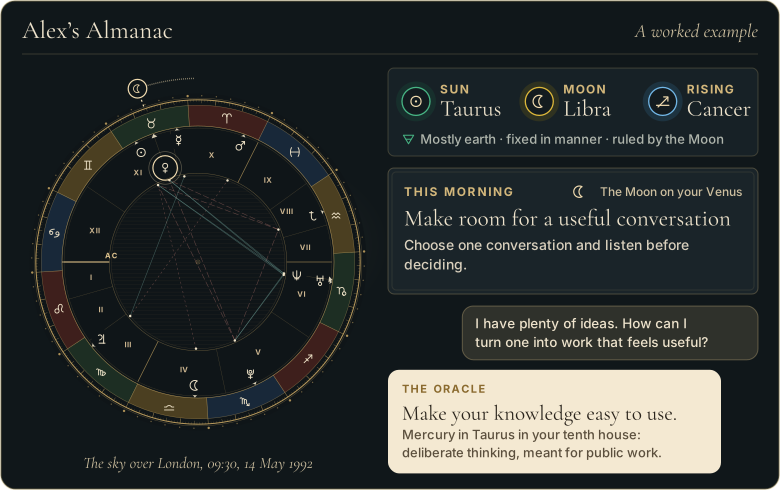
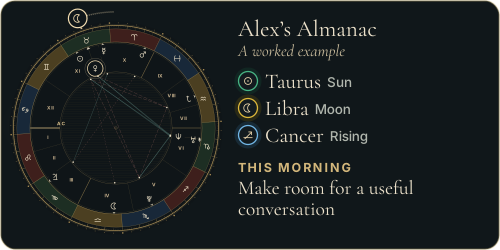
Walk through Alex’s whole example first
 The Road of AgesSee the turning points of your whole life, from your birth date
See your road's shape
The Road of AgesSee the turning points of your whole life, from your birth date
See your road's shape
Prefer to explore first?
 The Road of AgesThe turning points of your whole life, from your own chart
Walk my road
The Road of AgesThe turning points of your whole life, from your own chart
Walk my road
Free, by email
Your daily Almanac letter
One short letter at 7 each morning: the day’s theme read for your own chart, and one thing to do with it.
Exactness is a measured angular relationship
Each named aspect corresponds to an ideal division of the 360-degree circle: conjunction 0 degrees, sextile 60, square 90, trine 120, and opposition 180. Minor aspects use other divisions. If Venus is at 12 degrees 20 minutes Taurus and Mars at 12 degrees 20 minutes Leo, their separation is exactly 90 degrees at the stated precision, so the square is exact. If Mars is at 14 degrees Leo, the square is 1 degree 40 minutes from exact. Software may display a rounded 0-degree orb even when seconds of arc remain, so always note the precision of the data.
A one-minute story
The Book of the Sky
How people learned to read the sky, from Babylon to the day you were born.

Exact aspect versus permitted orb
An orb is the amount by which an aspect differs from its ideal angle. The aspect can still be recognized within an allowed orb, but it is not exact. Orb policies vary: many astrologers allow wider ranges for the Sun and Moon, narrower ranges for minor aspects, and special rules for configurations. “Exact within one degree” is convenient shorthand, not literal mathematical exactness. A transparent chart report should show the actual longitudes and orb rather than using color or line thickness alone. That makes it possible for a reader to compare methods without pretending one threshold is universal.
Applying, perfecting, and separating
In timing traditions, an aspect may be applying as the faster body moves toward the exact angle, perfect at exact contact, and separating afterward. Retrograde motion can complicate that sequence, and a body may station before perfection. A natal chart is a snapshot, so applying and separating language depends on reconstructed motion around the birth moment. In horary and electional astrology the sequence may carry special interpretive rules. Exactness alone does not reveal direction; ephemeris positions before and after the chart time are needed to establish whether the bodies are converging or moving apart.
A reliable calculation procedure
Convert each position to absolute zodiacal longitude: Aries begins at 0 degrees, Taurus at 30, Gemini at 60, and so on. Find the absolute difference, and if it exceeds 180 subtract it from 360. Compare the resulting shortest separation with the chosen aspect angle. For a trine between 29 degrees Pisces and 1 degree Leo, remember the Aries boundary when converting; subtracting sign degrees without absolute longitude produces an error. For high precision include minutes and seconds, and ensure both positions use the same zodiac, reference frame, and time rather than mixing tropical and sidereal output.
How to use Exact Aspect responsibly
Astrological terminology is most useful when the calculation and interpretive convention are stated separately. For Exact Aspect, a careful account identifies the chart factors, degrees, or classification rule first, then explains what astrologers have traditionally inferred from them. Different schools may use different orbs, planets, house systems, or symbolic vocabularies, so a borderline result should be described rather than forced into a label. Astrology is a historical divinatory practice, not a scientifically validated method for diagnosing personality or predicting events. Treat the interpretation as a bounded symbolic hypothesis, compare it with the full chart and lived evidence, and never use it to replace medical, legal, financial, mental-health, or safeguarding advice.
What sets Exact Aspect apart
An aspect is exact when the angle between the two bodies is complete to the minute, 90 degrees 0 minutes for a square. The Moon crosses about half a degree an hour, so its exact moments are fixed to the hour, while a slow planet can stay within a degree of exact for weeks. When a planet turns retrograde the aspect can become exact three times, in a pass, a return and a final pass.
- Precision: one degree is 60 arcminutes; exact means the angle is complete
- Moon: moves about 0.5 degree an hour, so an exact Moon aspect is timed to the hour
- Sun: moves about 1 degree a day
- Partile: the traditional word for two planets sharing the same degree number
- Triple pass: a slow transit can be exact three times if the planet turns retrograde
Often mistaken for something else: Partile and exact are close but not the same: partile means the same degree number, such as 12 degrees 10 minutes with 12 degrees 50 minutes, while exact means the angle is complete to the minute.
Sources and editorial method
Research and editorial references used for this page include:
- Astrodienst Astrowiki: Aspect - Reference overview of aspect angles, orbs, and terminology.
- Swiss Ephemeris documentation - Technical background for the planetary longitudes used in precise chart calculations.
These references support the factual, historical, textual, or interpretive claims on this page. Interpretive traditions are identified as such, and factual claims are kept separate from symbolic claims.
Related reading
Prioritize your strongest aspects
Exact Aspect in a book is one thing; Exact Aspect in your own birth chart is your life. The Oracle casts your real chart and tells you what it means for your love, your work, and your year ahead, in conversation. It opens with the 7-day Seeker trial.
Speak with the OracleHow Exact Aspect lives in your own chart across your year, in love, in work, in timing, is written in the Cosmic Codex: the whole year, once. Open the Cosmic Codex
More in Aspects
From the reference page to your own chart
Every word here
is in your own chart.
- A personal reading about love, work or purpose, written from your chart
- A practical next step to consider
- It opens with 7 days free, with the AI Oracle and daily guidance
$0 today, then $12/month after 7 days. Cancel anytime.
Common questions
Can an aspect be exact by sign but not by degree?
No in ordinary degree-based usage. Whole-sign relationships can exist without a degree-perfect aspect and should be labeled as such.
What does an orb of 0°00′ mean?
It means the difference rounds below the displayed minute; seconds may still separate the positions.
Do exact minor aspects matter more than wide major aspects?
There is no universal rule. State the aspect system and evaluate the full chart instead of ranking solely by numerical closeness.
Free, by email
The Almanac, in your inbox at 7
One short letter at 7 each morning: the day’s theme read for your own chart, and one thing to do with it.
