Traditional aspect terminology
Partile Aspect
Direct answer
Mars at 14°10′ Aries and Saturn at 14°55′ Cancer form a partile square by the same-whole-degree rule, with an orb of 45 minutes. They are close but not mathematically exact until their separation reaches precisely 90 degrees.
A partile aspect is traditionally an aspect perfected within the same degree numbers of two signs, though modern writers sometimes use partile loosely to mean very close or exact.
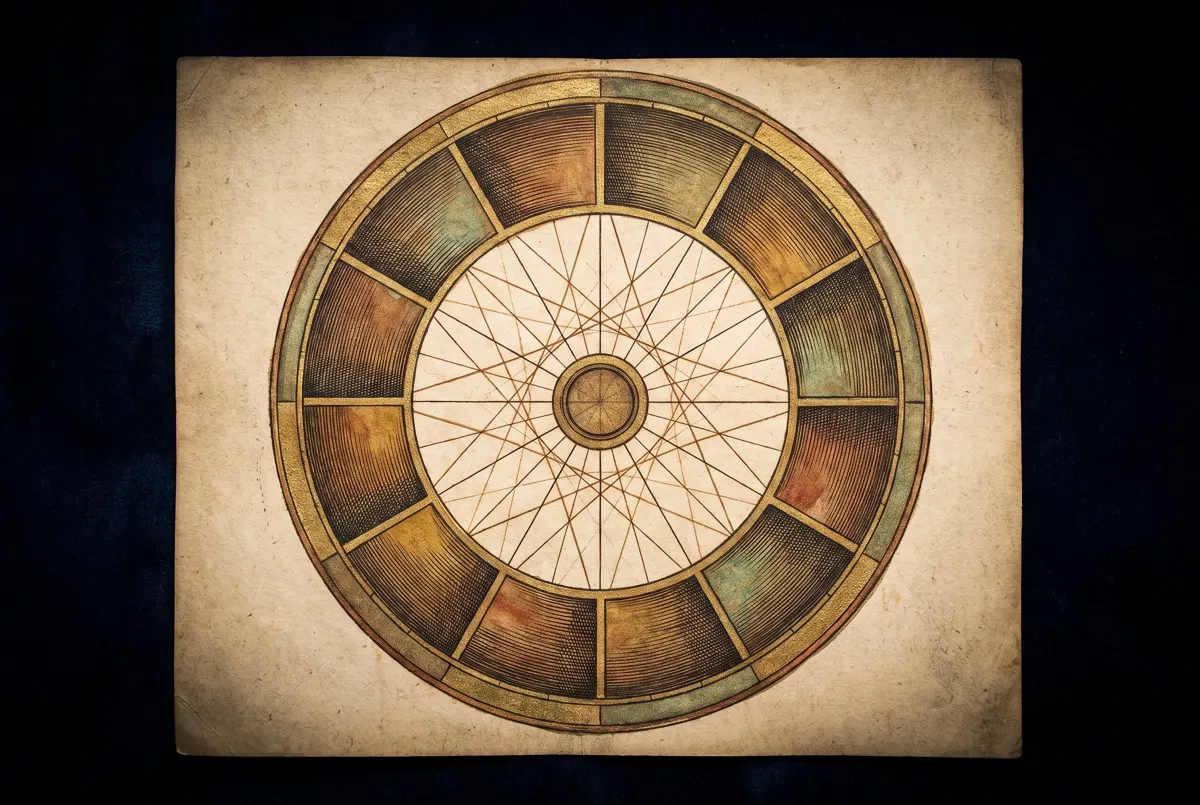
Partile Aspect means an aspect exact by degree or very close to exact.
A structural orientation; exact placements depend on the chart or technique being discussed.Quick facts
| Question | Direct answer |
|---|---|
| Traditional contrast | Partile versus platic, meaning within the same degree versus spread across a wider orb. |
| Does partile always mean 0°00′ orb? | No. Same whole degrees can still differ by up to nearly one degree. |
| Can usage vary? | Yes. Some modern authors use partile for any aspect within one degree. |
| Why state the orb? | It removes ambiguity between historical same-degree and modern exactness meanings. |
The Instruments
Ten readings, worked out from your own birth chart
An instrument is a reading this house works out for you. Give your birth date, time and place once, and each one reads today’s real sky against the chart you were born under. Eight are personal; two are calendars anyone can open. A free account opens one instrument a day. The plans open every instrument, every day.
- Natal Chart Every planet, house and aspect in your chart
- Active Transits Where the planets are now, read against your chart
- Daily Counsel What to pursue today, and what to leave alone
- Personal Timing Your best days to decide, weeks ahead
- Fellowship Your chart and another, read side by side
- Theme of the Day The one thing today is asking of you
- Sacred Numbers Your life path, your cycles, your name in numbers
- Aeolian Harmonics Classical music chosen to match your chart
- Mercury Retrograde Every Mercury retrograde this year, with its dates Open to all
- Void-of-Course Moon When the Moon is between signs, hour by hour Open to all




The traditional same-degree idea
In older astrological language, an aspect could be called partile when planets occupied corresponding degrees of signs configured by an aspect. A planet at the fourteenth degree of Aries and another at the fourteenth degree of Cancer were in a partile square even if their minutes differed. “Degree” was also sometimes counted ordinally, so positions from 13°00′ through 13°59′ could be described as being in the fourteenth degree. Translation and notation matter. The central idea is a relationship by degree parts, contrasted with a looser platic aspect operating within an allowed orb.
Partile, exact, and within one degree
Modern software calculates continuous longitude precisely, making “exact” naturally mean a zero orb at the displayed resolution. Contemporary astrologers may therefore use “partile” as a synonym for exact, or for an aspect less than one degree from exact, rather than requiring matching integer degree labels. All three usages appear. A report should avoid guessing which one the reader knows. Show positions, target angle, orb, and whether the author defines partile by same degree or by a numerical threshold. Precision prevents an old technical term from becoming a vague intensifier meaning merely “strong.”
Comparing three examples
Venus at 8°05′ Taurus and Mars at 8°50′ Scorpio are partile by matching degree and have a 45-minute opposition orb. Venus at 8°55′ Taurus and Mars at 9°05′ Scorpio have only a 10-minute orb but fall in different whole-degree labels, so a strict same-degree definition would not call them partile. Venus at 8°05′ and Mars at 8°05′ are both partile and exact. These examples explain why exactness and traditional partility overlap without being identical. Neither label by itself determines the aspect’s full interpretive importance.
Partility in applying and separating aspects
A close aspect may be applying, perfecting, or separating depending on planetary motion. Partile describes closeness or degree relationship, not direction. In horary or electional work, an applying partile aspect can signal imminent perfection under the chosen rules, while a separating one may describe what has just occurred. Retrogradation, prohibition, refranation, collection, or translation can alter the sequence. Inspect an ephemeris rather than assuming the faster planet always applies. For natal work, the distinction may be interpreted differently, but the chart still needs accurate time and positions.
How to use Partile Aspect responsibly
Astrological terminology is most useful when the calculation and interpretive convention are stated separately. For Partile Aspect, a careful account identifies the chart factors, degrees, or classification rule first, then explains what astrologers have traditionally inferred from them. Different schools may use different orbs, planets, house systems, or symbolic vocabularies, so a borderline result should be described rather than forced into a label. Astrology is a historical divinatory practice, not a scientifically validated method for diagnosing personality or predicting events. Treat the interpretation as a bounded symbolic hypothesis, compare it with the full chart and lived evidence, and never use it to replace medical, legal, financial, mental-health, or safeguarding advice.
Sources and editorial method
Research and editorial references used for this page include:
- Skyscript: Partile - Specialist reference for traditional terminology and its contrast with platic.
- Internet Archive: Christian Astrology by William Lilly - Primary early modern astrological source using aspect terminology.
These references support the factual, historical, textual, or interpretive claims on this page. Interpretive traditions are identified as such, and factual claims are kept separate from symbolic claims.
Related reading
Inspect your aspect pattern
Partile Aspect in a book is one thing; Partile Aspect in your own birth chart is your life. The Oracle casts your real chart and tells you what it means for your love, your work, and your year ahead, in conversation, free.
Speak with the OracleHow Partile Aspect lives in your own chart across your year, in love, in work, in timing, is written in the Cosmic Codex: the whole year, once. Open the Cosmic Codex
More in Aspects
- Quintile Triangle
- Septile
- Tredecile
- Antiscion Contact
- Benefic Aspect
- Dexter Aspect
- Harmonic Resonance
- Moiety of Orbs
Common questions
Is partile the same as exact?
Sometimes in modern usage, but historically it can mean corresponding whole degrees. Show the actual orb.
What is the opposite of partile?
Platic is the traditional contrast for an aspect operating more broadly within orb.
Can a closer aspect fail a strict same-degree test?
Yes. Positions on opposite sides of a degree boundary can be very close while displaying different degree numbers.