Minor astrological aspects
Tredecile
Direct answer
Calculate the smallest angular separation between two chart points and compare it with 108 degrees. The distance from exactness is the orb. Because this is a specialized minor aspect, practitioners generally use a tighter orb and interpret it only after verifying the geometry and naming convention.
A tredecile is a 108-degree astrological aspect, equal to three deciles of 36 degrees. It belongs to the fifth- and tenth-harmonic family and is also called a sesquiquintile in some modern aspect vocabularies.
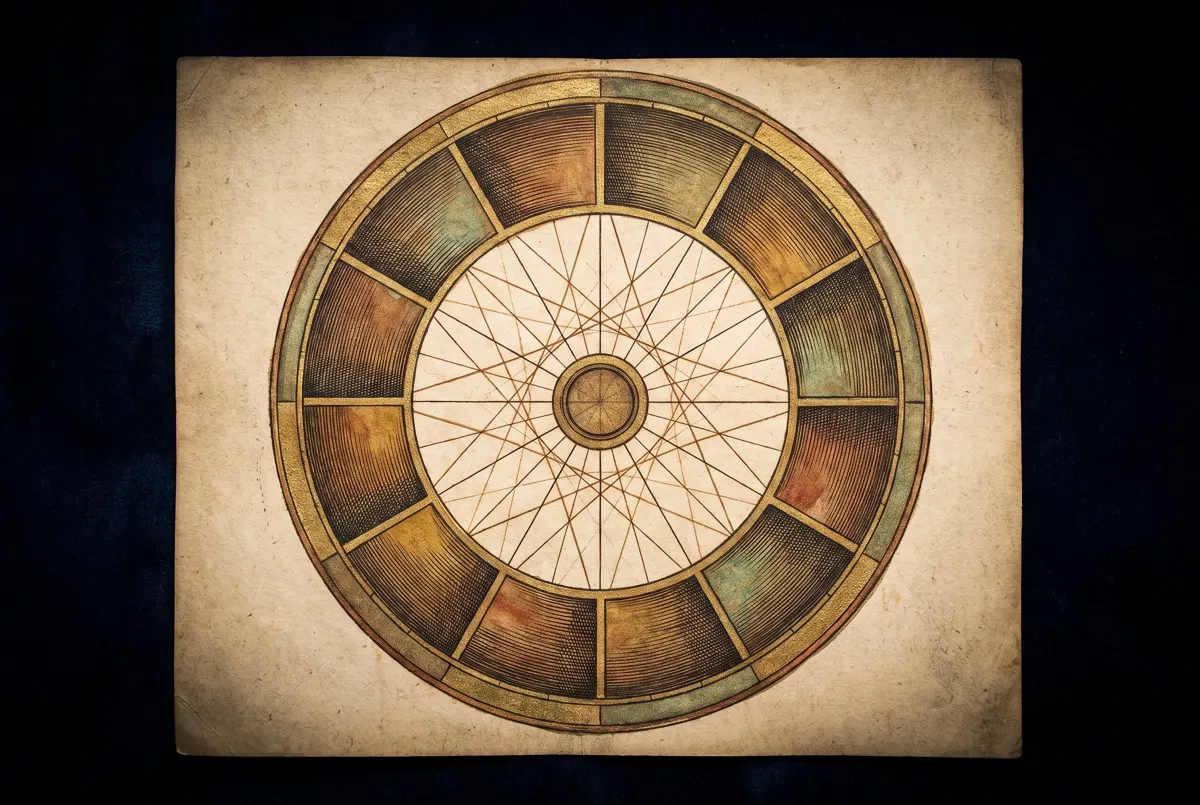
Tredecile means a 108-degree fifth-harmonic aspect used by some astrologers for specialized creativity themes.
A structural orientation; exact placements depend on the chart or technique being discussed.Quick facts
| Feature | Value |
|---|---|
| Exact angle | 108° |
| Fraction of circle | 3/10 of 360°, or three 36° deciles. |
| Harmonic family | Fifth-harmonic symbolism expressed through a tenth-harmonic subdivision. |
| Alternate name | Sesquiquintile is common; terminology is not perfectly standardized. |
The Instruments
Ten readings, worked out from your own birth chart
An instrument is a reading this house works out for you. Give your birth date, time and place once, and each one reads today’s real sky against the chart you were born under. Eight are personal; two are calendars anyone can open. A free account opens one instrument a day. The plans open every instrument, every day.
- Natal Chart Every planet, house and aspect in your chart
- Active Transits Where the planets are now, read against your chart
- Daily Counsel What to pursue today, and what to leave alone
- Personal Timing Your best days to decide, weeks ahead
- Fellowship Your chart and another, read side by side
- Theme of the Day The one thing today is asking of you
- Sacred Numbers Your life path, your cycles, your name in numbers
- Aeolian Harmonics Classical music chosen to match your chart
- Mercury Retrograde Every Mercury retrograde this year, with its dates Open to all
- Void-of-Course Moon When the Moon is between signs, hour by hour Open to all
The geometry of 108 degrees
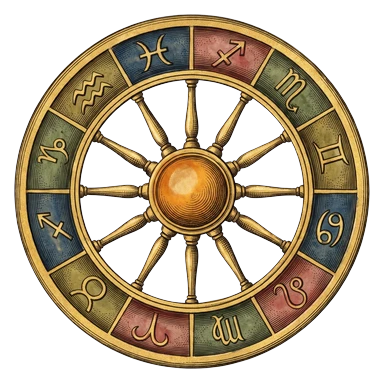
Dividing the zodiac into ten equal parts gives 36-degree deciles. Three such units total 108 degrees, while two quintiles of 72 degrees minus one decile also lead to the same angle through different descriptive language. The aspect belongs to a geometry closely associated with pentagons, decagons, and golden-ratio constructions, but a geometric relationship does not by itself dictate a psychological meaning. Always distinguish the exact mathematical angle from the symbolic tradition built around it.
How to calculate and verify a tredecile
Subtract one ecliptic longitude from the other, take the absolute value, and if the result exceeds 180 degrees subtract it from 360. Compare the resulting smallest separation with 108. For planets at 14° Taurus and 2° Virgo, convert both to absolute longitude before subtracting; sign counting alone often introduces a 30-degree error. An applying or separating label requires planetary speeds and chart context, not just the static positions. Software settings should show whether minor aspects and the selected orb are enabled.
Creativity, arrangement, and specialized skill
Modern harmonic astrologers often connect fifth-family aspects with making, arranging, stylizing, technical ingenuity, or imposing a chosen pattern on material. A tredecile may therefore be read as a distinctive way two planetary functions collaborate in craft or problem-solving. That is not always effortless or publicly visible. Planet, sign, house, dignity, and the full aspect network determine expression. A Mercury-Saturn tredecile might suggest structured thought in one biography and rigid overdesign in another; the angle alone cannot select the outcome. Compare it with quintiles, deciles, and any repeating fifth-harmonic network before giving one isolated minor contact disproportionate weight.
Orb discipline and terminology problems
There is no universally accepted orb. Many astrologers reserve roughly one or two degrees for specialized minor aspects, sometimes allowing more for the Sun or Moon, while others use harmonic-chart methods instead of natal orbs. State the rule rather than presenting a borderline hit as exact. Do not confuse tredecile or sesquiquintile at 108° with quindecile, tridecile, biquintile at 144°, or the 135° sesquisquare. Since astrology is not a scientifically validated predictor, interpretation is best treated as a focused symbolic hypothesis tested against the whole chart and biography. Record borderline cases instead of rounding them silently into exact aspects.
Sources and editorial method
Research and editorial references used for this page include:
- Merriam-Webster: Tredecile - Lexical definition identifying the 108-degree angular relation.
- Astrodienst Astrowiki: Harmonic astrology - Reference context for interpreting divisions of the circle through harmonic families.
These references support the factual, historical, textual, or interpretive claims on this page. Interpretive traditions are identified as such, and factual claims are kept separate from symbolic claims.
Related reading
Inspect your aspect pattern
Tredecile in a book is one thing; Tredecile in your own birth chart is your life. The Oracle casts your real chart and tells you what it means for your love, your work, and your year ahead, in conversation, free.
Speak with the OracleHow Tredecile lives in your own chart across your year, in love, in work, in timing, is written in the Cosmic Codex: the whole year, once. Open the Cosmic Codex
More in Aspects
- Antiscion Contact
- Benefic Aspect
- Dexter Aspect
- Harmonic Resonance
- Moiety of Orbs
- Partile Aspect
- Quintile Triangle
- Septile
Common questions
Is a tredecile 108 or 120 degrees?
It is 108 degrees. The 120-degree aspect is a trine. Similar-sounding labels and copied aspect tables can cause confusion.
Is tredecile the same as sesquiquintile?
Many modern astrologers use the names for the same 108-degree aspect, although terminology is not entirely standardized across authors.
What orb should I use?
A tight orb (often around one to two degrees) is common for this minor aspect. The important point is to declare and apply one rule consistently.