Astrology
Descendant
Direct answer
Descendant is the chart angle opposite the Ascendant. It is the western horizon point and is associated with partnership, projection, open opposition, and the qualities encountered through others.
Descendant is the western horizon point of the chart and the doorway into seventh-house relationship themes.
$0 today, then $12/month after 7 days. Cancel anytime.
At a glance
- Also called
- DC
- In astrology
- The Descendant begins the seventh-house axis in many house systems.
- Found in
- Astrology
- Related
- Ascendant, Birth Chart, House Ruler, Chart Ruler
Descendant is the western horizon point of the chart and the doorway into seventh-house relationship themes.
A structural orientation; exact placements depend on the chart or technique being discussed.
What does your own chart say about you?
Choose love, work or purpose. Your reading is written from your chart. Your reading uses your own birth details.
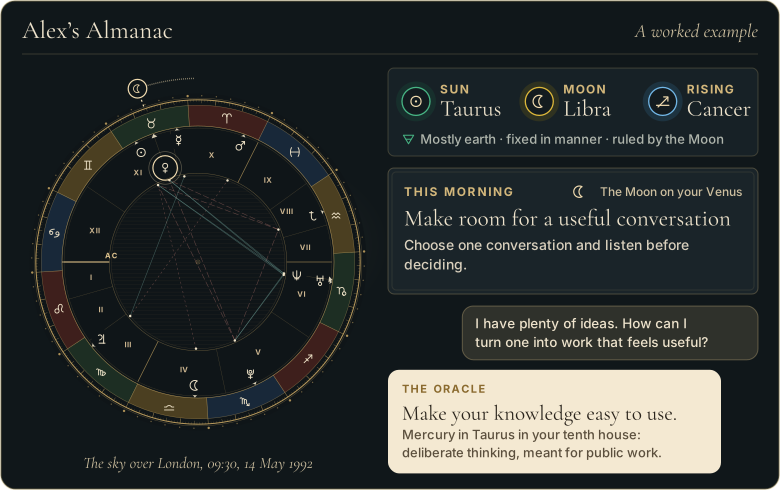
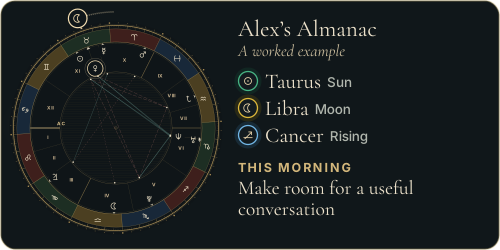
Walk through Alex’s whole example first
 The Road of AgesSee the turning points of your whole life, from your birth date
See your road's shape
The Road of AgesSee the turning points of your whole life, from your birth date
See your road's shape
Prefer to explore first?
 The Road of AgesThe turning points of your whole life, from your own chart
Walk my road
The Road of AgesThe turning points of your whole life, from your own chart
Walk my road
Free, by email
Your daily Almanac letter
One short letter at 7 each morning: the day’s theme read for your own chart, and one thing to do with it.
What sets Descendant apart
The Descendant is not found by its own rule but by subtraction: it is always exactly 180 degrees from the Ascendant, the point where the ecliptic meets the western horizon, where the Sun and planets set. It is the single degree of the zodiac going down at the moment of birth. The Greek texts called the seventh place Dysis, the setting, and the Latin texts Occidens.
- Position: exactly 180 degrees from the Ascendant, on the western horizon
- Sign: always the sign opposite the rising sign (Aries rising gives Libra)
- Old names: Dysis in Greek, Occidens in Latin: the setting place
- House: seventh cusp in quadrant systems; in whole sign houses the seventh begins at the sign boundary
- Angle: one of the four angles, with the Ascendant, Midheaven and Imum Coeli
Often mistaken for something else: The Descendant is a degree on the horizon; the seventh house is the region that follows it. In whole sign houses the two do not coincide, since the house starts at the sign edge.
A one-minute story
The Book of the Sky
How people learned to read the sky, from Babylon to the day you were born.

The story behind Descendant
The Descendant is one of the four major angles and has long been tied to marriage, alliances, contracts, and open adversaries.
The spiritual meaning of Descendant
Spiritually, Descendant can reveal what relationship teaches about humility, reciprocity, projection, and honest encounter.
Descendant in astrology
Its sign, ruler, aspects, and planets near it help describe relational dynamics.
Why Descendant matters
Descendant matters because relationship patterns often live at the edge of self-awareness. It can show what a person seeks, resists, admires, negotiates with, or projects onto close partners.
How to read Descendant
Astrologers reach for Descendant when interpreting partnership style, attraction, conflict mirrors, client relationships, open opponents, and the sign opposite the rising sign.
Descendant in practice: an example
Aries rising usually places Libra on the Descendant, making negotiation, fairness, aesthetics, and partnership especially visible.
Where readings of Descendant go wrong
The usual misreading is to use Descendant to claim a person is doomed to one relationship type.
Sources and editorial method
This entry summarizes the tradition in the Almanac's own words; where no source is listed, it is an editorial summary rather than a primary text, and symbolic readings are named as the tradition's, not as fact.
- Source
- The Great Almanac Dictionary
- Category
- Astrology
- Aliases
- setting sign, DC
- Last updated
- 2026-09-26
Explore your relationship axis
Descendant in a book is one thing; Descendant in your own birth chart is your life. The Oracle casts your real chart and tells you what it means for your love, your work, and your year ahead, in conversation. It opens with the 7-day Seeker trial.
Speak with the OracleHow Descendant lives in your own chart across your year, in love, in work, in timing, is written in the Cosmic Codex: the whole year, once. Open the Cosmic Codex
Related terms
More in Astrology
- Exaltation
- Hermetic Lots
- Lot of the Father
- Nodal Opposition
- Refranation
- Synastry
- Age of Pisces
- Bonification
From the reference page to your own chart
Every word here
is in your own chart.
- A personal reading about love, work or purpose, written from your chart
- A practical next step to consider
- It opens with 7 days free, with the AI Oracle and daily guidance
$0 today, then $12/month after 7 days. Cancel anytime.
Common questions
What is Descendant?
Descendant is the chart angle opposite the Ascendant. It is the western horizon point and is associated with partnership, projection, open opposition, and the qualities encountered through others.
Where does Descendant come from?
The Descendant is one of the four major angles and has long been tied to marriage, alliances, contracts, and open adversaries.
What does Descendant mean in astrology?
Astrologers reach for Descendant when interpreting partnership style, attraction, conflict mirrors, client relationships, open opponents, and the sign opposite the rising sign.
What does Descendant look like in a birth chart?
Aries rising usually places Libra on the Descendant, making negotiation, fairness, aesthetics, and partnership especially visible.
What does Descendant mean spiritually?
Spiritually, Descendant can reveal what relationship teaches about humility, reciprocity, projection, and honest encounter.
Free, by email
The Almanac, in your inbox at 7
One short letter at 7 each morning: the day’s theme read for your own chart, and one thing to do with it.