What does your own chart say about you?
Choose love, work or purpose. Your reading is written from your chart. Your reading uses your own birth details.
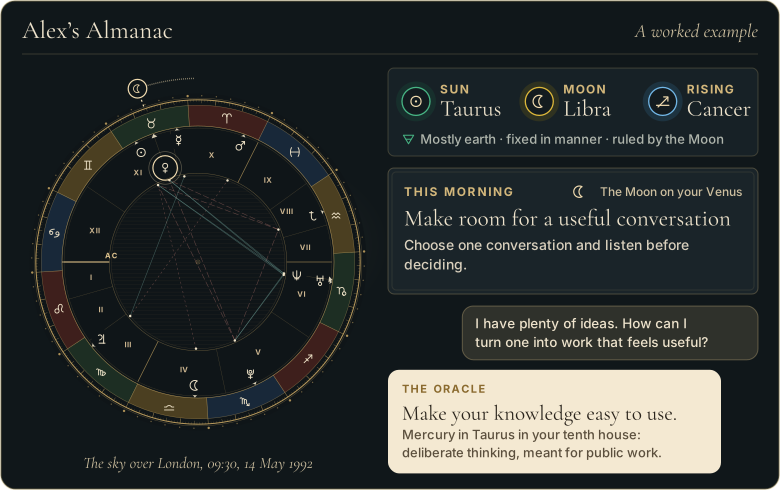
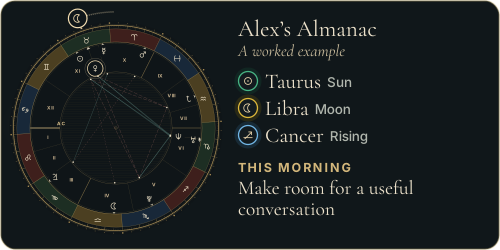
Walk through Alex’s whole example first
 The Road of AgesSee the turning points of your whole life, from your birth date
See your road's shape
The Road of AgesSee the turning points of your whole life, from your birth date
See your road's shape
Prefer to explore first?
 The Road of AgesThe turning points of your whole life, from your own chart
Walk my road
The Road of AgesThe turning points of your whole life, from your own chart
Walk my road
Personal astrology tool · The Great Almanac
Void-of-Course Moon Calendar
The Moon’s sign and phase now, its next sign changes, and the void-of-course hours ahead, measured.
The instrument
Void-of-Course Moon Calendar
The sky itself, measured
Void-of-Course Moon CalendarPreparing the instrument…
This one asks for nothing about you: the Moon’s sign, phase and void hours are measured in your browser from the same sky timeline every visitor receives. Which house the Moon is moving through in your own chart is the other half, and that reads from the natal chart saved in My Almanac.
Tap a dotted term to learn its meaning without losing your place. You can also browse the full lexicon.
About this tool and its method
What void-of-course means
The Moon crosses a sign in two to two and a half days, and along the way it makes aspects to the Sun and the planets: conjunctions, sextiles, squares, trines and oppositions. After its last such aspect in a sign, and until it enters the next, the Moon is said to be void of course: running on without a contact ahead of it. The old electional astrologers read that stretch as a time when new undertakings do not take root as expected, and used it for finishing, resting, and routine.
How to use the hours
The practical reading is modest. Place a launch, a first meeting, a signature or a proposal after the Moon has entered the next sign; use the void for the work that is already under way, for tidying, for rest. Nothing is forbidden, and nothing is promised: the void is measured in hours, and life does not pause for it. Most weeks hold two or three voids, some an hour long and some nearly two days.
Which aspects, which bodies
The Almanac judges the void against the Sun and the eight planets, Mercury to Pluto, by the five Ptolemaic aspects, each counted whether the Moon stands ahead of the planet or behind it. Some traditions omit the three outer planets, which starts some voids earlier; the method here is stated and kept to, so a window can be checked against it. Sign changes are where the Moon’s longitude crosses a multiple of thirty degrees; aspects are where its angle to a planet closes; both are found by interpolating between the ephemeris samples around them, six-hourly for the first four days and daily to the fourteenth, and each hour states the precision that allows. The calendar shows times in your own time zone.
What this tool does
The calendar above says where the Moon stands now, whether it is void-of-course, when it next changes sign, and every void window for the fourteen days ahead, measured from the ephemeris timeline this site serves and shown in your own time zone. Membership opens the calculator; no birth details are needed; which house the Moon is moving through in your own chart is the personal half, one question away.
A void is the stretch between the Moon’s last aspect in a sign and its passage into the next: a few hours, sometimes nearly two days, and measured here rather than copied.
Explore another reading
Continue with Theme of the Day to add another perspective to your Almanac.
Open Theme of the DayExplore another reading
Continue with Theme of the Day to add another perspective to your Almanac.
Open Theme of the DayGo deeper
Read in the journal
One membership, every instrument
Every instrument,
from your own chart.
- A personal reading about love, work or purpose, written from your chart
- A practical next step to consider
- It opens with 7 days free, with the AI Oracle and daily guidance
$0 today, then $12/month after 7 days. Cancel anytime.
Common questions
Is the Moon void-of-course right now?
Members see today’s answer in the calendar at the top of this page, measured from the ephemeris timeline the site serves, with every void for the fourteen days ahead, in your own time zone.
How long does a void-of-course Moon last?
From a few minutes to more than a day, depending on where the Moon’s last aspect in a sign falls. Most are a few hours.
What should I avoid during a void?
Tradition counsels against beginning things that need to take root: launches, first meetings, signatures. It does not forbid them. Finishing, routine and rest sit well in a void.
Why do other calendars give different hours?
Some judge the void against only the seven classical bodies. With fewer planets to aspect, the Moon’s last aspect in a sign can come earlier, so the void starts earlier and runs longer. This page states its method so the difference can be seen.
Does the void mean the same for everyone?
The hours are the same for everyone. What differs is the house of your chart the Moon is moving through, which is what a personal reading adds.
Free, by email
The Almanac, in your inbox at 7
One short letter at 7 each morning: the day’s theme read for your own chart, and one thing to do with it.