

Calendars and time
Time Zone
Direct answer
Time Zone: A Time Zone is a legally or administratively defined region that uses a common civil clock offset and associated local-time rules.
A Time Zone is a region sharing civil clock rules and a UTC relationship.
$0 today, then $12/month after 7 days. Cancel anytime.
At a glance
- Found in
- Calendars & Timekeeping
- Related
- Calendar, Solar Calendar, Lunar Calendar, Lunisolar Calendar
A Time Zone is a region sharing civil clock rules and a UTC relationship.
A cycle or timeline schematic for comparing the named timekeeping concept.
What does your own chart say about you?
Choose love, work or purpose. Your reading is written from your chart. Your reading uses your own birth details.
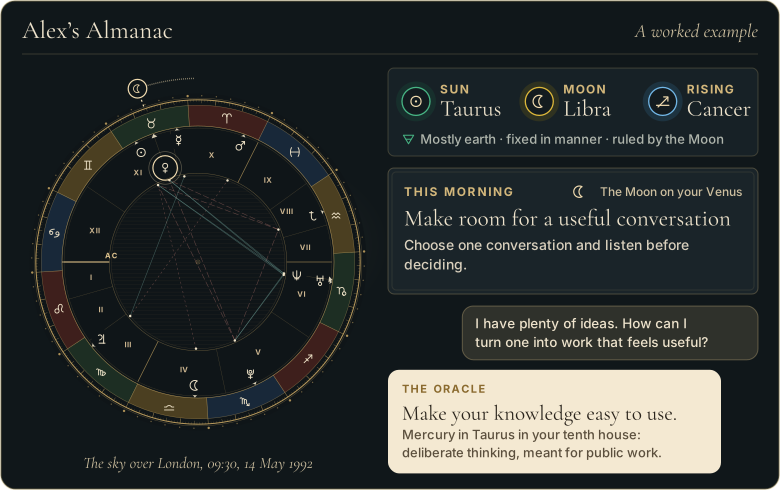
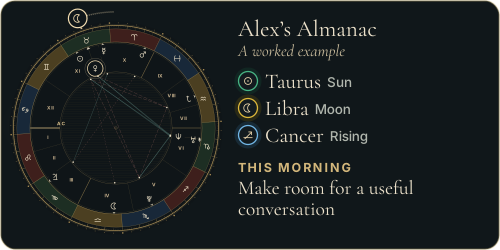
Walk through Alex’s whole example first
 The Road of AgesSee the turning points of your whole life, from your birth date
See your road's shape
The Road of AgesSee the turning points of your whole life, from your birth date
See your road's shape
Prefer to explore first?
 The Road of AgesThe turning points of your whole life, from your own chart
Walk my road
The Road of AgesThe turning points of your whole life, from your own chart
Walk my road
Free, by email
Your daily Almanac letter
One short letter at 7 each morning: the day’s theme read for your own chart, and one thing to do with it.
What sets Time Zone apart
A time zone is a record of rules, not just a number: it holds the standard offset, when daylight saving starts and stops, and every past change for that region. Zone width is nominally 15 degrees of longitude, one hour, but borders follow politics, so offsets of 30 and 45 minutes exist, like India at UTC+5:30 and Nepal at UTC+5:45. Before standard time each town kept local mean time, which differs by 4 minutes for each degree of longitude.
- Nominal width: 15 degrees of longitude per hour, from 360 divided by 24
- Offset range: from UTC-12 to UTC+14
- Odd offsets: India UTC+5:30, Nepal UTC+5:45
- Database: the IANA time zone database, names like Europe/Amsterdam, begun by Arthur David Olson
- Local mean time: shifts 4 minutes for each degree of longitude
Often mistaken for something else: A UTC offset is one number at one moment; a time zone is the whole set of rules that decides which offset applies when.
The story behind Time Zone
Standard time zones expanded with railways, telegraphy, navigation, and international coordination, but their boundaries remain political as well as geographic.
Why Time Zone matters
Time zones determine the displayed local date and time of an astronomical event, while the underlying instant remains unchanged.
Time Zone in practice: an example
A lunar event near midnight UTC can fall on different local calendar dates in New York and Tokyo.
Where readings of Time Zone go wrong
The usual misreading is to infer a time zone from longitude alone or treat abbreviations such as CST as globally unique.
Sources and editorial method
Research references used for this entry include:
- NIST: Local Time Frequently Asked Questions - Official reference for civil time zones and daylight-saving rules.
- NIST: UTC(NIST) Time Scale - Official explanation of Coordinated Universal Time and the U.S. realization UTC(NIST).
- Source
- The Great Almanac Dictionary
- Category
- Calendars & Timekeeping
- Last updated
- 2026-09-26
View an event in local time
A definition tells you what it is; your own birth chart tells you what it means for you. The Oracle casts your real chart and answers for your love, your work, and your year ahead, in conversation. It opens with the 7-day Seeker trial.
Speak with the OracleRelated terms
More in Calendars & Timekeeping
From the reference page to your own chart
Every word here
is in your own chart.
- A personal reading about love, work or purpose, written from your chart
- A practical next step to consider
- It opens with 7 days free, with the AI Oracle and daily guidance
$0 today, then $12/month after 7 days. Cancel anytime.
Common questions
What is a Time Zone?
A Time Zone is a legally or administratively defined region that uses a common civil clock offset and associated local-time rules.
What do people get wrong about a Time Zone?
The usual misreading is to infer a time zone from longitude alone or treat abbreviations such as CST as globally unique.
Free, by email
The Almanac, in your inbox at 7
One short letter at 7 each morning: the day’s theme read for your own chart, and one thing to do with it.


