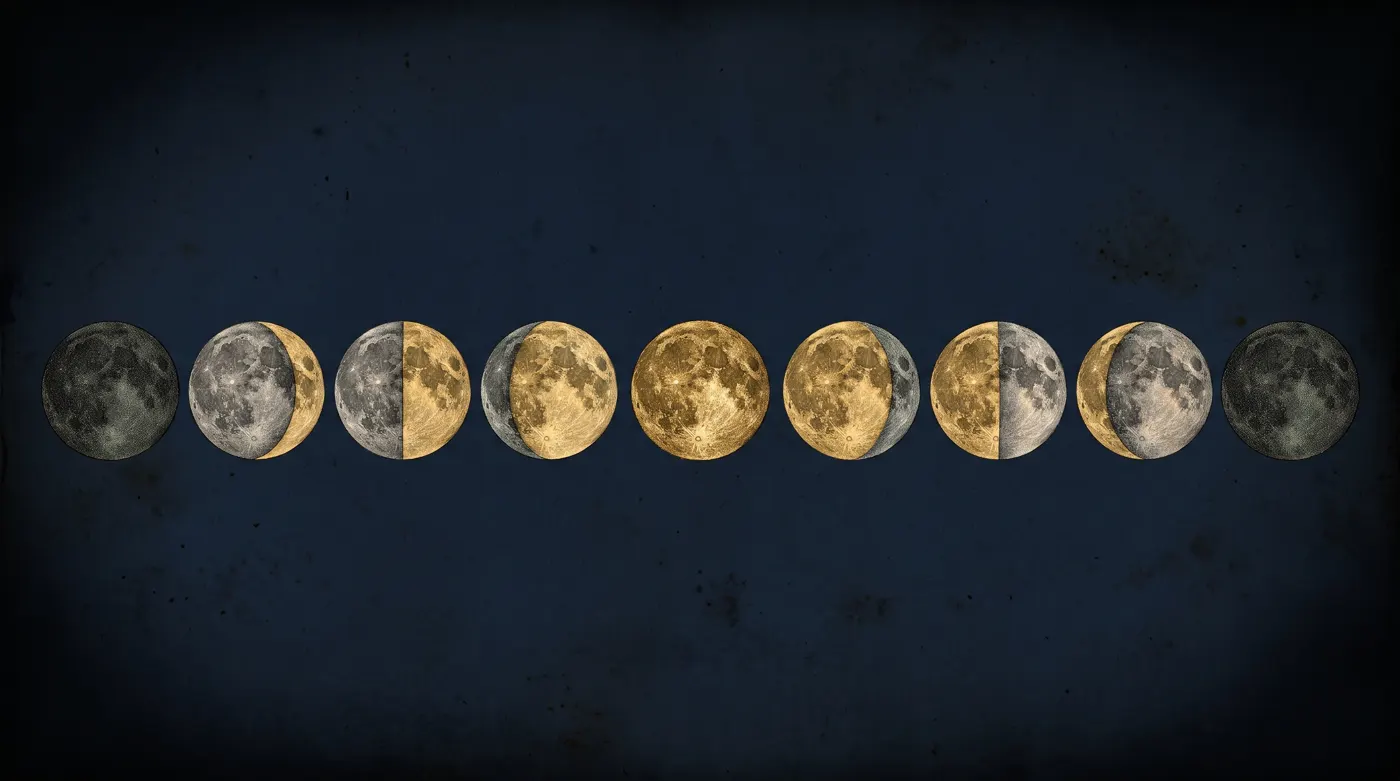
Complete cycle
A synodic month runs from one same phase to the next and lasts about 29.5 days.
Exact UTC dates and times of the upcoming new Moons, quarters, and full Moons, with a clear explanation of why the Moon changes shape through its 29.5-day cycle.
$0 today, then $12/month after 7 days. Cancel anytime.
Moon phases are changing views of the sunlit half of the Moon as the Moon orbits Earth. The sequence is geometric, not caused by Earth’s shadow; Earth’s shadow is involved only during a lunar eclipse.
A synodic month runs from one same phase to the next and lasts about 29.5 days.
Waxing means the illuminated portion is increasing; waning means it is decreasing.
Ordinary phases come from viewing geometry. A lunar eclipse requires special Sun-Earth-Moon alignment near a node.
Verified current positions · refreshes hourly
Current geocentric longitudes. No local rise, set, altitude, direction, weather, or future visibility is inferred.
The phase family is derived from current Sun and Moon longitude. It is not an exact phase-event time, illuminated fraction, moonrise calculation, or local visibility forecast. Void-of-course hours for the two weeks ahead, and the next sign changes, are measured on the Void-of-Course Moon Calendar.
The next full Moon is Mon, October 26, 2026 and the next new Moon is Mon, November 9, 2026, in Universal Time. Every instant below is computed with the full lunation series (Meeus, Astronomical Algorithms, ch. 49), corrected from dynamical to universal time and checked against Swiss Ephemeris to within half a minute, and stated in UTC; your local calendar can shift a date by one day.
| Phase | Date (UTC) | Time (UTC) |
|---|---|---|
| 🌕 Full Moon | Mon, October 26, 2026 | 04:11 |
| 🌗 Last Quarter | Sun, November 1, 2026 | 20:28 |
| 🌑 New Moon | Mon, November 9, 2026 | 07:02 |
| 🌓 First Quarter | Tue, November 17, 2026 | 11:47 |
| 🌕 Full Moon | Tue, November 24, 2026 | 14:53 |
| 🌗 Last Quarter | Tue, December 1, 2026 | 06:08 |
| 🌑 New Moon | Wed, December 9, 2026 | 00:51 |
| 🌓 First Quarter | Thu, December 17, 2026 | 05:42 |
| 🌕 Full Moon | Thu, December 24, 2026 | 01:28 |
| 🌗 Last Quarter | Wed, December 30, 2026 | 18:59 |
| 🌑 New Moon | Thu, January 7, 2027 | 20:24 |
| 🌓 First Quarter | Fri, January 15, 2027 | 20:34 |
| 🌕 Full Moon | Fri, January 22, 2027 | 12:17 |
| 🌗 Last Quarter | Fri, January 29, 2027 | 10:55 |
| 🌑 New Moon | Sat, February 6, 2027 | 15:56 |
| 🌓 First Quarter | Sun, February 14, 2027 | 07:58 |
| 🌕 Full Moon | Sat, February 20, 2027 | 23:23 |
| 🌗 Last Quarter | Sun, February 28, 2027 | 05:16 |
For the Moon’s sign changes and void-of-course hours in the four days ahead, measured to the hour, see the Void-of-Course Moon Calendar.
The common sequence is new Moon, waxing crescent, first quarter, waxing gibbous, full Moon, waning gibbous, last or third quarter, and waning crescent. These labels divide a continuous cycle into useful neighborhoods. Only new, first quarter, full, and last quarter describe exact geometric event moments in standard almanacs; the crescent and gibbous phases fill the intervals.
Sunlight always illuminates roughly half of the Moon. From Earth, the fraction of that lit hemisphere we can see changes as the angle among Sun, Earth, and Moon changes. Near new Moon the lit side mostly faces away from us. Near full Moon the lit side mostly faces Earth. The terminator (the boundary between lunar day and night) reveals relief especially well through binoculars or a telescope.
Lunar age counts time since new Moon, phase names describe parts of the cycle, and illuminated fraction estimates how much of the visible disk is sunlit. They correlate but are not interchangeable. A broad phase family derived from longitude is useful for orientation; precise illumination and exact event timing come from a lunar ephemeris that accounts for the Moon’s real orbit.
The full Moon generally rises near sunset and a new Moon travels near the Sun, but exact rise and set times change with location and date. Twilight definitions, refraction, the observer’s horizon, and the Moon’s changing declination all matter. Use a location-aware table rather than adding a fixed number of minutes to yesterday’s time.
A phase calendar is excellent for planning moonlight-sensitive observing, photography, or a simple nature journal. It is not a substitute for a local visibility forecast. If you also use lunar phases symbolically, label that practice as reflection or tradition. Claims about medical outcomes, emergencies, markets, or human behavior require evidence beyond the calendar.
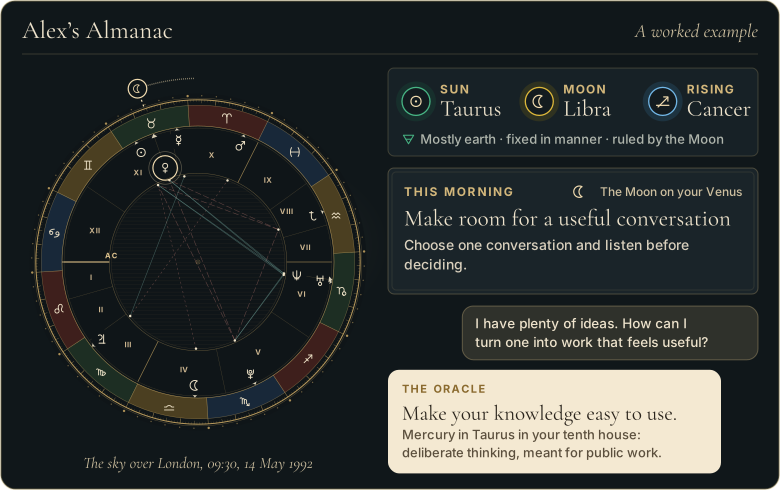
Choose love, work or purpose. Your reading is written from your chart. Your reading uses your own birth details.
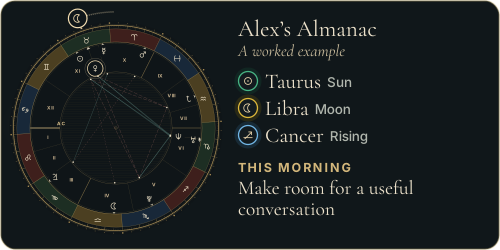
Walk through Alex’s whole example first
 The Road of AgesSee the turning points of your whole life, from your birth date
See your road's shape
The Road of AgesSee the turning points of your whole life, from your birth date
See your road's shape
 The Road of AgesThe turning points of your whole life, from your own chart
Walk my road
The Road of AgesThe turning points of your whole life, from your own chart
Walk my road
Free, by email
One short letter at 7 each morning: the day’s theme read for your own chart, and one thing to do with it.
From the reference page to your own chart
$0 today, then $12/month after 7 days. Cancel anytime.
No. Normal phases come from our changing view of the Moon’s sunlit half. Earth’s shadow crosses the Moon only during a lunar eclipse.
At first quarter the Moon is about one quarter of the way through its phase cycle, while its visible disk appears approximately half illuminated.
Not by itself. Rise and set are location-dependent calculations and should come from a service using your coordinates and date.
Free, by email
One short letter at 7 each morning: the day’s theme read for your own chart, and one thing to do with it.

Read more
Keep moving through the archive: signs, compatibility, chart timing, faith-aware discernment, and practical daily guidance.