Solar eclipse
The Moon’s shadow falls on Earth; type and duration depend on the observer’s path.
A grounded guide to solar and lunar eclipse geometry, paths of visibility, local circumstances, Saros cycles, and safe observation.
$0 today, then $12/month after 7 days. Cancel anytime.
An eclipse requires the Sun, Earth, and Moon to align near the Moon’s orbital nodes. A solar eclipse is highly location-specific and requires certified solar viewing protection outside totality; a lunar eclipse can be seen from much of Earth’s night side when the Moon is above the horizon.
The Moon’s shadow falls on Earth; type and duration depend on the observer’s path.
The Moon moves through Earth’s shadow; the event is safe to view with unaided eyes.
The Moon’s orbit is tilted to the ecliptic, so most new and full Moons miss exact node alignment.
Verified current positions · refreshes hourly
Current geocentric longitudes. No local rise, set, altitude, direction, weather, or future visibility is inferred.
The phase family is derived from current Sun and Moon longitude. It is not an exact phase-event time, illuminated fraction, moonrise calculation, or local visibility forecast. Void-of-course hours for the two weeks ahead, and the next sign changes, are measured on the Void-of-Course Moon Calendar.
A total solar eclipse occurs where the Moon fully covers the Sun; an annular eclipse leaves a bright ring because the Moon appears too small to cover the solar disk; a partial eclipse hides only part of the Sun. The umbral or antumbral path is narrow, while a much wider region may see a partial phase. A global event date never guarantees the same experience in every city.
During a penumbral lunar eclipse the Moon passes through Earth’s faint outer shadow. In a partial lunar eclipse part of the Moon enters the dark umbra. In a total lunar eclipse the entire lunar disk enters the umbra and can appear copper or red because Earth’s atmosphere filters and bends sunlight into the shadow. Local visibility still requires the Moon to be above the horizon.
The Moon’s orbit is inclined by about five degrees to Earth’s orbital plane. Eclipses cluster during periods when the Sun is near one of the lunar nodes, the crossing points of those planes. Saros cycles describe families of broadly similar eclipses after roughly 18 years, but the path shifts; recurrence does not make a past city’s circumstances repeat exactly.
Never look directly at the uneclipsed or partially eclipsed Sun without eclipse glasses or a solar viewer that meets the applicable safety standard and is undamaged. Ordinary sunglasses, smoked glass, exposed film, and camera screens are not safe substitutes. Optical devices require a proper solar filter mounted at the front aperture. Follow NASA and local expert guidance for the specific event.
Use an authoritative eclipse map or table that accepts your location. Confirm contact times, maximum obscuration, solar altitude, and time zone. Check the local weather close to the event and identify a safe, open site in advance. This page does not calculate future eclipse paths from today’s Moon position and does not claim visibility without a location.

Choose love, work or purpose. Your reading is written from your chart. Your reading uses your own birth details.
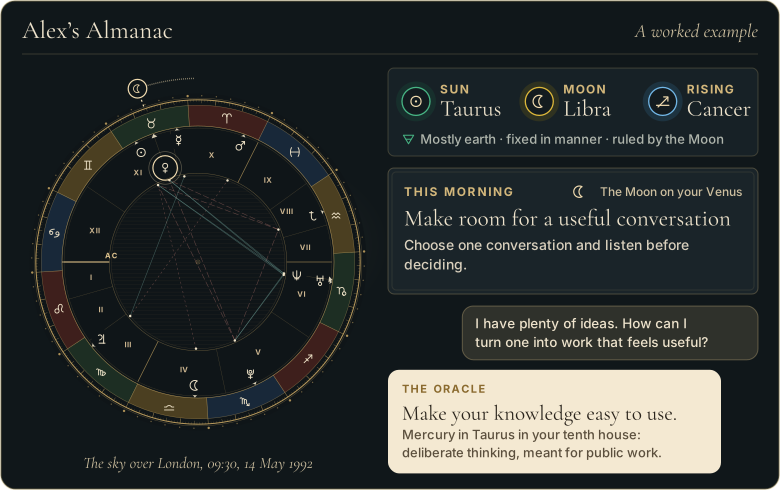
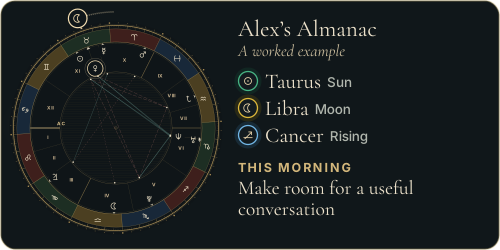
Walk through Alex’s whole example first
 The Road of AgesSee the turning points of your whole life, from your birth date
See your road's shape
The Road of AgesSee the turning points of your whole life, from your birth date
See your road's shape
 The Road of AgesThe turning points of your whole life, from your own chart
Walk my road
The Road of AgesThe turning points of your whole life, from your own chart
Walk my road
Free, by email
One short letter at 7 each morning: the day’s theme read for your own chart, and one thing to do with it.
From the reference page to your own chart
$0 today, then $12/month after 7 days. Cancel anytime.
The lunar orbit is tilted relative to the ecliptic. Most lunations pass above or below the alignment needed for an eclipse.
Yes. Lunar eclipses are safe to view with unaided eyes. Solar eclipses require event-specific eye safety except during the brief total phase for observers inside the path of totality.
No. A current longitude snapshot is not an eclipse-path calculation or future event table. Use NASA or USNO event resources.
Free, by email
One short letter at 7 each morning: the day’s theme read for your own chart, and one thing to do with it.

Read more
Keep moving through the archive: signs, compatibility, chart timing, faith-aware discernment, and practical daily guidance.