
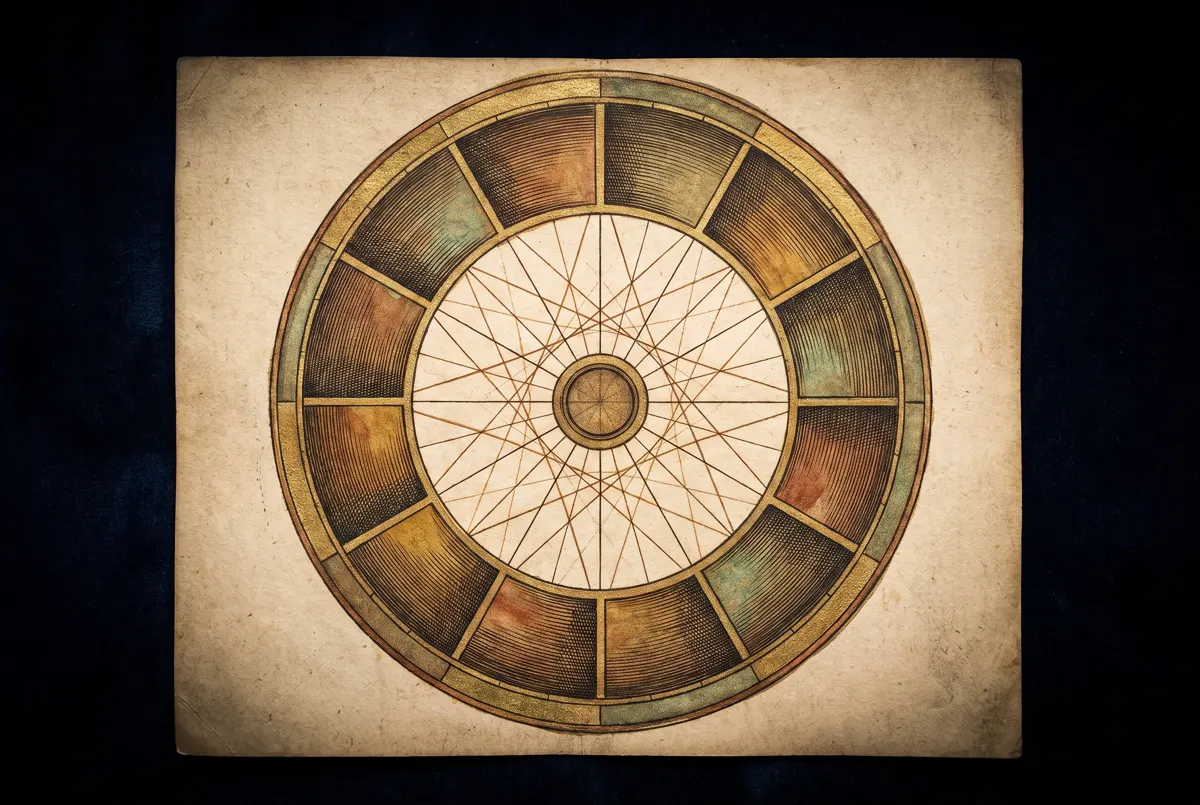
Natal chart emphasis
Singleton Planet
Direct answer
Always finish the phrase: singleton by what rule? For example, Mars may be the only water-sign planet among the ten major planets. Without the category and planet list, “singleton” is too ambiguous to verify.
A singleton planet is the only planet in a selected category, most often the only planet in one element, modality, hemisphere, or house type.
$0 today, then $12/month after 7 days. Cancel anytime.
Quick facts
| Question | Direct answer |
|---|---|
| Most common definition | The only major planet in an element or modality. |
| Is an unaspected planet a singleton? | Not necessarily; lack of aspects and categorical uniqueness are different properties. |
| Does one empty category create a singleton? | No. A singleton requires exactly one occupant in the named category. |
| Is it always the strongest planet? | No. Angularity, rulership, aspects, and the rest of the chart may be more important. |
Singleton Planet is a lone planet carrying an otherwise missing chart category.
A structural orientation; exact placements depend on the chart or technique being discussed.
What does your own chart say about you?
Choose love, work or purpose. Your reading is written from your chart. Your reading uses your own birth details.
Walk through Alex’s whole example first


 The Road of AgesSee the turning points of your whole life, from your birth date
See your road's shape
Prefer to explore first?
 The Road of AgesThe turning points of your whole life, from your own chart
Walk my road
Free, by email
Your daily Almanac letter
One short letter at 7 each morning: the day’s theme read for your own chart, and one thing to do with it.
Singleton is a relational label
A planet is not a singleton in isolation; it is singleton relative to a classification. If nine major planets occupy fire, air, and earth signs while Saturn alone occupies water, Saturn is an elemental singleton. If Venus alone lies in a mutable sign, it is a modality singleton. Some astrologers extend the term to hemispheres, quadrants, house groups, or only one planet above the horizon. Those broader uses can be meaningful, but they are not interchangeable. State the category, the bodies counted, and whether the Ascendant, nodes, or asteroids were excluded before interpreting the result.
A one-minute story
The Book of the Sky
How people learned to read the sky, from Babylon to the day you were born.

How to identify one consistently
Choose a planet set first, conventionally Sun through Pluto for modern natal work. Count placements across the four elements and three modalities. Exactly one planet in a category creates a singleton under that rule; zero creates a missing emphasis, and two do not. Repeat only if another classification is relevant. Do not count the Ascendant as if it were a planet unless the chosen author explicitly does so. A chart can have multiple singletons under different rules, which is a reason to prioritize rather than stack dramatic descriptions. Print the count table so readers can verify it.
How astrologers read concentrated uniqueness
Astrologers often propose two apparently opposite expressions. The singleton function may become a highly developed outlet because it carries an entire missing category, or it may feel awkward and overburdened because the person has fewer alternative ways to express that quality. Saturn as the only water planet, for example, does not simply mean “emotionally cold.” It could describe careful containment, duty around care, delayed trust, or a need to build emotional vocabulary. Sign, house, aspects, dignity, and angularity decide which hypotheses deserve attention. Biography remains more important than the memorable label.
Singleton, handle, unaspected planet, and sole dispositor
A Bucket handle is isolated by position around the chart wheel; an unaspected planet lacks specified angular relationships; a sole dispositor sits atop a rulership chain; and a singleton is alone in a chosen category. One planet can satisfy more than one definition, but none implies the others. Confusing them leads to circular reasoning in which every unusual-looking planet is declared overwhelmingly dominant. Instead, record each independent condition and look for convergence. If the same planet is angular, singleton by element, and ruler of the Ascendant, its prominence has several stated reasons rather than one inflated keyword.
How to use Singleton Planet responsibly
Astrological terminology is most useful when the calculation and interpretive convention are stated separately. For Singleton Planet, a careful account identifies the chart factors, degrees, or classification rule first, then explains what astrologers have traditionally inferred from them. Different schools may use different orbs, planets, house systems, or symbolic vocabularies, so a borderline result should be described rather than forced into a label. Astrology is a historical divinatory practice, not a scientifically validated method for diagnosing personality or predicting events. Treat the interpretation as a bounded symbolic hypothesis, compare it with the full chart and lived evidence, and never use it to replace medical, legal, financial, mental-health, or safeguarding advice.
What sets Singleton Planet apart
A singleton is defined by a category and a count of one: the single body in an element, a modality, a polarity or a hemisphere. The category must be named, because the same planet can be a singleton in one grouping and not another. A singleton differs from a missing element, which has none, and from an ordinary placement, which has company. With ten bodies to place, one standing alone in its category stands out.
- Definition: exactly one body in a given category
- Categories: four elements, three modalities, two polarities, hemispheres
- Contrast: an empty category is called missing, not a singleton
- Typical share: one body alone, with the other nine elsewhere
- Condition: the count depends on which bodies are included
Often mistaken for something else: A missing element is the opposite: a category with no bodies at all. The singleton is the lone occupant of a category that otherwise stands empty of company.
Sources and editorial method
Research and editorial references used for this page include:
- Astrodienst Astrowiki: Singleton - Overview of singleton definitions in natal astrology.
- Astrodienst: Elements and Crosses - Background on element and modality groupings used to identify singletons.
These references support the factual, historical, textual, or interpretive claims on this page. Interpretive traditions are identified as such, and factual claims are kept separate from symbolic claims.
Related reading
Find your singleton planet
Singleton Planet in a book is one thing; Singleton Planet in your own birth chart is your life. The Oracle casts your real chart and tells you what it means for your love, your work, and your year ahead, in conversation. It opens with the 7-day Seeker trial.
Speak with the OracleHow Singleton Planet lives in your own chart across your year, in love, in work, in timing, is written in the Cosmic Codex: the whole year, once. Open the Cosmic Codex
More in Astrology
- Tropical Zodiac
- Ascendant
- Co-Significator
- Earth Signs
- Frustration
- Latitude in Astrology
- Minor Grand Trine
- Planets and the Body
From the reference page to your own chart
Every word here
is in your own chart.
- A personal reading about love, work or purpose, written from your chart
- A practical next step to consider
- It opens with 7 days free, with the AI Oracle and daily guidance
$0 today, then $12/month after 7 days. Cancel anytime.
Common questions
Can the Sun or Moon be a singleton?
Yes, if it is the only counted planet in the stated element, modality, or other category.
Do asteroids remove a singleton?
Most astrologers classify with a fixed major-planet set first; adding many points makes categorical rarity less meaningful.
What is a missing element?
It means no counted planets occupy that element, which is different from having exactly one singleton planet there.
Free, by email
The Almanac, in your inbox at 7
One short letter at 7 each morning: the day’s theme read for your own chart, and one thing to do with it.
