Natal chart patterns
Bucket Chart Shape
Direct answer
Look for nine planets gathered on one side of the wheel and one planet clearly separated from them. The isolated planet is the handle; its identity, house, sign, and aspects describe how the concentrated chart tends to find expression.
A Bucket is a natal-chart distribution in which most planets occupy one broad group while a single planet stands apart as the handle. In modern astrology, that isolated planet is treated as a major outlet for the rest of the chart.
$0 today, then $12/month after 7 days. Cancel anytime.
Quick facts
| Feature | What to look for |
|---|---|
| Main group | Most planets form a Bowl-like concentration rather than being scattered around the wheel. |
| Handle | One planet is visibly isolated across the empty part of the chart. |
| Interpretive focus | The handle planet, especially its house position, is read as an outlet or point of leverage. |
| Method warning | Astrologers and chart programs do not all use identical arc and isolation thresholds. |
Bucket Chart Shape has one isolated handle planet outside the main group.
A structural orientation; exact placements depend on the chart or technique being discussed.
What does your own chart say about you?
Choose love, work or purpose. Your reading is written from your chart. Your reading uses your own birth details.
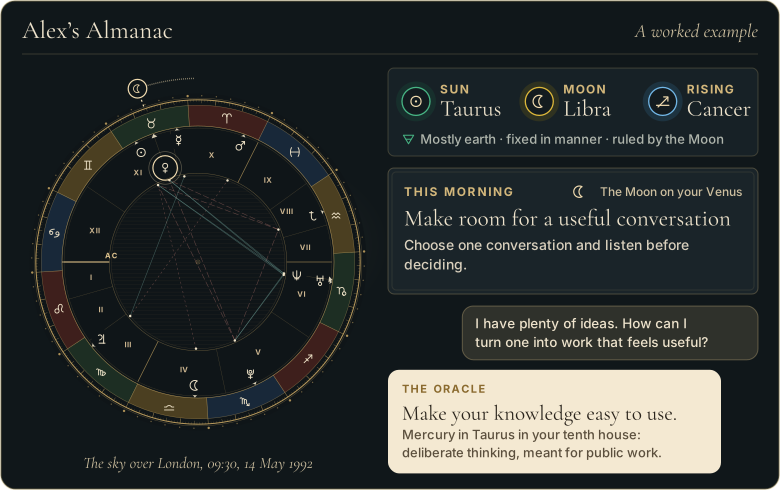
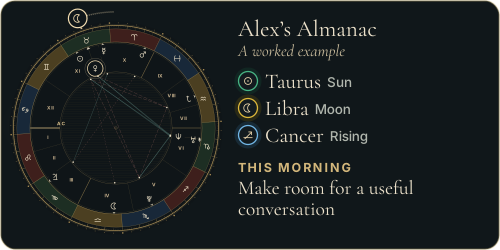
Walk through Alex’s whole example first
 The Road of AgesSee the turning points of your whole life, from your birth date
See your road's shape
The Road of AgesSee the turning points of your whole life, from your birth date
See your road's shape
Prefer to explore first?
 The Road of AgesThe turning points of your whole life, from your own chart
Walk my road
The Road of AgesThe turning points of your whole life, from your own chart
Walk my road
Free, by email
Your daily Almanac letter
One short letter at 7 each morning: the day’s theme read for your own chart, and one thing to do with it.
What makes a chart a Bucket?
The Bucket belongs to the family of planetary-distribution patterns popularized by twentieth-century astrologer Marc Edmund Jones. It resembles a Bowl with a handle: most of the planets are contained within a broad arc, while one planet sits far enough away to be visually and structurally distinct. The pattern concerns the distribution of planets around the whole wheel, not a single aspect such as a square or trine.
A useful definition must be stricter than “one lonely planet.” The clustered planets need to form a coherent main body, the candidate handle needs meaningful separation from that body, and another named pattern must not describe the chart more accurately. Published descriptions do not agree on one universal degree threshold, so a transparent classification should show the actual longitudes, state the planet list, and explain why the isolated body is more than an edge planet.
A one-minute story
The Book of the Sky
How people learned to read the sky, from Babylon to the day you were born.

How to identify the handle planet
- Plot the Sun, Moon, Mercury, Venus, Mars, Jupiter, Saturn, Uranus, Neptune, and Pluto on a 360-degree wheel.
- Find the smallest continuous arc that contains nine of the ten planets. A genuine main group should look concentrated rather than evenly dispersed.
- Check whether the remaining planet lies clearly across an empty sector. A planet just outside the cluster may be an edge planet, not a handle.
- Compare the result with Bowl, Fan, and Locomotive definitions before naming it. The visual metaphor should follow the geometry.
- Record the handle planet, its sign and house, its closeness to an angle, its rulerships, and its strongest aspects back into the main group.
Some astrologers include the lunar nodes, Chiron, or other points when interpreting a completed chart, but classic chart-shape classification normally begins with the ten major planets. Adding extra points can make almost any clean pattern disappear.
What the handle means in astrology
Within astrological interpretation, the handle is often described as the channel through which the rest of the chart acts. The planet names the function: Mars emphasizes initiative and conflict, Venus relationship and valuation, Saturn structure and obligation, and so on. The house usually makes the outlet concrete. A tenth-house handle may pull effort toward vocation and public responsibility; a fourth-house handle may repeatedly return attention to home, ancestry, and inner security.
The handle is not automatically the strongest or easiest planet. A retrograde, tightly squared, or debilitated handle may still be central, but the person may experience its role through delay, friction, or repeated learning. Conversely, a handle on an angle or supported by flowing aspects can be unusually visible. Interpretation should synthesize planet, sign, house, dignity, aspects, sect or other chosen technique, and the topics ruled by that planet.
Worked example
Imagine nine planets contained between Mercury at 2 degrees Cancer and Mars at 25 degrees Sagittarius, an occupied arc of 173 degrees, while Saturn stands alone at 10 degrees Pisces in the tenth house. The empty arcs from Mars to Saturn and from Saturn back to Mercury are 75 and 112 degrees, so Saturn is visibly isolated from the Bowl-like body rather than merely sitting at its edge. Under a method that accepts this geometry, Saturn is the handle. An astrologer might explore how career, authority, competence, reputation, and long-term responsibility become a repeated outlet for the many interests shown by the clustered planets. Saturn in Pisces would modify that story: boundaries, service, imagination, or uncertainty may need to be given durable form.
That reading is a hypothesis for reflection, not a prediction that the person must have a particular career. Biography matters. The same pattern can describe a manager, caregiver, artist, craftsperson, or someone who resists public duty before gradually accepting it.
Bucket, Bowl, Fan, or Locomotive?
| Pattern | Distinguishing geometry |
|---|---|
| Bucket | A broad main group plus one clearly isolated handle planet. |
| Bowl | All planets occupy roughly one half of the wheel, without a separate handle. |
| Fan | A tighter bundle-like group with one separated planet; definitions vary, but the main group is usually narrower than in a Bucket. |
| Locomotive | Planets occupy about two thirds of the wheel and leave one large empty sector, with no single isolated handle. |
Limits of the pattern
Chart shapes are an interpretive convention, not an astronomical property or scientifically validated personality measure. Borderline charts may receive different labels from different astrologers because orb choices, planet lists, and maximum-arc rules differ. A useful reading states the method, shows the actual distribution, and avoids forcing a memorable picture onto ambiguous geometry.
What sets Bucket Chart Shape apart
A Bucket is a Bowl with one exception: nine planets fill half the wheel or less, and the tenth stands alone in the empty half as the handle. Jones included it among his seven shapes in 1941. The handle is judged by being cut off from the rest, so a planet only a little beyond the bowl is a rim planet and not a handle.
- Bowl: nine planets inside about 180 degrees
- Handle: one planet in the other half, apart from the bowl
- Source: Marc Edmund Jones, in his 1941 typology
- Rim planets: the two planets at the edges of the bowl
- Count: nine plus one, which uses all ten bodies
Often mistaken for something else: A Fan is a name some writers use for the same bucket-like pattern, usually with a smaller group. Jones used only Bucket, so check which rule the author follows.
Sources and editorial method
Research and editorial references used for this page include:
- Marc Edmund Jones, The Guide to Horoscope Interpretation - Historical source for the influential seven-pattern chart-shape taxonomy.
- Astrodienst: The Jones Patterns - Modern overview showing how astrologers distinguish the Jones distribution patterns.
These references support the factual, historical, textual, or interpretive claims on this page. Interpretive traditions are identified as such, and factual claims are kept separate from symbolic claims.
Related reading
Find your handle planet
Bucket Chart Shape in a book is one thing; Bucket Chart Shape in your own birth chart is your life. The Oracle casts your real chart and tells you what it means for your love, your work, and your year ahead, in conversation. It opens with the 7-day Seeker trial.
Speak with the OracleHow Bucket Chart Shape lives in your own chart across your year, in love, in work, in timing, is written in the Cosmic Codex: the whole year, once. Open the Cosmic Codex
More in Astrology
From the reference page to your own chart
Every word here
is in your own chart.
- A personal reading about love, work or purpose, written from your chart
- A practical next step to consider
- It opens with 7 days free, with the AI Oracle and daily guidance
$0 today, then $12/month after 7 days. Cancel anytime.
Common questions
Can the Sun or Moon be the handle?
Yes. Any of the ten major planets can serve as the handle if it is sufficiently isolated from the other nine. A luminary handle may be especially noticeable, but geometry comes before symbolism.
Is an unaspected planet automatically a Bucket handle?
No. “Unaspected” concerns angular relationships; “handle” concerns position around the wheel. A handle can have aspects, and an unaspected planet can sit inside another distribution.
Does a Bucket guarantee success through the handle planet?
No. Astrology treats the handle as a focal channel, not a guarantee. Its condition and the person’s choices shape how that focus is lived.
Free, by email
The Almanac, in your inbox at 7
One short letter at 7 each morning: the day’s theme read for your own chart, and one thing to do with it.
