Natal chart patterns
Seesaw Chart Shape
Direct answer
Look for two real planetary clusters facing one another across the wheel, normally with at least two planets in each group and clear empty space on both sides. A single opposition is not enough: Seesaw describes the distribution of the chart as a whole.
A Seesaw is a natal-chart distribution with two distinct groups of planets separated by substantial empty arcs, creating a visual and interpretive emphasis on polarity.
$0 today, then $12/month after 7 days. Cancel anytime.
Quick facts
| Question | Direct answer |
|---|---|
| What defines it? | Two separated planetary groups, rather than one continuous occupied span. |
| Does it require exact oppositions? | No. The groups oppose broadly across the wheel; individual planets need not form exact 180-degree aspects. |
| What receives attention? | The signs, houses, rulers, and strongest aspect links connecting the two groups. |
| What is the main pitfall? | Calling any chart with several oppositions a Seesaw without checking the whole distribution. |
Seesaw Chart Shape divides planets into two opposing clusters.
A structural orientation; exact placements depend on the chart or technique being discussed.
What does your own chart say about you?
Choose love, work or purpose. Your reading is written from your chart. Your reading uses your own birth details.
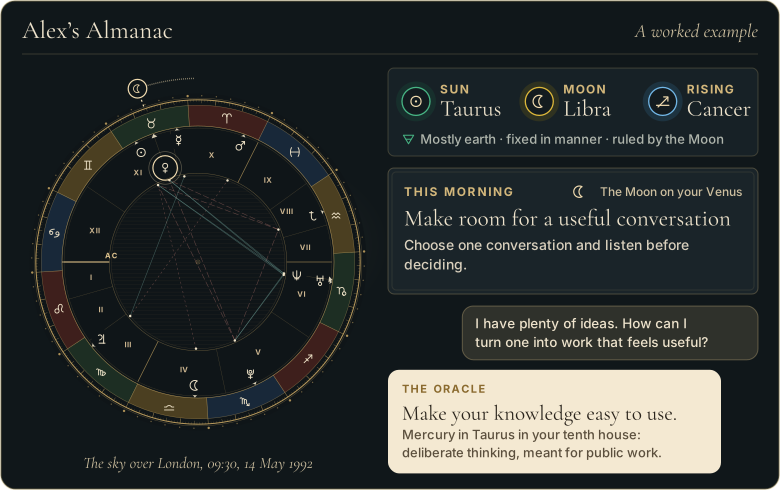
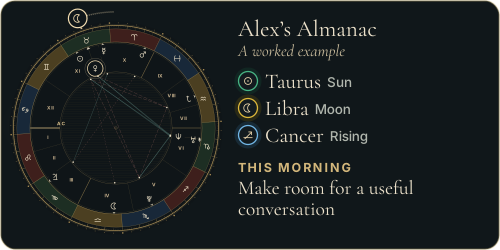
Walk through Alex’s whole example first
 The Road of AgesSee the turning points of your whole life, from your birth date
See your road's shape
The Road of AgesSee the turning points of your whole life, from your birth date
See your road's shape
Prefer to explore first?
 The Road of AgesThe turning points of your whole life, from your own chart
Walk my road
The Road of AgesThe turning points of your whole life, from your own chart
Walk my road
Free, by email
Your daily Almanac letter
One short letter at 7 each morning: the day’s theme read for your own chart, and one thing to do with it.
What a Seesaw chart looks like
The Seesaw is one of the planetary-distribution patterns associated with Marc Edmund Jones. Its defining feature is not merely tension or opposition but two visibly separate collections of planets. Imagine placing the ten major planets around a wheel: instead of forming one Bowl-like mass or scattering evenly, they gather into two occupied regions with a notable empty arc between each end. Definitions vary over the minimum gap and cluster size, but both groups must be substantial enough to function as groups. The pattern is sometimes called a Hourglass because the two masses appear balanced across an empty center.
A one-minute story
The Book of the Sky
How people learned to read the sky, from Babylon to the day you were born.

How to identify the two groups
Begin with the Sun through Pluto and sort their zodiacal longitudes. Mark every gap between consecutive planets, including the wrap from Pisces back to Aries. Two unusually large gaps should divide the occupied planets into two clusters, and neither cluster should consist of only one isolated handle planet. Then test neighboring labels: a Bucket has one lone handle, a Bowl fits the planets within roughly half the wheel, and a Splash lacks two dominant gaps. Publish the planet list and measured gaps when a case is borderline, because adding asteroids or using a different threshold can change the visual classification.
What astrologers mean by polarity
Astrologers traditionally read the Seesaw as an emphasis on comparison, alternation, and the attempt to reconcile competing demands. That does not mean indecision is inevitable. One person may become skilled at mediation because both sides remain visible; another may swing between roles until a workable rhythm develops. The houses occupied by the clusters show the concrete life arenas involved, while their signs describe style. Strong oppositions connecting the groups make the polarity explicit, but conjunctions inside each group can be equally important because they show how each side organizes itself before meeting the other.
A worked reading example
Suppose one group contains the Sun, Mercury, Venus, and Saturn around the second and third houses, while the other contains the Moon, Mars, Jupiter, Uranus, Neptune, and Pluto around the eighth and ninth. The geometry suggests a repeated negotiation between personal resources and shared obligations, or between familiar knowledge and transformative beliefs. The reading must then examine actual rulers and aspects. A tight Mercury-Jupiter opposition could make debate central; a supportive Venus-Moon trine might help the person translate between the camps. The Seesaw supplies an organizing question, not a verdict about personality or fate.
How to use Seesaw Chart Shape responsibly
Astrological terminology is most useful when the calculation and interpretive convention are stated separately. For Seesaw Chart Shape, a careful account identifies the chart factors, degrees, or classification rule first, then explains what astrologers have traditionally inferred from them. Different schools may use different orbs, planets, house systems, or symbolic vocabularies, so a borderline result should be described rather than forced into a label. Astrology is a historical divinatory practice, not a scientifically validated method for diagnosing personality or predicting events. Treat the interpretation as a bounded symbolic hypothesis, compare it with the full chart and lived evidence, and never use it to replace medical, legal, financial, mental-health, or safeguarding advice.
What sets Seesaw Chart Shape apart
In Jones's Seesaw the planets form two groups roughly opposite each other, divided by two empty gaps rather than the single gap of the Bowl and Locomotive. This is the only one of the seven shapes with two voids. The two groups usually face each other across an axis of opposition, so the shape gives a pair of houses or signs set against one another.
- Groups: two, standing roughly opposite one another
- Gaps: two empty stretches, one on each side
- Axis: an opposition between the groups, often across a sign pair
- Source: Marc Edmund Jones, 1941, among his seven
- Leading planet: not used, because there are two gaps
Often mistaken for something else: A Tripod has three groups and a Seesaw two. A single opposition between two planets is an aspect, not a chart shape.
Sources and editorial method
Research and editorial references used for this page include:
- Marc Edmund Jones, The Guide to Horoscope Interpretation - Historical source for the influential chart-pattern taxonomy.
- Astrodienst: The Jones Patterns - Modern overview of the major planetary-distribution patterns.
These references support the factual, historical, textual, or interpretive claims on this page. Interpretive traditions are identified as such, and factual claims are kept separate from symbolic claims.
Related reading
Read your Seesaw pattern
Seesaw Chart Shape in a book is one thing; Seesaw Chart Shape in your own birth chart is your life. The Oracle casts your real chart and tells you what it means for your love, your work, and your year ahead, in conversation. It opens with the 7-day Seeker trial.
Speak with the OracleHow Seesaw Chart Shape lives in your own chart across your year, in love, in work, in timing, is written in the Cosmic Codex: the whole year, once. Open the Cosmic Codex
More in Astrology
- Triple Conjunction
- Apex Planet
- Chiron Return
- Doryphory
- Firdaria
- Kali Yuga
- Melothesia
- Planetary Phase
From the reference page to your own chart
Every word here
is in your own chart.
- A personal reading about love, work or purpose, written from your chart
- A practical next step to consider
- It opens with 7 days free, with the AI Oracle and daily guidance
$0 today, then $12/month after 7 days. Cancel anytime.
Common questions
Is a Seesaw the same as having many oppositions?
No. Oppositions are aspects between particular planets; a Seesaw is a whole-chart distribution with two separated groups.
Can one group contain more planets than the other?
Yes. Visual balance does not require equal counts, although both sides need enough weight to read as genuine groups.
Should asteroids be included?
Classify the classic pattern with the ten major planets first. Add asteroids later without letting them erase the underlying distribution.
Free, by email
The Almanac, in your inbox at 7
One short letter at 7 each morning: the day’s theme read for your own chart, and one thing to do with it.
