
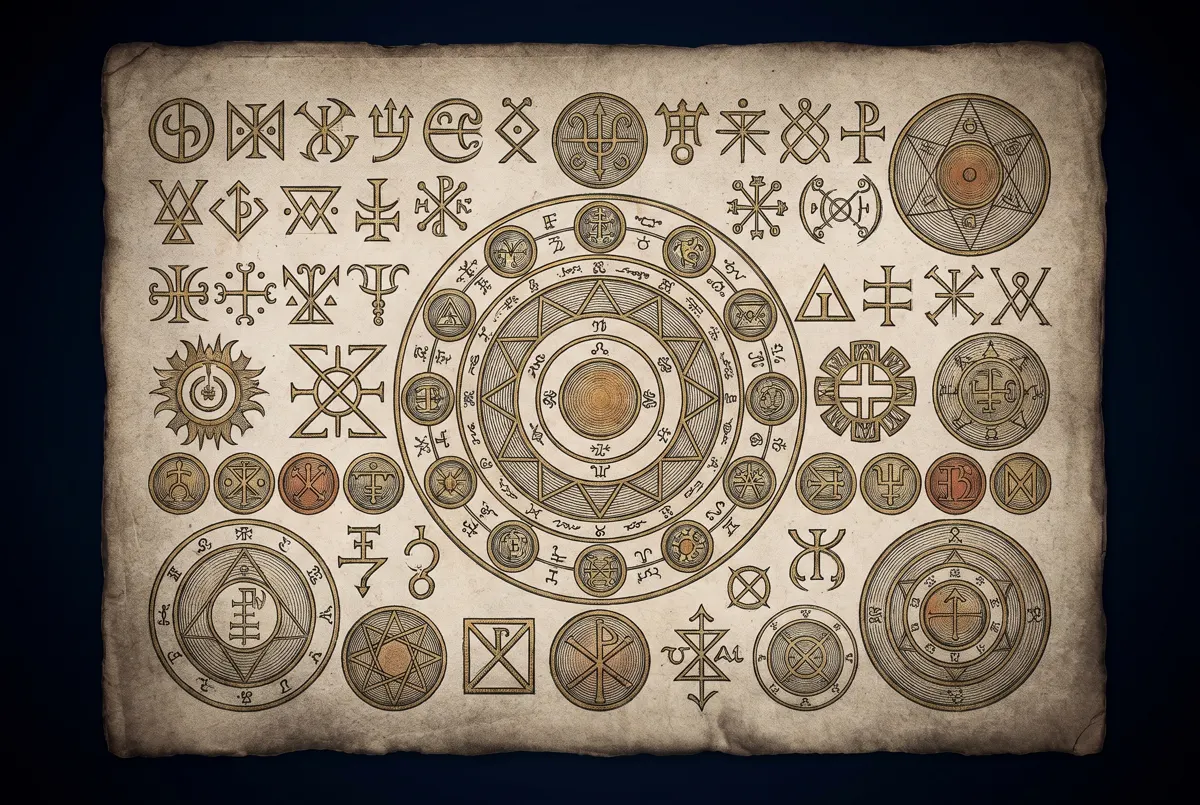
Alchemy and historical notation
Alchemical Symbols
Direct answer
Do not identify an isolated sign from a modern chart alone. Compare its shape, neighboring words, date, script, and manuscript tradition. Planetary glyphs often denote their corresponding metals, but the same mark can carry another meaning in medicine, astronomy, or a particular alchemist’s private notation.
Alchemical symbols are handwritten or printed signs used to abbreviate materials, planets, laboratory operations, apparatus, weights, and qualities. Their meaning changes by period, region, author, and immediate recipe context.
$0 today, then $12/month after 7 days. Cancel anytime.
Quick facts
| Symbol family | Typical use |
|---|---|
| Planetary metals | Sun/gold, Moon/silver, Mercury/mercury, Venus/copper, Mars/iron, Jupiter/tin, and Saturn/lead. |
| Principles | Sulfur, mercury, and salt in several early modern alchemical frameworks. |
| Processes | Signs or abbreviations for operations such as distillation, calcination, sublimation, and dissolution. |
| Variation | A sign may gain extra strokes, rotate, merge with letters, or change meaning between sources. |
Alchemical Symbols are symbolic marks from alchemy for substances, planets, and transformation processes.
A conceptual orientation, not an exact historical reproduction of every mark or seal.
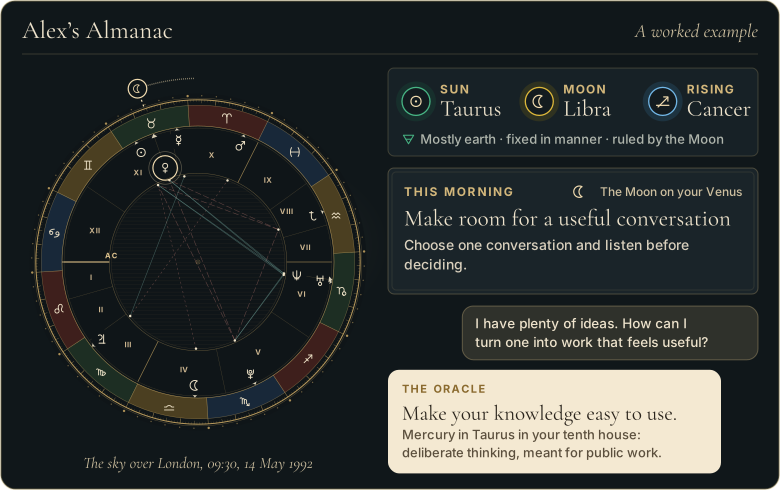
What does your own chart say about you?
Choose love, work or purpose. Your reading is written from your chart. Your reading uses your own birth details.
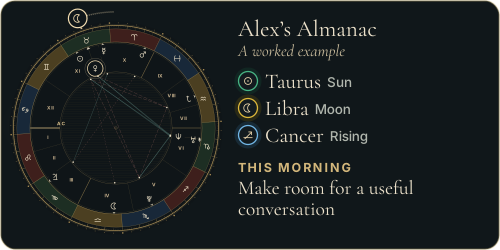
Walk through Alex’s whole example first
 The Road of AgesSee the turning points of your whole life, from your birth date
See your road's shape
The Road of AgesSee the turning points of your whole life, from your birth date
See your road's shape
Prefer to explore first?
 The Road of AgesThe turning points of your whole life, from your own chart
Walk my road
The Road of AgesThe turning points of your whole life, from your own chart
Walk my road
Free, by email
Your daily Almanac letter
One short letter at 7 each morning: the day’s theme read for your own chart, and one thing to do with it.
Why alchemists used symbols
Alchemy developed within manuscript and workshop cultures where compact notation saved space, accelerated copying, and connected substances with learned cosmology. Familiar planet signs could stand for the seven traditional metals, while specialized marks represented salts, acids, ores, equipment, measurements, and transformations. Symbols did not function only as secrecy. They also served the practical roles that abbreviations, chemical formulas, and laboratory shorthand serve today, although their standardization was far weaker and their philosophical associations often much richer.
The seven planets and seven metals
A durable correspondence linked gold with the Sun, silver with the Moon, quicksilver with Mercury, copper with Venus, iron with Mars, tin with Jupiter, and lead with Saturn. The mapping drew on color, behavior, mythology, medicine, mining, and cosmology, not modern atomic science. Even here, context matters: the same Saturn glyph in an astrological table means the planet, while in a recipe it may abbreviate lead. Later chemists retained some inherited signs before internationally recognizable element notation displaced them.
How to identify a symbol in a historical source
Begin with the page rather than a cropped character. Record the shelfmark, date, language, handwriting, title, and neighboring ingredients or verbs. Compare repeated occurrences: if a sign appears beside weights and melts in a later sentence, that evidence can narrow the substance. Consult a glossary made for the same century and region, then check variant forms in Unicode or specialist paleographic references. Treat a proposed reading as provisional when the ink is damaged or several signs share the same basic crescent, cross, or loop.
Historical interpretation and chemical safety
Alchemical recipes may involve mercury, lead, arsenic compounds, corrosive acids, toxic fumes, pressure, or intense heat. A decoded symbol is not permission to reproduce a procedure. Historical ingredient names can also refer to impure mixtures rather than modern laboratory substances, making attempted reconstruction more hazardous. Study facsimiles, transcriptions, and conservation research unless work is supervised in a properly equipped institution. Symbolic readings about transformation can coexist with chemical history, but neither justifies claims that every picture hides one universal spiritual code or that dangerous substances become safe through ritual intention.
What sets Alchemical Symbols apart
The most stable alchemical symbols are the seven metals, each paired with a planet and sharing its glyph. Gold is the Sun, silver the Moon, quicksilver Mercury, copper Venus, iron Mars, tin Jupiter and lead Saturn. The four elements have their own signs, triangles that point up for fire and down for water, with a bar through the triangle for air and for earth. Authors varied the symbols a great deal, so no single table fits every manuscript.
- Gold: Sun, a circle with a dot
- Silver: Moon, a crescent
- Seven metals: gold, silver, quicksilver, copper, iron, tin and lead
- Fire and water: a triangle pointing up for fire, down for water
- Air and earth: the same triangles with a bar across them
Often mistaken for something else: The planet glyphs in an astrology chart are the same drawings; in alchemy they also name the metal.
Lectures on this, free to read


Sources and editorial method
Research and editorial references used for this page include:
- Unicode Consortium: Alchemical Symbols chart - Standardized character repertoire with official names for many historically attested alchemical signs.
- Wellcome Collection: Alchemy collections - Digitized manuscripts, printed books, and catalog records for studying symbols in their original contexts.
These references support the factual, historical, textual, or interpretive claims on this page. Interpretive traditions are identified as such, and factual claims are kept separate from symbolic claims.
Related reading
See it in your own chart
A definition tells you what it is; your own birth chart tells you what it means for you. The Oracle casts your real chart and answers for your love, your work, and your year ahead, in conversation. It opens with the 7-day Seeker trial.
Speak with the OracleYour year, written once from your chart alone: the Cosmic Codex reads the whole of it, month by month. Open the Cosmic Codex
More in Sigils, Seals & Symbols
From the reference page to your own chart
Every word here
is in your own chart.
- A personal reading about love, work or purpose, written from your chart
- A practical next step to consider
- It opens with 7 days free, with the AI Oracle and daily guidance
$0 today, then $12/month after 7 days. Cancel anytime.
Common questions
Are alchemical symbols the ancestors of chemical element symbols?
They are part of chemistry’s notational history, but modern element symbols arose through later standardization. The relationship is developmental rather than a one-to-one translation.
Why does one alchemical substance have several signs?
Handwriting, language, local convention, printer type, compound form, and individual authorship all produced variants. Some signs also distinguish preparations of the same base material.
Can a Unicode character identify a manuscript sign conclusively?
No. Unicode standardizes encoded characters, not the meaning of every historical mark. Context and a source-specific glossary are still necessary.
Free, by email
The Almanac, in your inbox at 7
One short letter at 7 each morning: the day’s theme read for your own chart, and one thing to do with it.
