Natal Chart vs TransitsWhat Is the Difference?
Your birth chart and today’s sky answer different questions. Keeping them separate makes an astrology reading easier to understand.
Direct answer
Short version
A natal chart uses the sky for your birth date, time and place. A transit compares a planet at a later time with a point in that natal chart. Natal positions stay tied to the birth event; transiting positions change with the date examined. Astrology adds symbolic interpretations to that comparison.

What does your own chart say about you?
Choose love, work or purpose for a personal insight and a useful next step. Your reading uses your own birth details.
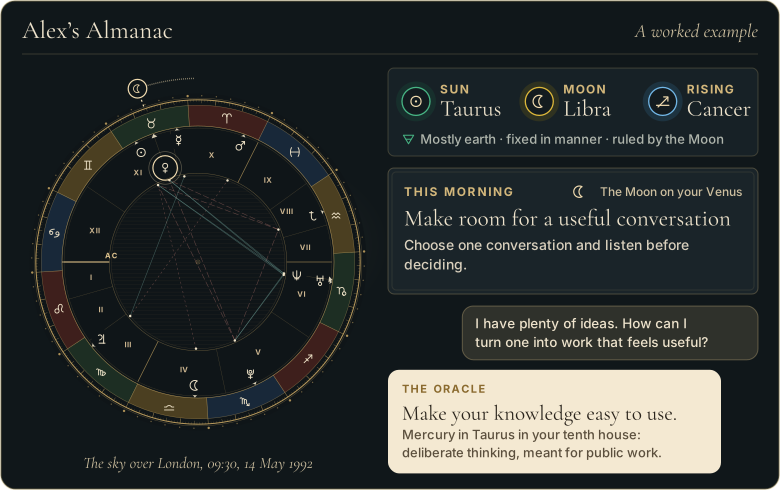
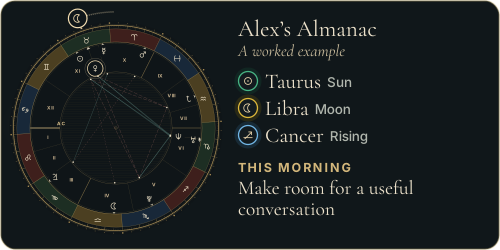
Walk through Alex’s whole example first
 The Road of AgesSee the turning points of your whole life, from your birth date
Free first look
The Road of AgesSee the turning points of your whole life, from your birth date
Free first look
Prefer to explore first?
 The Road of AgesThe turning points of your whole life, from your own chart
Walk my road
The Road of AgesThe turning points of your whole life, from your own chart
Walk my road
Visual guide
Natal Chart vs Transits: What Is the Difference?
A natal chart is a reference snapshot
The birth chart provides the fixed reference for a personal transit comparison. It does not become a new birth chart every morning. A corrected birth time or different calculation settings may change the chart you see, but that is a change in its inputs or method. Distinguish a calculated zodiac position from the meaning a tradition assigns to it.
A transit needs two named ends
Look for both the moving planet and the natal point. Venus trine Saturn can describe two planets in the current sky, or transiting Venus compared with natal Saturn. These are different comparisons. A personal reading should specify which it means. Without that distinction, a general sky observation can be mistaken for an individual chart finding.
Exact contact and the wider window
An exact aspect is the moment the chosen angle is reached. An orb is the allowance around that angle used by the astrologer or software. Different orbs produce different start and end dates, even when the underlying positions agree. Ask which threshold was used before comparing calendars. A highlighted interval describes a calculation rule; it does not guarantee an event within it.
Use the distinction to ask a better question
A natal interpretation might prompt you to explore a recurring habit. A transit interpretation might prompt you to revisit that habit during a stated period. Keep the suggested action grounded in current circumstances: a conversation still needs consent, available time and relevant facts. You can use symbolism as a reflection prompt while leaving the actual decision open.
Concrete examples
| Example | What it means in practice |
|---|---|
| Natal Mercury | A birth-chart reference used in traditional interpretations of communication. |
| Transiting Mercury to natal Saturn | Mercury at a later date compared with Saturn at birth. |
| Mercury and Saturn in today’s sky | A current-sky aspect, which is not by itself a contact to your own chart. |
Related Almanac guides
More from the journal
Sources and editorial method
Research and editorial references used for this page include:
- NASA JPL: Horizons tutorial - Astronomical ephemerides for a selected time and observer.
- Astrodienst: Chart types - Natal and other chart calculation options.
References support the explanation of calculations. Astrological meanings are symbolic interpretations; these examples do not describe a specific person.
From the reference page to your own chart
Every word here
is in your own chart.
- Your chart and numbers, read for you in about a minute
- Ask the Oracle anything about them
- Every personal tool and daily guidance
Free reading, no card needed. Optional membership: payment details required, 7 days free, then $12/month. Cancel before it renews and you pay nothing.
Common questions
Does my natal chart change each day?
Its reference event stays the same. The later sky changes; corrected inputs or a different system can change the chart displayed.
Does everyone experience the same transit?
Everyone shares the current sky, but its angles to different natal charts vary. Interpretations are symbolic, and people’s circumstances also differ.
Can astronomical data prove a transit prediction?
Astronomical data describes positions and motion. It does not by itself establish claims about personal events or outcomes.