
Applying vs Separating TransitsRead the Direction, Not Just the Orb
Two contacts can have the same orb and be moving in opposite directions. The missing detail is how the transiting body is moving relative to the exact aspect.
Direct answer
Short version
For a transit to a fixed natal position, applying means the angular distance from the exact aspect is decreasing; separating means it is increasing. Orb describes how close the contact is, while phase describes its current direction. You need motion or positions at nearby times to distinguish them. A single close position does not establish whether an exact contact lies ahead, has already happened, or will be interrupted by a station.

What does your own chart say about you?
Choose love, work or purpose for a personal insight and a useful next step. Your reading uses your own birth details.
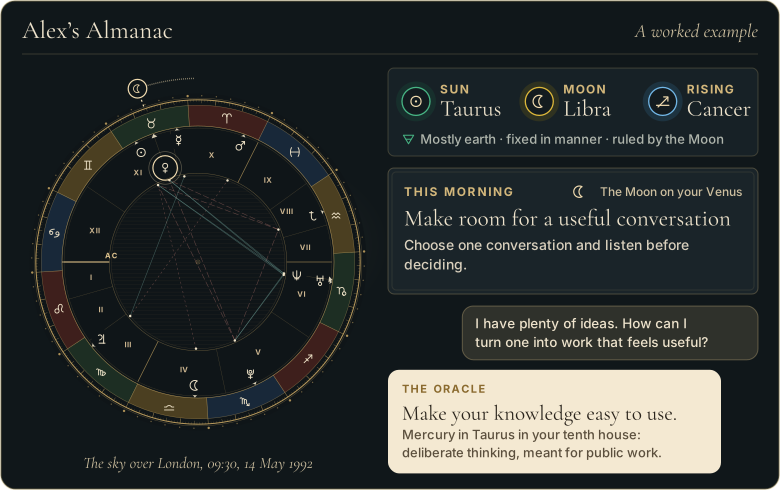
Walk through Alex’s whole example first
 The Road of AgesSee the turning points of your whole life, from your birth date
Free first look
The Road of AgesSee the turning points of your whole life, from your birth date
Free first look
Prefer to explore first?
 The Road of AgesThe turning points of your whole life, from your own chart
Walk my road
The Road of AgesThe turning points of your whole life, from your own chart
Walk my road
Visual guide
Applying vs Separating Transits: Read the Direction, Not Just the Orb
Orb and phase answer different questions
An orb is a distance, such as one degree from an exact conjunction. Phase describes whether that distance is getting smaller or larger at the time being examined. A large applying orb is not necessarily closer to exactness than a small separating one. Also distinguish a transit to a natal point from an aspect between two moving planets. In the transit comparison, the natal longitude stays fixed at the birth-chart value. In a current-sky comparison, both planets move, so their relative motion matters. A label copied from one type of chart can be misleading in the other. Begin by stating which comparison you are making and the time for which the positions were calculated.
A degree-by-degree example you can check
Imagine a fictional natal Sun at 15 degrees Taurus. A transiting planet at 14 degrees Taurus, moving directly toward 15 degrees, is one degree from conjunction and applying. At 16 degrees Taurus, continuing directly away from 15 degrees, it is also one degree from conjunction but separating. If the same planet is retrograde at 16 degrees and moving toward 15 degrees, the conjunction is applying again. These positions illustrate geometry only; they are not claims about the current sky or a particular planet’s dates. The signs alone cannot tell the story. Two planets may occupy the same sign and still be many degrees apart, while a close aspect can cross a sign boundary. Exact degrees and direction are the useful evidence.
Why retrograde motion and stations need a longer view
An applying contact does not guarantee that exactness will occur before the planet changes direction. A planet can approach the natal degree, slow down, station and move away without reaching it on that pass. Another transit can cross the target, return across it during retrograde motion and cross it again after turning direct. The number of passes depends on the actual path; do not assume every slow transit has three. Near a station, extending today’s speed as a straight-line forecast can be particularly misleading. Inspect a calculated time window, its timezone and its stated precision. If the available data only establish that a contact is close now, say that. A date, countdown or repeated-pass story should come from measured positions rather than from interpretive wording.
Use phase as context, not as a deadline for your life
In astrological practice, application is often interpreted as a developing theme and separation as a period of integration. Those are symbolic readings of motion, not proof that a particular event will begin or end at the exact moment. A useful journal separates three things: the measured contact, the interpretation you are considering, and what actually happened. For example, someone preparing a difficult conversation might note an applying contact, rehearse a respectful opening and choose a time when both people are available. Later they can record the response and whether the preparation helped. They should also record occasions when nothing notable happened. Another person’s consent, a real deadline and the practical facts remain more direct guides than a transit label.
Concrete examples
| Example | What it means in practice |
|---|---|
| Same orb, different direction | With a fixed target at 15 degrees Taurus, direct motion from 14 toward 15 is applying; direct motion from 16 toward 17 is separating. Both starting positions are one degree from the target. The difference is motion. |
| A station before exactness | A hypothetical planet approaches from 14 degrees but turns retrograde before 15. It was approaching the target, yet that pass never became exact. Check the full trajectory before promising an exact-contact date. |
| A useful follow-up question | Instead of asking when a transit will make someone call, ask which contact is being measured, what the timing data support, and what communication choice would be respectful whatever the other person decides. |
Prayerful reflection
What is the chart actually measuring, what meaning am I adding, and what evidence would lead me to reconsider that meaning?
Related Almanac guides
More from the journal
Sources and editorial method
Research and editorial references used for this page include:
- Astrodienst: applying aspects - Terminology within astrological interpretation.
- Swiss Ephemeris programmer documentation - Calculation of planetary positions and speeds, separate from symbolic interpretation.
- The Almanac’s calculation and interpretation method
The degree examples are deliberately hypothetical so they can be checked without mistaking them for live sky data. The definitions describe angular motion; the practical scenarios are original editorial illustrations. Accurate positions do not by themselves establish the predictive validity of an astrological interpretation.
From the reference page to your own chart
Every word here
is in your own chart.
- Your chart and numbers, read for you in about a minute
- Ask the Oracle anything about them
- Every personal tool and daily guidance
Free reading, no card needed. Optional membership: payment details required, 7 days free, then $12/month. Cancel before it renews and you pay nothing.
Common questions
Can I tell applying from separating by looking only at the orb?
No. A one-degree orb could be shrinking or growing. Check the direction of motion or compare nearby calculated positions, and be explicit about whether the target is a fixed natal point or another moving planet.
Does a separating transit mean the issue is over?
No. Separating describes angular motion at the time being examined. A real situation may continue, and a later change of direction may bring another pass. Interpretation should not be presented as a guaranteed timetable for events.
Does every applying transit become exact?
No. A station can reverse the approach before exactness. Inspect the measured path over the relevant window rather than inferring an exact date from a close position or one current speed value.

