

Life Path vs Personal Year NumberWhat Changes and What Stays the Same
Your Life Path uses your complete birth date. Your Personal Year combines your birth month and day with a selected calendar year. One stays fixed; the other changes with the year you are exploring.
Direct answer
Short version
Life Path uses the birth month, birth day and birth year. Personal Year uses the birth month, birth day and selected calendar year. The Almanac reduces the components and preserves 11, 22 and 33 where its reduction method reaches them. A yearly number adds a symbolic reflection prompt; it does not replace the Life Path or forecast what must happen.

What could this mean for your life?
Explore your recurring patterns, what matters to you, and a way forward. Your reading uses your own birth details.
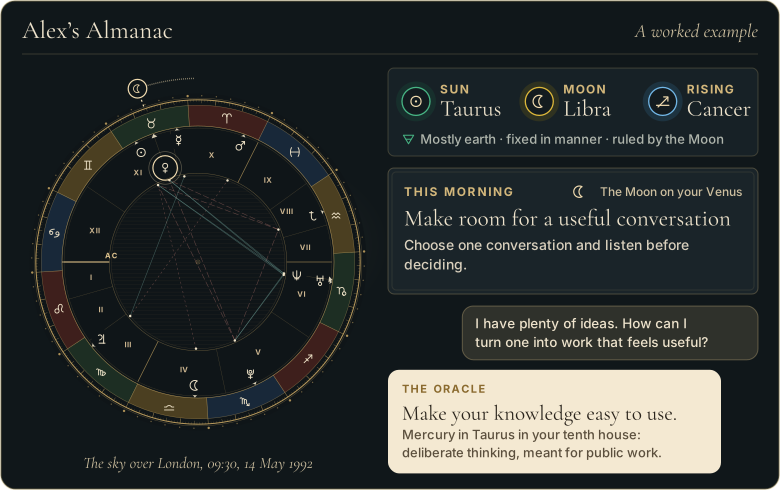
Walk through Alex’s whole example first
 The Road of AgesSee the turning points of your whole life, from your birth date
Free first look
The Road of AgesSee the turning points of your whole life, from your birth date
Free first look
Prefer to explore first?
 The Road of AgesThe turning points of your whole life, from your own chart
Walk my road
The Road of AgesThe turning points of your whole life, from your own chart
Walk my road
Visual guide
Life Path vs Personal Year Number: What Changes and What Stays the Same
The simplest difference is in the inputs
Imagine two cards on a desk. The first says birth month, birth day, birth year. The second says birth month, birth day, selected calendar year. The first card gives the Life Path; the second gives the Personal Year. A birthday celebration does not change the date on the first card. Entering a different calendar year changes the second. Neither card contains your name, current address or employment situation. That matters when reading an interpretation: the calculation has no independent knowledge of those circumstances. You supply the context. Numerology assigns symbolism to a numerical pattern, so it should not be mistaken for a psychological assessment or an evidence-based forecast.
Worked example: 14 May 1992, explored in 2026
Using the Almanac’s component method, May is 5, day 14 reduces to 5, and birth year 1992 adds to 21 and reduces to 3. The Life Path total is therefore 5 + 5 + 3 = 13, reducing to 4. For the Personal Year in 2026, the birth-year component is replaced by the Universal Year: 2 + 0 + 2 + 6 = 10, reducing to 1. Now the total is 5 + 5 + 1 = 11. The Almanac retains 11 and also exposes its root 2. This fictional example therefore has Life Path 4 and Personal Year 11/2 under this method. A calculator that reduces yearly cycles fully may show 2 instead. Compare the rule before treating that difference as an error.
Master numbers and when the year changes
A method should say where it preserves master numbers, whether it reduces date components separately, and when a yearly cycle begins. Those choices can explain why two sites display different labels from the same birthday. The Almanac uses the calendar year supplied by the selected date, so its Personal Year changes when that calendar year changes. Some practitioners discuss transitions around the birthday or prefer a different yearly reduction rule. Record the convention instead of mixing methods mid-calculation. In this example, 2027 has Universal Year 11 under the Almanac’s rule; 5 + 5 + 11 = 21, reducing to Personal Year 3. Life Path remains 4. A master number is not a ranking of importance, spiritual worth or personal potential.
Reading the pair in a situation you actually face
Consider a fictional person with Life Path 4 who is organizing a small community project during the 11/2 year in the example. They might use 4 as a prompt about structure: who owns each task, what can be delivered, and what routine makes the work sustainable? They might use the root 2 as a prompt about cooperation: whose input is missing, where is a conversation needed, and which responsibility is better shared? Those questions can coexist. The person could draft a clear plan and invite another organizer to revise it. If the conversation reveals a genuine budget or capacity problem, that information should guide the next decision. The numbers do not prove that the year requires success, delay or partnership, and an uneventful year does not mean the calculation was lived incorrectly.
Concrete examples
| Example | What it means in practice |
|---|---|
| Life Path 4, Personal Year 11/2 | Keep a dependable routine while asking for another perspective. A concrete practice is to review one recurring commitment with the person who shares it, then agree on a manageable next step. |
| The Personal Year changes; the situation continues | A calendar boundary does not erase an ongoing project or relationship. Keep the practical facts in view and change your reflection question if useful, without forcing life to match a new label. |
| Two people have the same Personal Year | Shared numerical results are normal because the system has a small set of outcomes. The same number does not imply the same circumstances, personality, timing or relationship compatibility. |
Prayerful reflection
Which habit has helped me over time, and which question is worth giving more attention this year? What small action would remain sensible if I set the numbers aside?
Related Almanac guides
More from the journal
Sources and editorial method
Research and editorial references used for this page include:
- Hans Decoz: date-based numerology calculations - A practitioner reference for the distinction between birth-date and annual calculations; conventions can differ.
- The Almanac’s methodology
The 1992, 2026 and 2027 examples follow the current Almanac calculation code and are checked with it. The article states its master-number and calendar-year rules explicitly. The project scenario is invented to illustrate reflection, not to demonstrate predictive validity.
From the reference page to your own chart
Every word here
is in your own chart.
- Your chart and numbers, read for you in about a minute
- Ask the Oracle anything about them
- Every personal tool and daily guidance
Free reading, no card needed. Optional membership: payment details required, 7 days free, then $12/month. Cancel before it renews and you pay nothing.
Common questions
Does my Life Path number change every year?
No. It is calculated from your full birth date using the chosen method. A different annual number usually refers to Personal Year, not a changed Life Path. Always check the label and inputs before comparing results.
Does Personal Year start on January 1 or my birthday?
The Almanac uses the selected calendar year and changes the calculation with that year. Other practitioners use different timing conventions. Keep the convention visible and consistent rather than claiming that one date establishes a universal personal turning point.
Is Personal Year 11 the same as Personal Year 2?
They share root 2, but a master-number-preserving method displays 11 as well. The Almanac shows both the retained result and its root. A method that reduces yearly numbers completely may display only 2, so compare calculation rules before calling either result a mistake.