Best Astrology for BeginnersA Clear Learning Path
The best way to learn astrology is to build one complete chart in layers. Start with accurate birth data and the Big Three, learn what planets, signs, houses, and aspects each contribute, then practice synthesis before adding predictive techniques.
Direct answer
Short version
For a beginner, the most efficient order is: learn the chart wheel; understand the Sun, Moon, and Ascendant; study the seven traditional planets before optional points; learn signs as styles, houses as life areas, and aspects as relationships; then combine one placement at a time. Add transits only after the natal chart makes sense.
The Instruments
Ten readings, worked out from your own birth chart
An instrument is a reading this house works out for you. Give your birth date, time and place once, and each one reads today’s real sky against the chart you were born under. Eight are personal; two are calendars anyone can open. A free account opens one instrument a day. The plans open every instrument, every day.
- Natal Chart Every planet, house and aspect in your chart
- Active Transits Where the planets are now, read against your chart
- Daily Counsel What to pursue today, and what to leave alone
- Personal Timing Your best days to decide, weeks ahead
- Fellowship Your chart and another, read side by side
- Theme of the Day The one thing today is asking of you
- Sacred Numbers Your life path, your cycles, your name in numbers
- Aeolian Harmonics Classical music chosen to match your chart
- Mercury Retrograde Every Mercury retrograde this year, with its dates Open to all
- Void-of-Course Moon When the Moon is between signs, hour by hour Open to all


Quick facts
| Layer | Question it answers | Beginner focus |
|---|---|---|
| Planet | What function is acting? | Sun through Saturn first; add outer planets after the basic grammar is stable. |
| Sign | How does the function act? | Element, modality, ruler, strengths, and excesses rather than stereotypes. |
| House | Where in life does it act? | Use an accurate birth time and learn the four angles before memorizing every house. |
| Aspect | How do two functions relate? | Conjunction, opposition, square, trine, and sextile with stated orbs. |
| Transit | When is a natal factor emphasized? | Moving planet to natal planet or angle; do not confuse temporary timing with natal character. |
The chart is a grammar, not a list of personality labels
A natal chart maps celestial longitudes for a particular moment and location onto a zodiac and, when birth time is available, a system of houses. Astrologers then interpret several kinds of information together. The planet names a function, the sign describes its style, the house locates a life area, and aspects show how functions cooperate or conflict. A beginner who learns those roles separately can eventually form sentences; a beginner who memorizes hundreds of placement keywords usually collects contradictions.
Astrology is an interpretive tradition, not a scientifically established way to diagnose personality or predict events. That boundary improves study because it encourages precise calculation, historical awareness, and modest claims. The goal is not to make every experience fit the chart. It is to understand what astrologers mean, test interpretations against biography, and keep agency, evidence, and ordinary judgment intact.
A six-stage learning order that prevents overwhelm
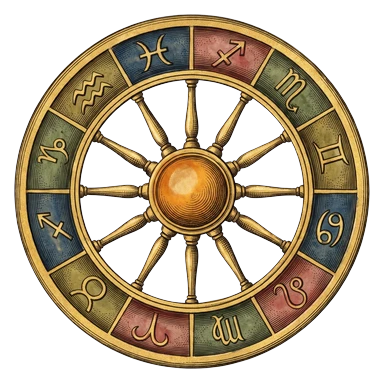
- Learn the wheel: twelve signs, 360 degrees, four angles, and the difference between zodiac signs and astronomical constellations.
- Study the Sun, Moon, Ascendant, Mercury, Venus, and Mars in one chart. Use Jupiter and Saturn next; add Uranus, Neptune, Pluto, nodes, Chiron, and asteroids later.
- Learn elements and modalities before memorizing sign descriptions. Fire, Earth, Air, and Water describe substance; cardinal, fixed, and mutable describe rhythm.
- Learn houses from the angles outward. First, fourth, seventh, and tenth houses anchor self, home, partnership, and public life.
- Learn the five major aspects and calculate their actual angular distance. An aspect is not exact merely because two planets occupy compatible or conflicting signs.
- Practice synthesis with one planet-sign-house-aspect chain, then compare it with the person’s real history before adding more techniques.
How to use the Big Three without turning them into a shortcut
The Sun, Moon, and Ascendant are a useful entry because they introduce three different chart functions. The Sun concerns identity, vitality, and creative direction. The Moon concerns emotional habit, protection, memory, and nourishment. The Ascendant is the eastern horizon at birth; it begins the first house in most systems and helps organize the chart’s local orientation. Calling them the Big Three does not make everything else minor, but it gives a beginner a manageable first synthesis.
Read each factor through the same questions. What is the planet or angle? Which sign modifies it? Which house contains it? What aspects are close? What rules the sign, and where is that ruler? A Cancer Moon in the second house trine Saturn is not interchangeable with a Cancer Moon in the ninth square Uranus. The sign stays the same while context changes the story.
A worked beginner synthesis
Imagine Mercury at 12 degrees Virgo in the tenth house, opposite Saturn at 14 Pisces in the fourth. Mercury names speech, learning, trade, and analysis. Virgo emphasizes discrimination, editing, and practical method. The tenth house places the function near vocation, reputation, or public responsibility. Saturn opposite Mercury introduces a polarity with privacy, family duty, caution, delay, or fear of error. A concise synthesis might be: careful public thinking grows stronger when private doubts and responsibilities are named instead of allowed to silence expression.
That statement is a hypothesis, not a verdict. Ask whether the person actually works through writing, analysis, administration, teaching, or technical craft. Ask whether criticism, family expectations, or perfectionism affected public speech. Look for contrary evidence. A useful chart reading becomes more specific as it meets biography; it does not become more certain simply because it contains more astrological terms.
A practical four-week study plan
Week one: draw or print one chart and label every sign, house, angle, and major planet. Week two: write one plain sentence for each planet using planet, sign, and house, without aspects. Week three: add only conjunctions, oppositions, squares, trines, and sextiles within clearly stated orbs. Week four: choose two current transits, record exact dates, and observe what is happening without forcing correspondence. Repetition with one chart teaches more than jumping among dozens of calculators.
Keep a glossary in your own words. When a source says Mars means aggression, translate that into observable functions such as initiating, competing, defending, separating, exerting, or becoming angry. Concrete verbs reduce stereotype. When two sources disagree, record the method behind each claim rather than blending them into a vague compromise.
Common beginner mistakes
- Reading a Sun sign as a whole personality and treating people born under one sign as interchangeable.
- Using an uncertain birth time for precise Ascendant, Midheaven, or house claims without disclosing the uncertainty.
- Adding asteroids, lots, harmonics, progressions, returns, and minor aspects before the basic chart has been synthesized.
- Calling every difficult aspect bad and every trine good instead of asking how the functions are actually used.
- Searching only for confirming interpretations and ignoring misses, context, mental health, material conditions, and personal choice.
- Using a chart to diagnose illness, excuse harmful conduct, rank spiritual worth, or make decisions that require professional expertise.
Sources and editorial method
Research and editorial references used for this page include:
- Astrodienst: A Brief Introduction to Astrology - Overview of the planets, signs, houses, rulers, and aspects used in natal-chart synthesis.
- Astrodienst: The Aspects - Reference for major aspect geometry and the role of orbs in chart interpretation.
- NASA Goddard: The Path of the Sun, the Ecliptic - Astronomical explanation of the ecliptic and the zodiac constellations along the Sun’s apparent path.
These references support the factual, historical, textual, or interpretive claims on this page. Interpretive traditions are identified as such, and factual claims are kept separate from symbolic claims.
Related reading
Common questions
What should an astrology beginner learn first?
Learn the chart wheel and the Big Three, then planets, signs, houses, and the five major aspects. Practice natal synthesis before adding transits or specialized techniques.
Do beginners need an exact birth time?
Exact time is important for the Ascendant, Midheaven, and house cusps. Planetary zodiac degrees can still be calculated without it, although the Moon may move enough during a day to require a time range.
How long does it take to learn astrology?
Basic chart grammar can be learned in weeks, but reliable synthesis takes sustained practice. Progress is better measured by clear reasoning and honest limits than by the number of techniques collected.
Is astrology scientifically proven?
No. Astrology is not scientifically established as a causal or predictive system. It can be studied as a historical and symbolic tradition without presenting its interpretations as verified facts.